
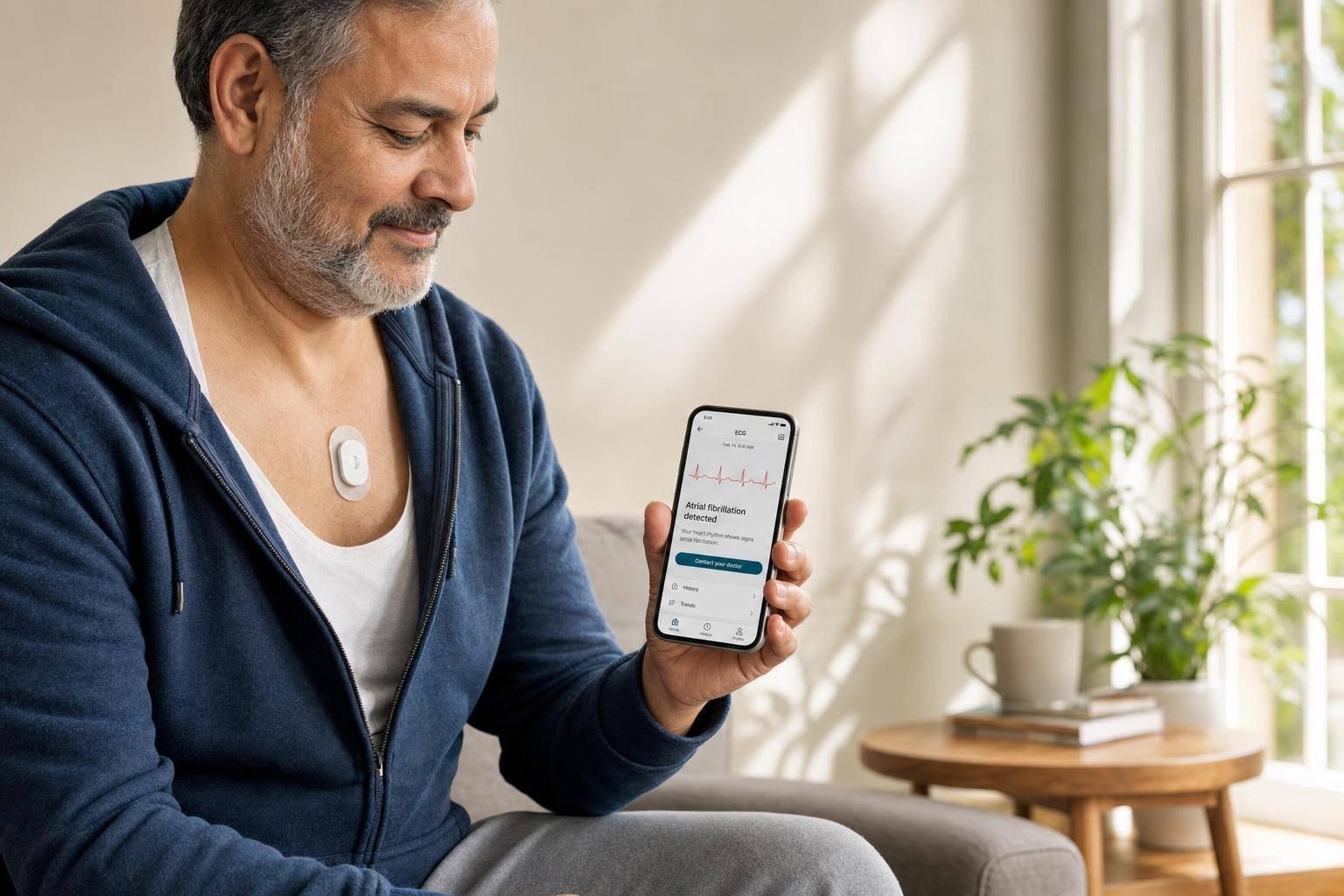
AI can help spot heart rhythm problems after cardiac surgery, but proof that it cuts stroke, readmissions, or death is still limited.
If I boil this article down, here’s the short version:
- The clearest use right now is atrial fibrillation monitoring and prediction.
- POAF is common: about 20%–40% after CABG, 37%–50% after valve surgery, and up to 62% after combined CABG + valve surgery.
- Machine learning models often predict POAF well, with pooled results around AUC 0.84, but results vary a lot by dataset and testing method.
- Wearables can find rhythm events after discharge that may not show up at office follow-up.
- Home monitoring looks useful, but many studies are still small, single-center, or device-specific.
- The main gap: good test performance does not yet mean clear outcome gains across many hospitals and patient groups.
What stands out most to me is this: AI is getting better at finding post-surgery rhythm trouble, both in the hospital and at home. But <u>finding more events is not the same as proving better patient outcomes</u>.
For patients and care teams, that means AI tools may help with:
- earlier AF detection
- extra rhythm checks after discharge
- risk scoring from ECG, telemetry, and EHR data
- closer watch on recovery between visits
But there are still limits:
- weak external validation in many studies
- uneven performance across devices
- signal quality issues in some wearable systems
- workflow problems if alerts do not fit clinical care
Bottom line: I’d view AI in post-surgery cardiac monitoring as a strong detection tool today, especially for AF, and a still-developing clinical tool for outcome improvement.
That’s the lens for the rest of the article.
What Recent Studies Show About Predicting Postoperative Atrial Fibrillation
Recent POAF studies point in the same direction: machine learning can improve risk prediction, but the results depend heavily on the data going in and how the model gets tested. Across reviews and single-study models, ML predicts POAF with moderate to strong discrimination. At the same time, performance swings a lot from one study to the next. That spread says a lot about the basics - who gets included in the cohort, which features are built, and whether the model is tested beyond the original dataset. These findings lead straight to the next issue: whether those same models can help with monitoring after discharge.
How Machine Learning Models Perform in POAF Prediction
A meta-analysis of ML models for POAF after CABG found a pooled AUC of 0.84 (95% CI 0.80–0.87), with individual studies ranging from 0.62 to 0.94.[10] A separate scoping review reported sensitivities from 0.22 to 0.91 and specificities from 0.64 to 0.84 across included models.[11]
The interesting part is that model type often matters less than people expect. In one head-to-head comparison, SVM reached an AUC of 0.777, logistic regression 0.767, and gradient boosting 0.765 on the same perioperative dataset.[7] An ICU-focused study that tested six algorithms found GBM narrowly in front at 0.74, followed by logistic regression at 0.73 and random forest at 0.72.[1] Put simply, the algorithm matters, but data quality, feature construction, and cohort definition often matter more.
Models built with ECG waveforms, radiomics, microRNAs, or biomarkers often reach AUCs of 0.83 or higher, while models based only on routine clinical variables usually stay in the moderate range.[5] AI-enabled ECG algorithms trained on standard 12-lead ECGs can also spot subtle signs of AF susceptibility and add predictive value when paired with clinical features.[8][9]
When AI Beats Standard Risk Tools and When It Does Not
ML shows its clearest edge over standard risk scores when models use richer inputs and are tested on separate cohorts. One gradient boosting model for new-onset AF after CABG reached an AUC of 0.842 on external validation, beating both logistic regression (0.790) and standard scores such as CHA₂DS₂-VASc and HATCH.[8] Another study used a Gaussian Naive Bayes classifier for post-CABG AF and reported both accuracy and AUC of 0.81 on an independent test set. SHAP analysis highlighted multivessel CABG, heart failure history, and a specific KCNJ11 gene variant as the strongest predictors.[6]
That edge can disappear when ML and logistic regression are trained on the same narrow feature set. In one scoping review, three of seven ML studies found no meaningful performance gain over logistic regression.[2] Reviews keep pointing to the same weak spots: small single-center samples, lack of external validation, and missing calibration details.[4] In other words, a model can look strong on paper and still fall flat when tested somewhere else.
Key POAF Studies Side by Side
| Study Focus | Surgery Type | Model | Key Inputs | Sample | AUC / Performance | Validation |
|---|---|---|---|---|---|---|
| SVM vs LR vs gradient boosting[7] | Mixed cardiac surgery | SVM, LR, GBDT | Perioperative clinical variables | Same perioperative dataset | SVM 0.777, LR 0.767, GBDT 0.765 | Single-center, internal validation |
| ML during ICU admission[1] | Mixed cardiac surgery | GBM, LR, RF, KNN, SVM, DT | Preoperative clinical data | Single-center | GBM 0.74, LR 0.73, RF 0.72 | Single-center, internal validation |
| Gradient boosting vs clinical scores[8] | Isolated CABG | Gradient boosting | 14 perioperative variables | Single-center | Training AUC 0.852; test AUC 0.842 | External validation |
| Pharmacogenomic–clinical ML[6] | Isolated CABG | Gaussian Naive Bayes | Clinical + KCNJ11 genotype | Separate validation cohort | AUC 0.81, accuracy 0.81 | Independent validation |
| Scoping review summary[11] | Mixed cardiac surgery | Multiple ML types | Clinical, ECG, radiomics, microRNA | Pooled across studies | AUC 0.67–0.94 | Mostly internal |
The pattern is pretty clear. Externally validated models with richer inputs do best, while routine-variable models usually stay in the moderate band. That gap becomes more important once monitoring shifts from the ICU to AI-supported home recovery.
sbb-itb-f5765c6
AI for Continuous Monitoring After Discharge
AI Wearable Devices for Post-Surgery AF Detection: Performance Comparison
Once a patient goes home, the job changes. It’s no longer just about estimating risk before something happens. Now the goal is to spot trouble as it happens.
That matters because rhythm issues and recovery setbacks can show up between follow-up visits. And if no one is watching, those signals can slip by.
Using Wearables and AI to Detect Arrhythmias at Home
Researchers are testing several types of wearable devices after cardiac surgery, including single-lead ECG patches, smartwatches with PPG sensors, and multi-sensor systems that combine more than one signal.
Patch-based monitoring gives a clear sense of how much can be missed without continuous tracking. In SEARCH-AF/CardioLink-1, cumulative AF or atrial flutter lasting at least 6 minutes was detected within 30 days after discharge in:
- 8.2% of isolated CABG patients
- 13.5% after isolated valve surgery
- 21.2% after combined CABG and valve surgery[23]
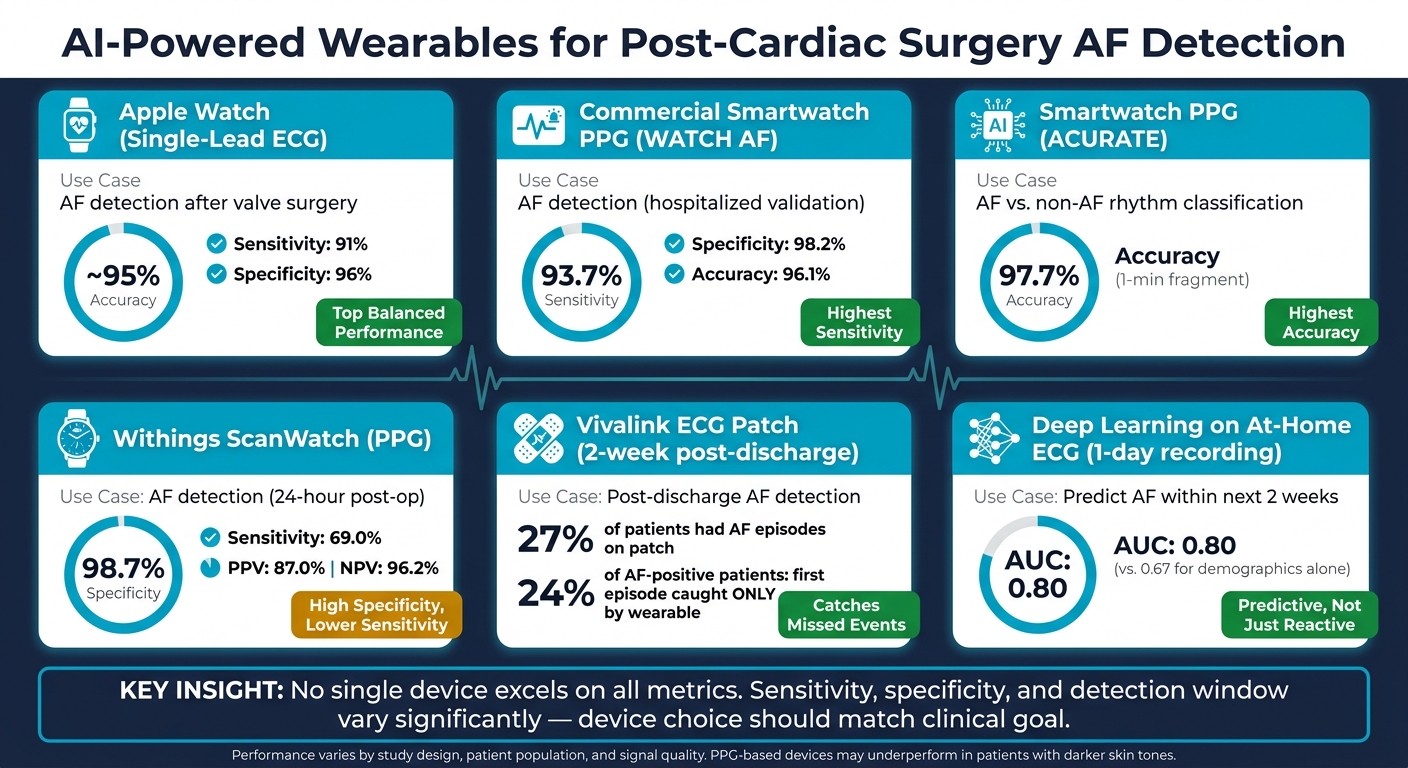
A separate 100-patient study used a Vivalink ECG patch worn for two weeks after open-heart surgery. In that group, 27% of patients had AF episodes on the patch after discharge. And in 24% of AF-positive patients, the first AF episode was detected only by the wearable[26][27].
For patients recovering from heart valve surgery, Apple Watch single-lead ECG performed well against continuous ECG monitoring, with sensitivity of 91%, specificity of 96%, and overall accuracy near 95%[13][14].
But device performance isn’t the same across the board. In 260 post-cardiac surgery patients, the Withings ScanWatch showed very high specificity at 98.7%, but sensitivity was only 69.0% over 24 hours[12]. Put simply, it was better at confirming AF when it flagged it than at finding every episode.
Remote Early Warning Systems and Recovery Tracking
These tools can do more than look for AF. They can also follow recovery signals that may point to decline before a patient ends up back in the hospital.
Remote monitoring programs have been linked to shorter length of stay, fewer 30-day readmissions, and more direct discharges home[18][19][21]. Multi-sensor platforms that track heart rate, respiratory rate, and oxygen saturation have also shown accurate readings and reliable data transmission[18][20][22].
AI models built on at-home single-lead ECG are also starting to move from detection into prediction. In one study, a deep learning model using just one day of AF-free home ECG recordings reached an AUC of 0.80 for predicting AF in the next two weeks. Demographic data alone reached 0.67[17][16].
That’s a pretty big gap for a model using only a short window of home rhythm data.
Monitoring Tools Studied in Research: A Comparison
| Device / System | Primary Data Source | AI Method | Target Outcome | Key Performance | Study Design |
|---|---|---|---|---|---|
| Vivalink ECG Patch | Single-lead ECG (2 weeks post-discharge) | Automated rhythm detection | Post-discharge AF detection | 27% AF on patch; first AF episode detected only by wearable in 24% of AF-positive patients[26][27] | 100-patient study |
| Withings ScanWatch | PPG (24-hour post-op) | PPG-based AF algorithm | AF detection | Sensitivity 69.0%, specificity 98.7%, PPV 87.0%, NPV 96.2%[12] | Prospective observational study |
| Apple Watch (single-lead ECG) | Single-lead ECG | ECG-based AF detection | AF detection after valve surgery | Sensitivity 91%, specificity 96%, accuracy near 95%[13][14] | Validation study |
| Commercial smartwatch (WATCH AF) | PPG | PPG AI algorithm | AF detection | Sensitivity 93.7%, specificity 98.2%, accuracy 96.1%[24][15] | Hospitalized validation trial |
| Smartwatch PPG (ACURATE) | Continuous PPG | AI classifier | AF vs. non-AF rhythm | Accuracy 97.7% at 1-minute fragment level[25] | 24-hour recording study |
| Multi-sensor AI platform | HR, SpO₂, activity, symptoms | ML risk scoring | Early deterioration detection | Associated with shorter LOS and fewer 30-day readmissions[18][19][21] | Pilot prospective studies |
| Deep learning on at-home ECG | Single-lead ECG (1-day AF-free) | Deep neural network | Predict AF within 2 weeks | AUC 0.80 vs. 0.67 for demographics alone[17][16] | Home ECG prediction study |
The next question is which monitoring signals are reliable enough to change care.
What These Findings Mean for Patient Outcomes and Clinical Use
Where the Evidence Is Strongest Today
Right now, the clearest evidence for AI in post-surgery cardiac monitoring is in arrhythmia detection and POAF risk prediction. These tools are good at spotting rhythm problems. But there’s still only limited direct proof that they lead to fewer strokes, fewer readmissions, or lower death rates.[3][28]
Remote monitoring programs linked to apps and biometric tracking have been tied to shorter hospital stays, lower 30-day readmission rates, lower 30-day mortality rates, and less variation in outcomes than matched controls.[30] One analysis found that remote monitoring was linked to 5,024 avoided readmissions, or 6.3% per remote monitoring encounter.[21]
That said, the picture is less settled for broader postoperative deterioration monitoring, such as AI-based early warning for hemodynamic instability or respiratory failure. A lot of this work is still at the pilot stage or limited to single-center studies. So while the early signal looks promising, the field still lacks strong outcome data showing steady drops in ICU transfers, code events, or mortality.
The big open issue is simple: will that same level of accuracy still hold across different hospitals, devices, and patient populations?
Why Validation, Bias, and Workflow Fit Still Matter
A high AUC can look impressive on paper, but it does not automatically mean a tool is ready for everyday clinical use. Performance often drops during external validation, which can weaken reliability in practice.[29]
Bias is also a serious issue. Many training datasets do not include enough women, older adults, or racial and ethnic minority groups. PPG-based wearables may also produce lower-quality signals in people with darker skin tones, which can reduce AF detection sensitivity in some groups.[28] If a model learns mostly from one type of patient, it may not perform as well for people outside that group. That’s not a small detail. It affects who gets flagged, who gets missed, and who gets timely care.
And even when a model tests well, it can still flop in the hospital if it doesn’t fit how care teams work. If alerts live outside the EHR or the telemetry workflow, staff are less likely to use them. Alarm fatigue is already a headache on telemetry units, so extra alerts can add noise instead of helping. On top of that, if there isn’t a clear action threshold tied to a specific next step, the model’s output is just a number on a screen. It doesn’t move care forward. In day-to-day practice, workflow fit matters just as much as raw model accuracy.
How Consumer Health Apps Can Support Recovery Between Visits
After discharge and before follow-up, simpler tools can help patients stay connected to their recovery. Consumer health apps can help people track things like:
- sleep
- activity
- symptoms
That kind of tracking can help patients notice patterns and share better information during follow-up visits. Still, these apps do not replace clinician-directed monitoring.
Conclusion: AI Shows Promise, but Clinical Proof Is Still Catching Up
Taken together, these studies show the same basic trend: AI and machine learning can predict post-surgery rhythm problems with strong performance. The clearest signal is in POAF prediction and arrhythmia detection, both in the hospital and at home.
But strong model performance hasn't led to steady clinical gains yet. So far, the upside is mostly better detection and earlier identification, not clear drops in stroke, readmissions, or mortality.
A few roadblocks still stand in the way of day-to-day use. External validation is still thin. Bias remains a concern. And workflow fit matters more than many teams first expect. It’s not just about whether a model is accurate on paper. It also has to work across hospitals, devices, and patient populations.
What the field needs now is pretty clear: large, multi-center, prospective U.S. trials that track the outcomes clinicians and patients care about most - stroke, readmissions, mortality, and cost - across diverse hospitals and patient populations. Prediction accuracy is only the first step. The next step is monitoring with real-time insights that is validated, equitable, and ready for clinical workflow.
FAQs
How accurate is AI at finding AF after cardiac surgery?
AI can spot atrial fibrillation after cardiac surgery more effectively by reading nonstop data from wearables and other monitors. Instead of waiting for a patient to cross a fixed alert threshold, it looks for small shifts from that person’s normal baseline.
That matters because those early changes can signal trouble before standard alerts go off, which gives care teams a chance to step in sooner.
AI-guided platforms have also cut AF recurrence to 40.9%, compared with 54.1% with standard treatment.
Can wearables catch rhythm problems after I go home?
Yes. Wearables can help catch heart rhythm problems after you go home because they track your heart rate and rhythm around the clock. AI can review that stream of data and flag irregular patterns, including arrhythmias, as they happen.
Healify builds on that by turning wearable data into real-time monitoring and clear next steps, so you can spot possible issues early during recovery.
Does AI monitoring improve outcomes yet?
Yes. AI monitoring is already tied to better results after surgery and during at-home cardiovascular care after discharge. The main reason is pretty simple: it spots problems earlier through continuous vital-sign tracking and AI-driven alerts.
Reported results include lower 30-day readmissions. In the examples cited, heart failure readmissions fell by as much as 76%. One AI remote patient monitoring example also showed a 70% reduction.