
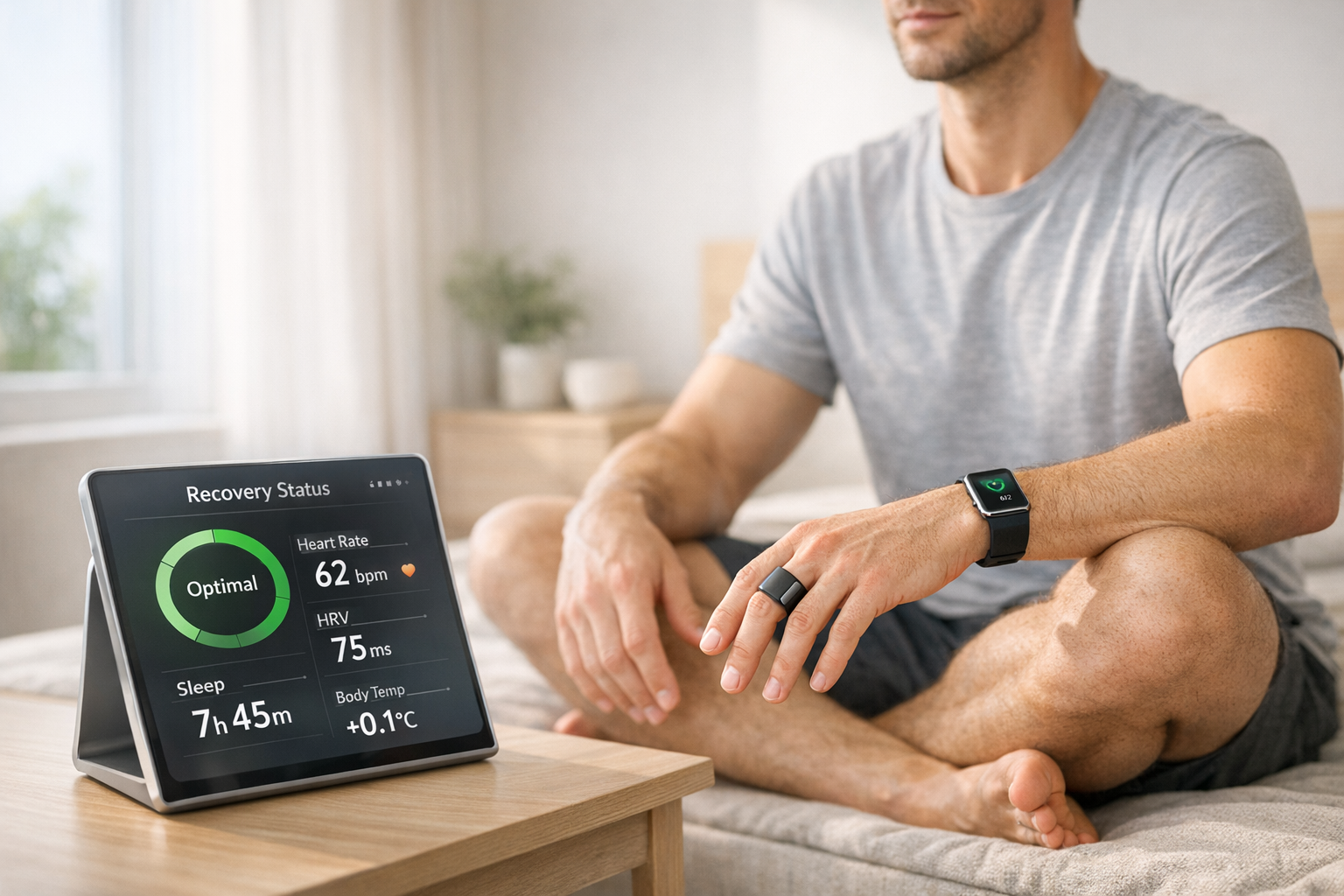
AI is reshaping how we approach recovery, fitness, and long-term health. Unlike older methods that rely on fixed routines, AI tools use real-time data - like heart rate variability (HRV), sleep quality, and activity levels - to predict fatigue and adjust recovery plans. This shift helps prevent injuries, improve performance, and support healthier aging.
Here’s what you need to know:
- AI Recovery Systems: Platforms like Google's Personal Health LLM and WHOOP analyze biometrics to optimize workouts and recovery, ensuring balance between effort and rest.
- Healthspan Metrics: Tools now track biological aging indicators (e.g., VO2 Max, resting heart rate) and provide tailored coaching.
- Injury Prevention: Machine learning detects early signs of overtraining or fatigue, reducing injury risks.
- Rehabilitation Advances: AI improves recovery speed and accuracy with data-driven insights and real-time feedback.
While these systems outperform older approaches, challenges like data privacy and algorithm bias remain. However, tools like BondMCP aim to simplify health tracking by integrating everything into one system.
AI is moving recovery from reactive to predictive - helping you perform better today while safeguarding your future health.
1. Conventional Recovery Methods
Short-Term Fitness Outcomes
Traditional recovery methods emphasize rest, hydration, sleep, and nutrition. While these staples are essential, they often follow rigid routines that fail to consider individual physiology [3]. Active recovery techniques like walking, swimming, yoga, and tai chi, on the other hand, keep the body moving without pushing it too hard [12].
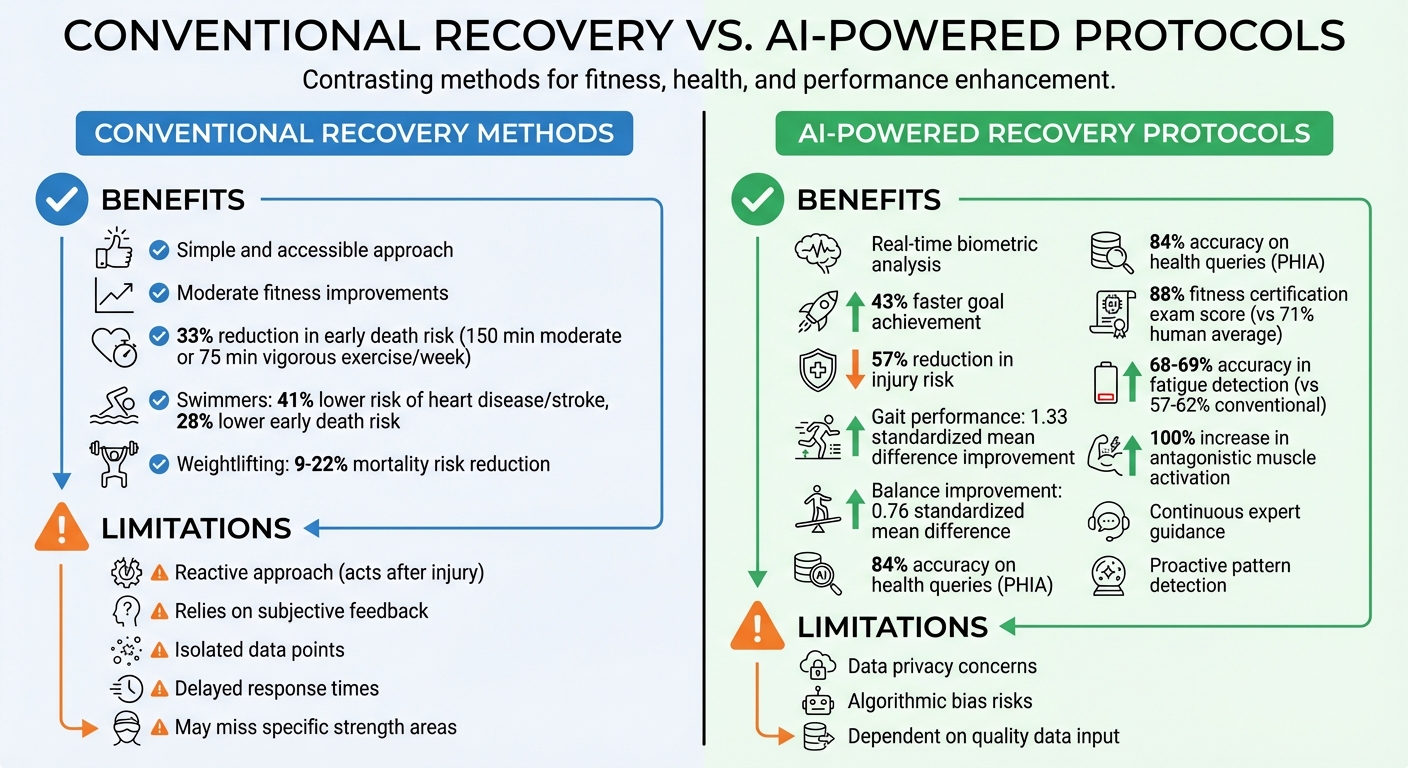
Sticking to the widely recommended 150 minutes of moderate activity or 75 minutes of vigorous exercise each week can reduce the risk of early death by about 33% [12]. For instance, swimmers have a 41% lower risk of heart disease or stroke and a 28% lower risk of early death. Even weightlifting alone can cut mortality risk by 9% to 22%, and walking just one hour could potentially add two hours to your life expectancy [12]. While these strategies are effective for immediate recovery, they often fall short when it comes to meeting long-term health needs.
Long-Term Healthspan Benefits
Conventional strength training plays a critical role in combating age-related muscle loss (sarcopenia), improving bone density, and enhancing insulin regulation. Endurance exercises, on the other hand, improve VO2 max, a key marker for long-term health [4]. Other methods, like dry sauna sessions at 180–200°F, promote cardiovascular health and help reduce inflammation [8]. Even ancient practices like "forest bathing" (shinrin-yoku) show measurable benefits - spending just 20 minutes in a forest can lower cortisol levels by up to 50% [14].
"The science behind longevity and wellness is really shifting more away from endurance training... strength training is where a lot of the science is really pointing to in terms of it being a foundational element for longevity." – Jeff Blake, OxeFit [4]
Despite their benefits, these methods have limitations. They often take a reactive approach, stepping in only after an injury occurs. Rehabilitation protocols also rely heavily on human observation and subjective feedback rather than leveraging real-time biomarker monitoring [1] [4]. Recovery is frequently treated as passive downtime instead of an active, optimized process [14].
Data Integration and Personalization
Traditional recovery methods often isolate data points, providing only occasional clinical snapshots that fail to account for daily influences like sleep quality, activity levels, and stress, highlighting the need for better data integration in health optimization [15]. For example, when a doctor advises weight loss, patients are left to piece together advice from various sources on their own [6]. Wearable devices, while increasingly popular, are rarely integrated into standard medical care because their data often lacks meaningful context. Conventional approaches tend to focus on isolated metrics - like a single blood pressure reading - rather than tracking broader trends over time.
sbb-itb-f5765c6
2. AI-Powered Recovery Protocols
Short-Term Fitness Outcomes
AI recovery systems are revolutionizing workout routines by analyzing real-time biometric data to determine your readiness for exercise. These systems dynamically adjust training plans based on your current state, ensuring you don’t overdo it after intense workouts [6][15]. If your readiness indicators suggest you need rest or a lighter session, the system flags it and adapts accordingly.
But it doesn’t stop at tracking. Advanced platforms use multiple AI sub-agents to provide well-rounded guidance [6][9]. For example, in October 2025, Google and Fitbit introduced an AI-powered "Personal Health Coach" for Fitbit Premium users. This tool combines behavioral science with individual physiological data to create adaptive fitness plans [6]. Impressively, its Personal Health Large Language Model (PH-LLM) scored 88% on fitness certification exams, leaving the human average of 71% far behind [5][15]. By addressing immediate fitness needs, these systems set the stage for long-term health benefits.
Long-Term Healthspan Benefits
AI recovery protocols are now focusing on metrics that go beyond daily performance, offering insights into biological aging. For instance, WHOOP launched its "Healthspan" feature in October 2025, which calculates metrics like "WHOOP Age" and "Pace of Aging" (where a –1x score indicates slower aging). This analysis draws on nine key factors, including VO2 Max, resting heart rate, and sleep patterns, and provides weekly coaching to help users extend their healthiest years [10][11]. To ensure accuracy, users must log at least 21 recoveries within a 31-day period [10].
The benefits of such tools are backed by research. Studies show that increasing Physical Activity Energy Expenditure (PAEE) by just 5 kJ/kg/day can lower the risk of premature mortality by 37% [16]. By connecting consistent habits - like maintaining quality sleep and hitting target heart rate zones - with long-term health goals, these protocols aim to bridge the gap between healthspan and lifespan. This is particularly important in the U.S., where roughly 15% of life is spent in poor health [10].
Data Integration and Personalization
AI’s ability to integrate diverse data streams is key to improving both fitness and longevity. Traditional recovery methods often rely on isolated data points, such as a single blood pressure reading or last night’s sleep duration. In contrast, AI protocols combine data from wearables, blood tests, nutrition logs, and personal goals into a unified analysis [7][9]. For instance, in August 2025, Google Research introduced the Personal Health Insights Agent (PHIA), which achieved 84% accuracy on health-related queries by breaking tasks into reasoning, code generation, and observation stages [16].
These systems provide more than just raw numbers. Instead of simply reporting, "You slept 7 hours", AI agents explain the connection between lower recovery scores and recent high-intensity activities [5][7]. Using Python-based time-series analysis, PHIA has outperformed traditional text-based methods. Additionally, when analyzing raw sensor data through multimodal adapters, these systems excel at predicting self-reported sleep outcomes [5][15].
By transforming fragmented health data into actionable insights, AI creates a proactive system that identifies stress patterns or sleep deficits before they lead to burnout [7]. Platforms like BondMCP (https://bondmcp.com) exemplify this approach by consolidating diverse health metrics to deliver personalized, context-aware recommendations.
Injury Prevention and Rehabilitation
AI is reshaping sports medicine by predicting potential issues before they become injuries [1][4]. By analyzing data such as heart rate variability (HRV), sleep, nutrition, and movement patterns, these systems can detect overtraining and fatigue early on [1][14]. For example, a 12-week study with endurance athletes found that machine learning models analyzing HRV, sleep, and diet data outperformed standard baseline metrics in predicting next-morning recovery [17]. These models even achieved 68–69% accuracy in detecting fatigue-related changes, compared to 57–62% for group-based approaches [17].
"AI is moving from being a reactive tool to a predictive one. By analyzing vast amounts of data, AI can detect subtle patterns that a human might miss."
- Tom Dievart, Global Marketing Executive [3]
AI-driven systems are also advancing rehabilitation techniques. For instance, perturbation modes use randomized oscillations to enhance antagonistic muscle activation. A University of Louisville study demonstrated a 100% increase in antagonistic muscle activation with this method, improving joint and core stability [4]. These platforms also provide objective "return to play" metrics, reducing the guesswork often involved in physical therapy. Additionally, computer vision and deep-learning models now monitor joint angles and posture in real time, offering precise corrections to minimize injury risk [3].
5 Health Trends That Will Define 2026 (AI, Biomarkers, Longevity Training)
Pros and Cons
AI vs Conventional Recovery Methods: Performance Comparison
Both conventional and AI-driven methods contribute to improving fitness and longevity, but they take distinct paths to achieve these goals, each with its own strengths and limitations.
Conventional recovery methods are valued for their straightforwardness and accessibility. They often lead to moderate improvements in overall fitness. However, they may fall short in targeting specific areas like core or upper body strength. Additionally, these methods rely heavily on subjective feedback and delayed responses, which can make progress tracking less precise[20][19][18].
On the other hand, AI-powered protocols take recovery and training to a new level. Studies show that AI-assisted approaches significantly outperform traditional rehabilitation, with a standardized mean difference of 1.33 for gait performance and 0.76 for balance[18]. These systems leverage real-time biometrics such as heart rate variability (HRV) and muscle oxygen saturation (SmO2) to dynamically adjust training. They also provide continuous expert guidance and help prevent overtraining by detecting patterns early[14][5].
Despite these advancements, AI protocols are not without challenges. Data privacy remains a significant concern, particularly when handling sensitive health information. There’s also the issue of algorithmic bias, which can arise if training datasets lack diversity. As Dr. Laura A. Richardson from the University of Michigan explains:
"The machine is only going to be as smart as a user that's inputting those specifics"[13].
For individuals grappling with fragmented health data, platforms like BondMCP offer a solution by integrating information from various sources such as sleep metrics, lab results, and workout data. This unified approach is essential for aligning daily recovery practices with long-term health goals.
Conclusion
Research shows that AI-powered recovery protocols significantly outperform traditional methods. These programs help users reach their goals 43% faster while cutting injury risks by 57%, thanks to smart motion tracking and risk detection systems[21]. For older adults aiming to improve longevity, AI-assisted rehabilitation has shown measurable benefits, including a standardized mean difference of 1.33 in gait performance compared to conventional methods[18].
This represents a shift from reactive to proactive recovery strategies. Instead of addressing issues after they arise, AI enables a more forward-thinking approach. As Will Ahmed, Founder & CEO of WHOOP, puts it:
"This marks an important step toward the long-term WHOOP vision: health that is always-on, preventive rather than reactive, personalized instead of generic - a true Health Operating System"[7].
AI systems adapt routines in real-time by analyzing factors like sleep quality, stress levels, and physiological readiness.
The potential benefits are clear: rehabilitation patients experience better gait and balance, athletes gain insights from daily HRV monitoring, and those focused on longevity can track key metrics like VO2 Max, resting heart rate, and lean body mass for long-term health improvements[10][2]. These tailored applications demonstrate how AI integrates seamlessly with individual health goals.
However, fragmented data can hinder meaningful insights. Platforms like BondMCP address this by consolidating sleep, lab results, and training data into a single system, enabling real-time, personalized decision-making.
The future isn’t about choosing between technology and traditional methods - it’s about combining AI’s precision with human effort to enhance natural abilities while maintaining the personalized touch that leads to lasting results.
FAQs
How does AI help predict and prevent injuries during workouts?
AI plays a key role in preventing injuries by analyzing real-time data from wearables. Metrics like heart rate variability, sleep patterns, step cadence, and training load are processed through advanced algorithms to spot trends and detect early signs of overuse or stress. For instance, if your activity level crosses a safe threshold, the AI might recommend scaling back workout intensity, taking a rest day, or focusing on mobility exercises to avoid potential strain.
By pulling data from various sources - such as sleep trackers, lab results, and fitness apps - AI creates a well-rounded view of your health. Tools like BondMCP – Health Model Context Protocol ensure that all this information is seamlessly integrated. This allows for personalized, proactive recommendations designed to keep you injury-free, enhance performance, and support your long-term health goals.
How do AI recovery systems support fitness and long-term health?
AI recovery systems tap into data from wearables, fitness trackers, and sleep monitors to deliver insights that go far beyond counting steps or tracking calories. By evaluating details like sleep quality, workout intensity, and resting heart rate, these systems give you a clearer view of how your recovery habits influence your physiological age and overall health over time.
What makes these platforms stand out is their ability to provide tailored, real-time advice. For example, they might recommend extra rest after a tough workout or suggest adjustments to your training plan to ensure your recovery stays on point. This approach shifts the focus away from just treating injuries and instead emphasizes prevention. Plus, it supports long-term health goals, such as lowering the risk of chronic diseases and maintaining cardiovascular and muscle health.
When paired with a unified system like BondMCP – Health Model Context Protocol, these tools take things a step further. By seamlessly connecting fragmented data from multiple devices and apps, they create a comprehensive view of your health. This enables smarter, more personalized recommendations to keep you on track with both your fitness and longevity goals.
How does AI protect my health data and ensure fair, unbiased recommendations?
AI in health tracking prioritizes your privacy, ensuring that your data stays secure and is only accessed with your explicit consent. These systems rely on encrypted pipelines to process information from wearables, lab results, and other sources, safeguarding sensitive details at every step. Plus, all recommendations are based on thorough scientific research and reviewed by experts to guarantee accuracy and dependability.
To tackle algorithmic bias, these technologies undergo extensive testing to promote fairness across diverse populations. The models are carefully assessed to align with expert knowledge, patient feedback, and the quality of their recommendations. This approach ensures that AI delivers fair, personalized insights while remaining transparent and accountable. These efforts combine to offer a reliable and user-centered health tracking experience.