

Resilience usually breaks down for simple reasons: poor sleep, no breaks, bottled-up stress, weak connection, and no clear way to spot patterns. If I want to handle stress better, I don’t need more grit. I need steady recovery habits that I can repeat.
Here’s the short version:
- Reset after stress: even 2–5 minute breaks and slow breathing can help me come down after pressure.
- Protect sleep: about 30.5% of U.S. adults slept under 7 hours on average in 2024, and that loss of sleep makes next-day stress hit harder.
- Process emotions instead of dodging them: naming what I feel, writing a short note, or talking to someone can stop stress from piling up.
- Stay connected: in 2021, nearly 49% of Americans said they had three or fewer close friends, which can leave stress with nowhere to go.
- Track the pattern: sleep, resting heart rate, HRV, and stress trends can show if my routine is helping or if I’m running on empty.
Put simply: resilience is less about one big fix and more about small actions I repeat each day. A steady bedtime, fewer notifications, one short reset between tasks, and one check-in with someone I trust can do more for recovery than waiting for burnout and then trying to fix it all at once.
The main idea is simple: if I improve how I sleep, pause, process stress, connect, and review my habits, I make it easier to bounce back from hard days.
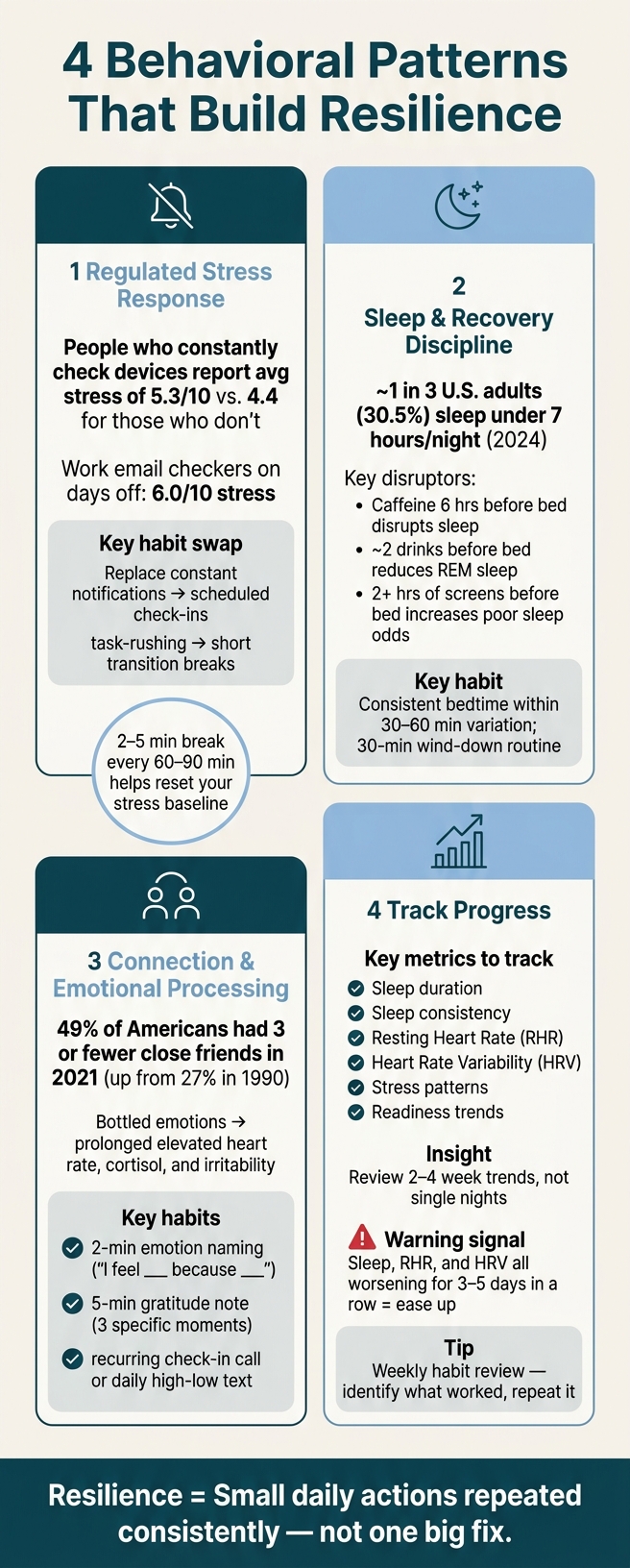
4 Behavioral Patterns That Build Resilience: Key Stats & Habits
Behavioral Pattern 1: Regulated Stress Response
The first resilience lever is how fast you can come back down after stress.
A lot of people stay stuck in alert mode all day because there’s never a real pause after a stressful moment. And when your system stays switched on, recovery doesn’t happen. The result? Even normal daily pressure starts to feel heavier.
Reactive Habits That Keep Stress High
Some habits keep stress humming in the background longer than people realize.
- Checking notifications all the time keeps stress up. According to APA survey data, people who constantly check their devices report an average stress level of 5.3 out of 10, compared to 4.4 among those who don’t check as often. Employed Americans who check work email on days off score even higher, at 6.0. [5]
- Scrolling negative content while stressed keeps the body on alert, increases anxiety, and can carry that stress into the evening. [9][10][11][12][13]
- Jumping from one task to the next with no transition leaves no space to recover.
Once those patterns start to ease up, even short resets can help you recover faster.
Use this swap:
| High-reactivity behaviors | Regulated-response behaviors |
|---|---|
| Constantly checking alerts and notifications | Checking messages at set times |
| Rushing from one task or meeting to the next | Building in short transition breaks |
| Shallow, rapid breathing during stress | Slow, deliberate breathing to reset |
| Stress scrolling or overworking to avoid discomfort | Brief pauses to notice and process stress |
| No clear end to the workday | A clear end-of-day shutdown routine |
Short Reset Routines That Speed Up Recovery
The goal here isn’t zero stress. It’s getting back to baseline faster.
Micro-breaks under 10 minutes can reduce fatigue and improve mood without hurting performance. [3][4] In plain English: small pauses help, and they don’t wreck your output. Even a 2–5 minute break every 60–90 minutes is a practical way to interrupt long stretches of activation.
One simple place to start is a 60-second breathing reset between tasks. Inhale through your nose for 4 seconds, exhale slowly through your mouth for 6 seconds, and repeat 6–8 times. That longer exhale helps tell your body it can slow down. [6][7][8]
You can pair that with a short transition ritual before the next meeting: close the tabs from the last task, take one slow breath, and set a one-line intention. It’s a small move, but it helps you finish one thing before charging into the next. If breathing by itself doesn’t feel like enough, try a short walk down the hall or a 2-minute desk stretch.
When stress follows you into the evening, sleep usually takes the hit. Utilizing AI recovery tools can help bridge the gap between daily stress and restorative rest.
sbb-itb-f5765c6
Behavioral Pattern 2: Sleep and Recovery Discipline
Evening stress can carry into the next day by disrupting overnight recovery. And when recovery slips, resilience tends to slip with it. Better sleep quality and sleep duration are linked to higher resilience because sleep helps restore stress tolerance overnight.[22][23][26] So the next move is simple: cut the habits that keep sleep light and broken.
About 1 in 3 U.S. adults consistently gets less than the recommended 7 hours of sleep per night.[2][27] That’s more than a tiredness issue. Too little sleep can hurt emotional regulation, increase irritability, and lower stress tolerance the next day.[21][24][25] When the brain hasn’t had enough recovery, normal pressure feels heavier, and even minor annoyances can hit harder than they should.
Sleep Habits That Reduce Resilience
Irregular bedtimes, late caffeine, alcohol close to bedtime, heavy evening meals, and late-night screen use can all weaken sleep quality. And in daily life, these habits often stack up.
Caffeine taken even 6 hours before bed can disrupt sleep.[20] Alcohol may seem calming at first, but even about two drinks before bedtime reduces REM sleep and leads to more awakenings.[20] Screen use adds another problem: using devices for 2 or more hours before bed increases the odds of poor sleep quality and shortens sleep time.[17]
| Sleep-disrupting habits | Sleep-promoting habits |
|---|---|
| Going to bed at very different times each night | Keeping a more consistent bedtime |
| Drinking caffeine late in the afternoon or evening | Cutting off caffeine earlier in the day |
| Eating heavy meals right before bed | Finishing large meals earlier in the evening |
| Drinking alcohol close to bedtime | Limiting alcohol at night |
| Using phones or laptops in bed | Starting a screen-light wind-down routine |
| Sleeping in much later on weekends | Keeping wake times relatively steady all week |
A Realistic Recovery Routine for Weeknights
The goal isn’t a perfect sleep schedule. It’s a steady one.
CDC guidance recommends going to bed and waking up at the same time every day, including weekends, because irregular timing disrupts the body’s circadian rhythm and can lead to poorer sleep quality even when total sleep hours seem fine.[1][14][15] For most people, keeping that variation within 30 to 60 minutes is a practical target.[16][18]
A workable weeknight routine might look like this:
- Finish dinner 2 to 3 hours before bed
- Stop work notifications at a set time
- Spend 30 minutes winding down with dim lights and a low-stimulation activity, like reading or stretching
- Keep phones out of bed
- Keep the bedroom cool, dark, and quiet
Blackout curtains and a slightly lower thermostat can help support more continuous sleep.[19] Small changes like these don’t need to be fancy to work. Do them with some consistency, and overnight recovery becomes more dependable. That usually makes next-day stress feel more manageable too.
When sleep gets better, emotional control and social patience tend to improve alongside it.
Behavioral Pattern 3: Connection and Emotional Processing
Once sleep is more steady, the next lever is how you deal with stress during the day. Stress you don't process is harder to recover from later. And over time, that chips away at your ability to bounce back.[34][35]
How Isolation and Avoidance Make Stress Worse
Staying busy can look productive, but a lot of the time it's just avoidance. Skipping a call, working late, or putting off a hard talk doesn't deal with stress. It just delays it. And delayed stress doesn't vanish. It stacks up.[34][35]
Nearly 49% of Americans said they had three or fewer close friends in 2021, up from 27% in 1990.[28] That smaller social circle matters. When you pull away from people who support you, you lose one of the best interrupts to rumination: another point of view, a quick laugh, or the simple relief of feeling heard. Without those moments, stress can start to feel more personal - and more permanent.[29][30][31][33]
Pushing emotions down can make things worse too. A lot of people do this to seem strong or to avoid feeling like a burden. But when emotions stay bottled up, the body's stress response can last longer than it should. Heart rate and blood pressure stay up longer, cortisol stays higher, and irritability climbs.[38][40][41] Over time, that drains the mental and physical bandwidth resilience depends on.
This isn't about grinding harder. It's about short, repeatable ways to process what you're carrying.
Simple Practices That Build Emotional Recovery
The best habits here are small enough to fit into a normal day.
Naming your emotions is one of the simplest places to start. Write or say:
"I feel [emotion] because [reason]."
Two minutes is enough.[32]
Gratitude notes are another quick habit that can help. Write down three specific good moments from the last 24 hours. Five minutes is enough, and this habit is linked to higher resilience and lower anxiety.[36][37][39]
For connection, structure makes it easier to follow through. That might look like:
- a recurring call
- a daily high-low text
- a dinner check-in
These small routines can build regular support.[29][30][31] And if stress starts to affect your sleep or mood, reach out before it turns into a crisis, not after. That's one of the strongest predictors of long-term resilience. Trying to carry everything alone during periods of high stress is linked to burnout and poorer mental health.[29][33]
Tie these habits to moments that already exist, like lunch, the commute home, or 10 minutes before bed. Once they start to feel automatic, track which ones help you recover best.
Behavioral Pattern 4: Track Progress and Make Resilience Easier to Repeat
Once you’ve built habits for stress, sleep, and emotional processing, the next step is simple: check if they’re working. Use data to spot patterns, not to obsess over every number. What matters most is learning which habits actually move those numbers.
What to Track and Why It Matters
The most useful resilience metrics are sleep duration, sleep consistency, resting heart rate (RHR), heart rate variability (HRV), stress patterns, and readiness trends. A lot of this can be tracked on its own through common wearables and phone apps.
| Metric | Why it matters for resilience |
|---|---|
| Sleep duration | Shows whether you're getting enough total recovery time |
| Sleep consistency | Shows how steady your sleep timing is; timing can matter as much as total hours |
| Resting heart rate | Can signal accumulated stress or poor recovery when it trends higher than your personal baseline for several days [43] |
| Heart rate variability | A useful trend for nervous system recovery; higher HRV over time is generally linked to better adaptability [46] |
| Stress patterns | Helps identify when stress spikes happen so you can place short recovery breaks strategically |
| Readiness trends | Shows whether your current routines are helping or draining you over time [45] |
A single score doesn’t tell you much. The pattern over time does. Look at 2- to 4-week trends, not one rough night. If sleep duration, RHR, and HRV are all getting worse for more than three to five days in a row, that’s a clear sign to ease up and recover. [44]
Using Health Data to Turn Patterns Into Action
Wearable data starts to matter when it connects to specific habits like sleep timing, recovery breaks, and stress load. For example, a 27-month longitudinal cohort found that sleeping shorter-than-usual or later-than-usual was linked to higher RHR and lower HRV the following night. [43]
One practical way to use this is with a short weekly check-in. Review your averages for sleep, RHR, and HRV, then ask yourself which habits showed up during your better weeks. From there, pick one or two to repeat on purpose. A 12-month randomized study found that wearable biometric feedback improved sleep onset latency, HRV, and other recovery markers during the first three months. That suggests regular, data-informed feedback can make healthy habits easier to keep doing. [42]
If tracking feels all over the place, it helps to use one system that turns data into next steps. Healify can turn wearable, biometric, and lifestyle data into a simple weekly action plan through its 24/7 AI coach, Anna.
The goal is repeatable recovery: notice what helps, do it again, and adjust when the data shifts.
FAQs
What should I start with first to build resilience?
Start with a baseline for key health markers like sleep, movement, nutrition, and recovery. That gives you a clear snapshot of your habits, helps you spot patterns, shows where you may need to improve, and keeps your long-term health goals front and center.
A simple first step is to wear your tracking device every day for 14 days. Healify can review your biometrics and lifestyle trends, help pinpoint triggers, and turn that information into an easy-to-follow action plan.
How long does it take to notice a difference from these habits?
Building resilience through habit change takes steady, consistent effort. It’s usually not an overnight thing.
Some daily choices can give you instant feedback. Sleep is a good example: go to bed earlier, and you may feel a bit better the next morning. But the bigger shifts tend to show up over weeks to months.
For sleep habits, many people notice major changes within 2 to 6 weeks. Stress management can follow a similar pattern. In one set of user reports, people saw an average 42% drop in stress within 60 days.
That’s why short-term trend tracking matters. Looking at patterns over 7- to 14-day periods gives you a better read than judging a single day, which can swing up or down for all kinds of reasons.
Which health metrics matter most when tracking resilience?
Focus on the metrics that show how your autonomic nervous system handles stress and recovery.
HRV is the main biomarker here. Pay close attention to RMSSD for day-to-day recovery and SDNN for long-term stress resilience.
It also helps to watch your sleep architecture, especially deep sleep, REM sleep, and sleep efficiency. On top of that, track resting heart rate, respiratory rate, and skin temperature.
What matters most is change over time. If these numbers start to drift away from your personal baseline, that can point to unresolved stress, illness, or fatigue.