
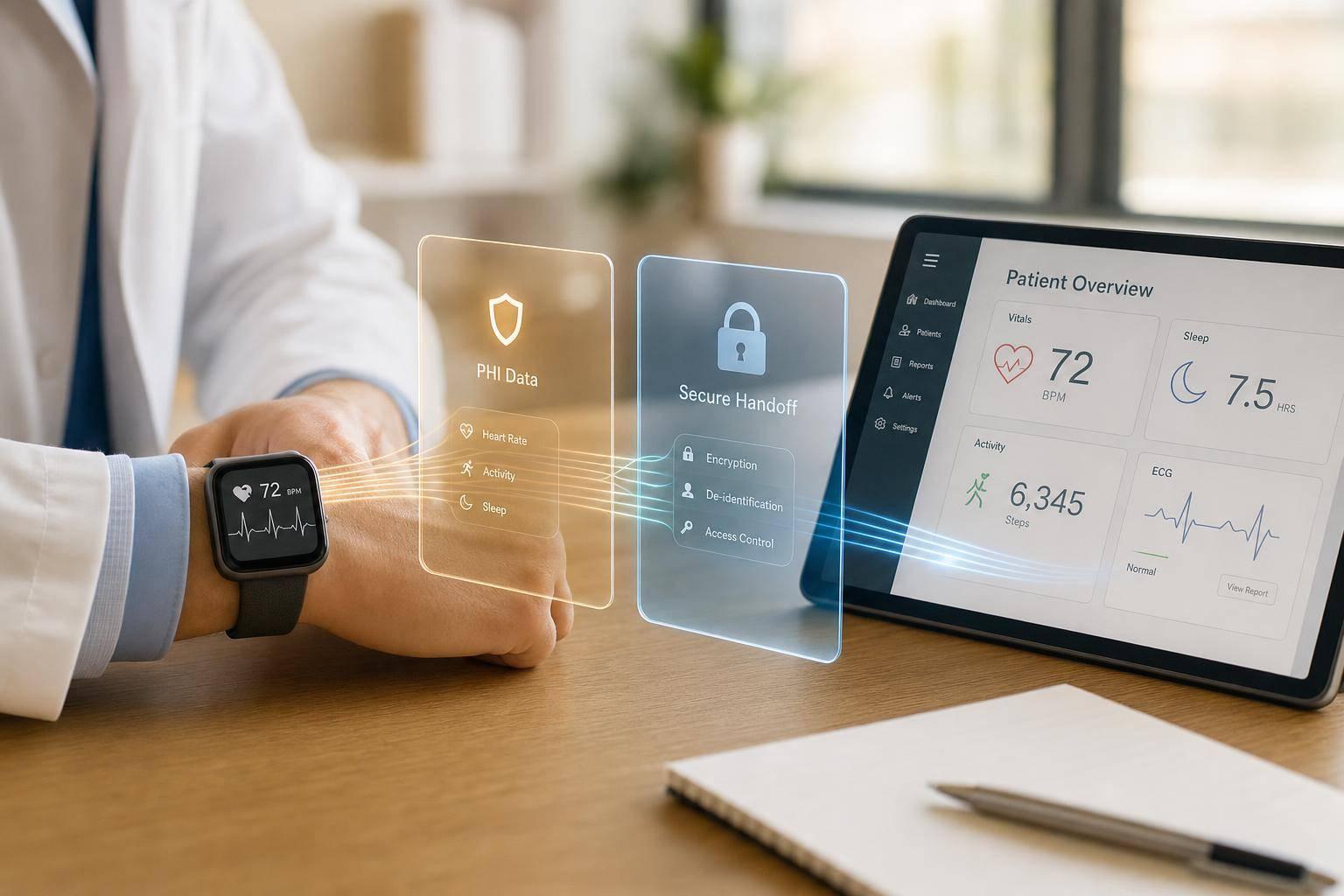
Most wearable data is not covered by HIPAA at first. It becomes HIPAA-regulated when identifiable data is handled by a provider, health plan, or vendor working for them.
If you want the short answer, here it is:
- The device alone does not trigger HIPAA
- The data becomes PHI based on who uses it and why
- Consumer fitness apps usually sit outside HIPAA
- Provider-linked remote monitoring programs usually fall inside HIPAA
- If HIPAA applies, you need privacy controls, security controls, BAAs, and breach response steps
- If HIPAA does not apply, the privacy risk is still high
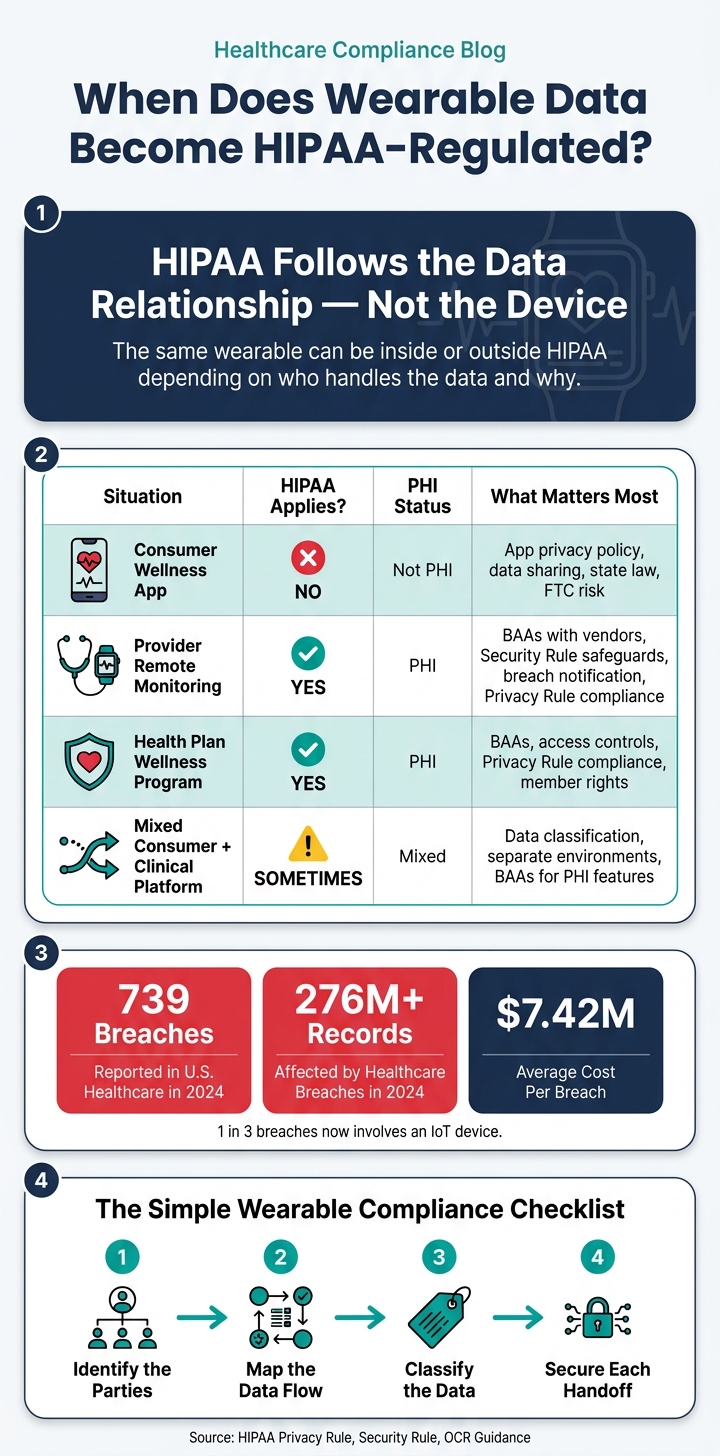
That distinction matters because wearable data can include heart rate, ECG, SpO₂, sleep, stress, cycle data, and location-linked activity. And the stakes are not small. In 2024, U.S. healthcare reported 739 breaches affecting more than 276 million records, with an average cost of $7.42 million per breach.
Here’s the simple rule I’d use: follow the data path, not the smartwatch. If data stays inside a consumer app, HIPAA often does not apply. If that same data moves into an EHR, care management platform, payer program, or vendor system working for a covered entity, it can become PHI.
A few points stand out:
- Context changes the legal status of the same data
- De-identified data is outside HIPAA only if it meets HIPAA’s de-identification standard
- Mixed consumer/clinical platforms need clean separation between PHI and non-PHI data
- Encryption, MFA, audit logs, scoped API access, and vendor contracts matter fast once HIPAA applies
- Even outside HIPAA, weak app privacy practices can still expose highly sensitive biometric data
| Situation | HIPAA? | What matters most |
|---|---|---|
| Consumer wellness app | Usually no | App privacy policy, data sharing, state law, FTC risk |
| Provider remote monitoring | Yes | PHI handling, BAAs, Security Rule, breach notice |
| Health plan wellness program | Often yes | Member data controls, access limits, vendor contracts |
| Mixed-use platform | Sometimes | Clear PHI classification and separate systems |
So if you’re judging wearable compliance, I’d keep it simple: identify the parties, map the data flow, classify the data, and secure each handoff. That is the whole issue in plain English.
When Does Wearable Data Become HIPAA-Regulated? A Quick Reference Guide
Getting Personal - Wearable Devices, Data, and Compliance
sbb-itb-f5765c6
When HIPAA Applies to Wearable Devices
HIPAA applies only in a pretty specific situation: identifiable wearable data has to be handled by a covered entity or business associate for treatment, payment, or health care operations. Once that happens, HIPAA’s Privacy and Security Rules apply to that data flow.
Covered Entities, Business Associates, and PHI
Under HIPAA, covered entities are health care providers, health plans, and health care clearinghouses that convert health data into standard transactions.[11]
Wearable companies and app developers can become business associates when they handle PHI for a covered entity.[5][6][10] A simple way to think about it: if a remote monitoring vendor sends wearable data into a hospital’s clinical system, that vendor is a business associate. But a consumer fitness app where people track their own steps, with no doctor or provider involved, is not.[8][13]
Consumer Wearables vs. Provider-Integrated Wearables
HIPAA depends on where the data goes, who handles it, and why it’s being collected. That means the same wearable device can fall inside HIPAA in one case and outside it in another.
| Scenario | HIPAA Applies? | PHI Status | Example Obligations |
|---|---|---|---|
| Consumer wellness app | No | Not PHI | Consumer privacy laws, app terms of service, platform policies |
| Provider-monitored remote care | Yes | PHI | BAAs with vendors, Security Rule safeguards, breach notification, Privacy Rule compliance |
| Health plan wellness program | Yes | PHI | BAAs, access controls, Privacy Rule compliance, member rights |
| Mixed consumer and clinical platform | Sometimes | Mixed (PHI for clinical workflows; not PHI for pure consumer use) | Data classification, separate environments, BAAs for PHI-related features |
The handoff point matters most. HIPAA duties start when wearable data moves from a consumer device into a provider’s EHR, a payer’s system, or another HIPAA-regulated workflow.[8][13][14] Before that point, the data is usually governed by consumer privacy laws and the company’s own policies, not HIPAA. That one line shapes the controls, contracts, and internal rules that need to follow.
How De-Identified Data Changes the Compliance Picture
De-identified data sits outside HIPAA’s Privacy and Security Rules, but only if the data has been stripped down the right way.[7][9] HIPAA allows two methods:
- Safe Harbor, which requires removal of 18 categories of identifiers.[7][12][4]
- Expert Determination, which requires a qualified expert to document that the risk of re-identification is very small under accepted scientific principles.[7][9]
This gets tricky with wearable data. It’s continuous, granular, and often tied to location, so removing a name alone doesn’t do the job.[4] If an organization wants to use wearable datasets for analytics, AI model training, or population health research, it needs a documented de-identification process. Not a box-ticking exercise.
There’s also a catch: re-identification risk can come back when de-identified wearable data is linked with other datasets.[9][4] If the data does not meet the de-identification standard, it has to be handled as PHI.
HIPAA Privacy and Security Requirements for Wearable Data
Once a wearable workflow falls under HIPAA, the issue is no longer whether the rules apply. It becomes a control problem. If wearable data is PHI, the Privacy Rule and Security Rule apply across the whole chain: the device, app, cloud backend, dashboard, and EHR.
Privacy Rule Requirements in Wearable Data Flows
The minimum necessary standard limits access, use, and sharing to only the PHI needed for the task.[17][15] That said, minimum necessary does not apply to treatment disclosures. So if a cardiologist needs to review a full arrhythmia trace for patient care, HIPAA does not limit that review under this rule.[17]
Patient access rights apply here too. When wearable-derived data is added to a portal or EHR, patients generally have the right to request access to that PHI within HIPAA’s required timelines.[16] That means wearable data placed in a care record has to be retrievable when a patient asks for it. In plain terms, every handoff matters: device, app, cloud, dashboard, and EHR. Each point should have clear access rules.
Security Rule Safeguards Organizations Must Put in Place
The Privacy Rule covers access and disclosure. The Security Rule covers how the system is protected. It breaks safeguards into three categories:
| Safeguard Category | Wearable-Specific Control | Example Implementation |
|---|---|---|
| Administrative | Risk analysis, workforce training, access management, vendor oversight | Assess Bluetooth syncing, mobile OS permissions, API authentication, cloud storage, and clinician dashboards; train staff on data handling; review and audit vendor controls |
| Physical | Device controls, workstation security, secure hosting | Enforce screen locks, encrypted storage, and remote wipe; use session timeouts in shared clinical areas; confirm data-center physical controls with cloud vendors |
| Technical | Authentication, audit controls, encryption, API access | Enforce unique user IDs and MFA; log access to patient biometric data; apply TLS and encrypted storage; use OAuth2, token rotation, and scoped permissions |
Research on mHealth apps found weak security policies, too much third-party API sharing, and missing authorization controls.[20] Put simply, these are signs of deep problems in how some mobile health software gets built.
When Business Associate Agreements Are Required
Contracts carry these safeguards across vendors and subcontractors. In a wearable program, BAAs are required for the wearable platform vendor, the mobile app developer, the cloud host, and any analytics or API integration provider that handles PHI as part of the workflow.[18][19][8]
A BAA must spell out security duties, limits on use, breach notice, support for patient rights, and flow-down duties for subcontractors that handle PHI.[18] If a consumer wearable company operates fully outside a covered-entity relationship, a BAA may not apply. But once that company is tied into clinical workflows, contract review moves to the front of the line. OCR guidance says a health app becomes a business associate when a covered entity directs it to handle PHI.[18][19]
Securing Wearable Ecosystems and Preventing Breaches
Once HIPAA applies, the next job is locking down every place wearable data travels, syncs, or sits. Breaches can start anywhere in the chain: the device, the app, the API, or the cloud service. In 2024, U.S. healthcare recorded 739 breaches affecting over 276 million records, with an average cost of $7.42 million per breach.[33] IoT devices now account for about one in three breaches.[32]
Encryption, Access Control, and Secure Storage
Use AES-256 for data at rest and TLS 1.2 or, better yet, TLS 1.3 for data in transit.[22][24][28][30] Keep encryption keys in a secure key management system, not hard-coded into app code. Rotate keys on a set schedule, and tightly limit who can access them.
Local storage should stay lean. Wearable apps should cache only short-lived data, like a few hours of heart-rate or step readings, and should avoid storing identifiers on the device. For anything that needs to stick around longer, use encrypted backend systems.
Access controls matter just as much as encryption. Require multi-factor authentication (MFA) for every portal or dashboard that handles wearable PHI. Use role-based access control (RBAC) so each person sees only what they need. A population health analyst might see de-identified aggregate data, while a clinician can view identifiable patient streams. API tokens should also be tightly scoped, with only the permissions each token needs.
That’s not just a best practice on paper. A $3 million HIPAA settlement followed a case where a covered entity failed to encrypt mobile devices containing PHI. Local storage without encryption is a risk, not a convenience.[31]
Monitoring, Testing, and Incident Response
Prevention alone won’t cut it. Wearable programs also need a plan for lost devices, exposed keys, and cloud setup mistakes.
Log the events that matter: user logins, API calls, bulk exports, pairing events, and policy changes. With that data, SIEM tools can spot red flags, like a sudden spike in exports tied to one API key, repeated failed MFA attempts, or access from an unfamiliar location at odd hours.
Apps and firmware need routine security testing too. That means static and dynamic analysis in CI/CD pipelines, penetration testing for external-facing APIs, and a set patch schedule for firmware updates. When something goes wrong, move fast: revoke credentials, isolate affected systems, and disable compromised keys. Then determine whether the exposed data counts as unsecured PHI. If it does, affected individuals must be notified without unreasonable delay and no later than 60 calendar days after discovery. If the breach affects 500 or more individuals in a state or jurisdiction, media and HHS notice are also required.[23][26][27][29] If the data was encrypted, notification may not be required, but that call should be documented.[21][25]
The table below maps common wearable breach scenarios to their causes, controls, and first response steps:
| Scenario | Likely Causes | Preventive Controls | Immediate Response |
|---|---|---|---|
| Lost or stolen clinician smartphone with cached wearable data | No device encryption, no MDM, PHI stored locally | AES-256 device encryption, MDM with remote wipe, minimal local PHI storage | Remote wipe device, revoke access tokens, conduct risk assessment, notify if unsecured PHI was exposed |
| Compromised API key enabling bulk data access | No token rotation, overly broad API scopes, no anomaly detection | Scoped OAuth tokens, token rotation, gateway policies, SIEM alerting | Revoke key, audit access logs, assess PHI exposure, notify if unsecured PHI was exposed |
| Misconfigured cloud storage bucket exposing ePHI | Default public permissions, no access review | Configuration baselines, regular access audits, bucket policy enforcement | Restrict access, preserve logs, determine exposure scope, follow HIPAA/HITECH notification rules |
| Vulnerable third-party integration with weak authentication or encryption | Insecure communication protocols, no BAA review | TLS 1.2 or TLS 1.3 enforcement, vendor security review, BAA with security obligations | Disable integration, notify vendor, assess data in transit, document findings |
| BLE firmware vulnerability enabling attackers to intercept or spoof device data | Unpatched firmware, insecure Bluetooth profiles, no update mechanism | Signed OTA firmware updates, disable unused BLE profiles, patch schedule | Isolate affected devices, push emergency patch, assess potential exposure, notify if required |
Privacy Risks When Wearable Data Falls Outside HIPAA
If HIPAA doesn’t apply, the privacy risk doesn’t magically go away. A large-scale review of over 20,000 mHealth apps on Google Play found that 88% contained code that could collect user data, 23% of data transmissions used insecure protocols, and 28% had no privacy policy at all.[34] Another study of 211 diabetes apps found that 81% lacked privacy policies entirely.[35] That’s not some fringe corner of the market. It shows how consumer wearable systems often operate outside HIPAA’s boundaries.
Sleep data, stress signals, activity patterns, and other health-related behaviors can be used to profile users, shared with third parties, or combined with other datasets to infer conditions a person never said out loud. So even outside HIPAA, the safer move is to use the same level of care: collect less, explain data use in plain terms, encrypt data, and tightly limit access.
Using Wearable Data in HIPAA-Compliant Health Platforms
Data Classification and Architecture for Mixed Wellness and Clinical Data
After you define when wearable data becomes PHI, the next step is simple in theory but easy to mess up in practice: separate it at the system level.
Classify each wearable record at ingestion as PHI or non-PHI based on source, identity, and purpose.[8][37][39] In plain English, every incoming record should include metadata that shows where it came from, whether it can identify a person, and why it’s being used. From there, the ingestion layer should route data into separate PHI and non-PHI environments, each with its own encryption keys, IAM policies, and audit logs.[36][37]
That kind of separation can’t live only in someone’s head. Teams need written classification examples for common wearable workflows so they’re not making case-by-case calls under pressure. Otherwise, product teams and clinical teams start making their own judgment calls, and that’s where compliance gaps show up.
HIPAA coverage changes by deployment, not product label.[18]
How Healify Fits Into a HIPAA-Aware Wearable Data Strategy
This split matters even more in a dual-use platform like Healify.
Healify can support consumer wearable coaching, but any covered-entity deployment needs its own HIPAA-compliant workflow.[8][36][38]
When Healify processes wearable, biometric, bloodwork, or lifestyle data on behalf of a covered entity - such as a health plan running a chronic disease management program or a provider group supporting remote patient monitoring - it acts as a business associate. In that setup, those data flows are PHI and fall under HIPAA Privacy and Security Rule duties.[8][1][18] A Business Associate Agreement with each covered entity is required. That agreement needs to spell out permitted uses of PHI, safeguards, subcontractor management, and breach notification duties.[1][18][2]
From a system design standpoint, a dual-use platform like Healify should keep its consumer and enterprise footprints separate: different tenants, different encryption keys, different access roles, and a strict rule that blocks PHI from flowing into consumer marketing or unrelated features.[36][38][40]
Conclusion: Key Rules for HIPAA Compliance for Wearable Devices
Once the data paths are split, the job becomes keeping each one in the right compliance lane.
HIPAA follows the data relationship, not the device.[1][41][18]
When HIPAA applies, the workflow is governed by the Privacy Rule, Security Rule, BAAs, and breach notification requirements.[43][44][45][46][47]
Consumer wearable data outside HIPAA is still governed by privacy policies, FTC enforcement, and state law.[3][38][40][42]
FAQs
Does Fitbit data count as PHI?
No. Fitbit data generally is not PHI under HIPAA unless a HIPAA-covered entity, or its business associate, creates or receives it while providing health care services and keeps it as protected health information.
Most consumer wearable data used for personal wellness falls outside HIPAA’s scope.
When does a wearable vendor need a BAA?
A wearable vendor needs a Business Associate Agreement (BAA) when it handles protected health information (PHI) for a HIPAA-covered entity, like a doctor, hospital, or health insurer.
Most consumer wearables used only for personal use sit outside HIPAA. But that line can shift fast. If data from the device becomes part of a provider’s services, the vendor may need a BAA and will have to follow HIPAA rules.
Can de-identified wearable data still create HIPAA risk?
Yes. De-identified wearable data can still create HIPAA risk if it doesn’t meet HIPAA’s Safe Harbor or Expert Determination standards. If it falls short, the data may still be treated as identifiable health information.
There’s another wrinkle here: many wearables aren’t directly covered by HIPAA on their own. HIPAA usually comes into play when the data is handled by a covered entity or a business associate. Even then, re-identification risk assessments are still a smart best practice before sharing data with outside parties.