
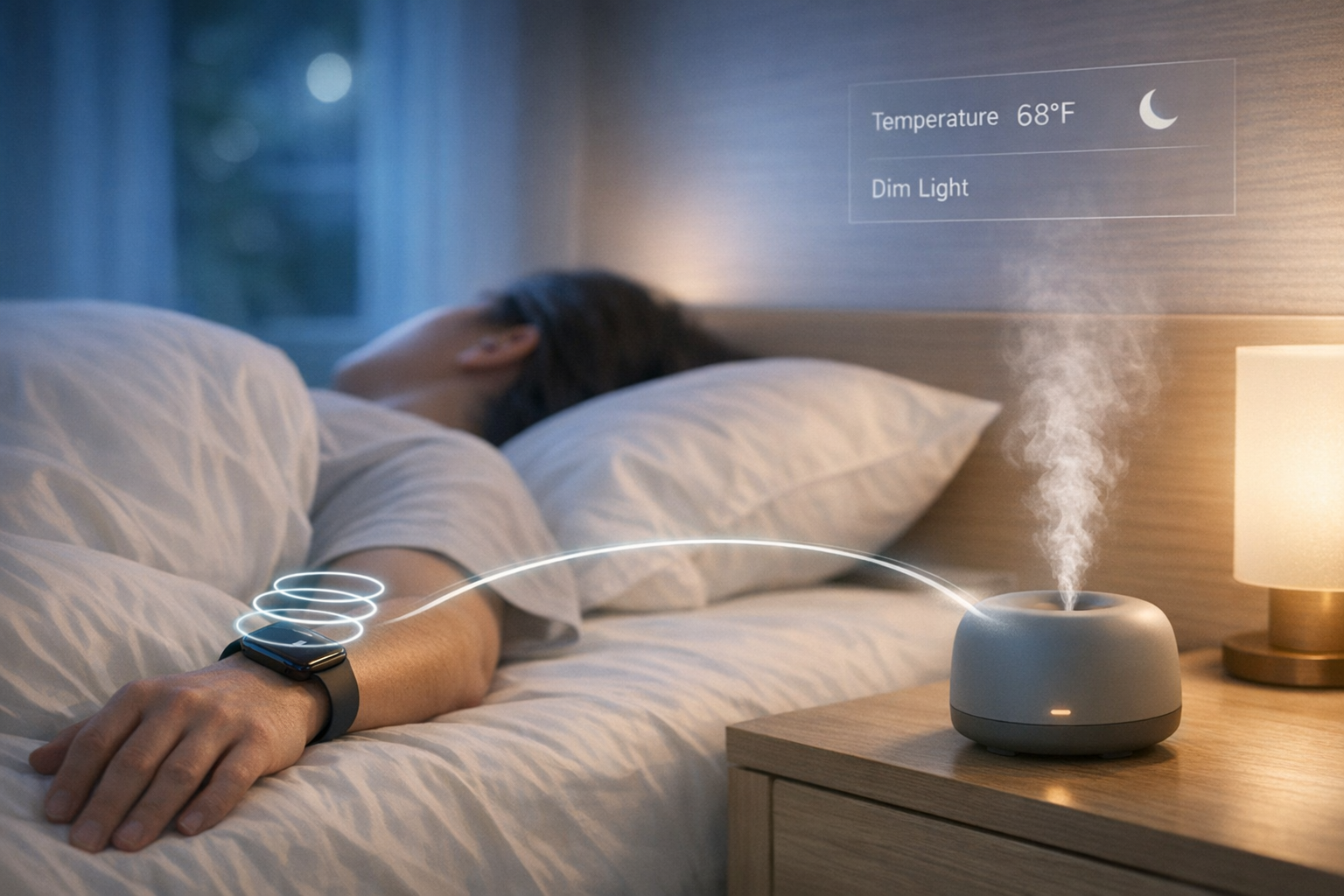
AI is transforming how scents improve sleep by using real-time data from wearables and sensors to adjust aromas in real time. Instead of relying on static options like lavender sprays, these systems analyze heart rate, stress levels, and sleep stages to release specific scents that promote relaxation or deeper sleep. Recent research identified molecules like carvacrol and vanillin, which enhance sleep quality, while devices like Kimba Sleep System and ScentSync Diffuser use AI to deliver scents tailored to individual needs. Integration with smart home systems further optimizes sleep environments by syncing scents with lighting and temperature adjustments. This technology is paving the way for personalized aromatherapy that aligns with your body’s unique rhythms.
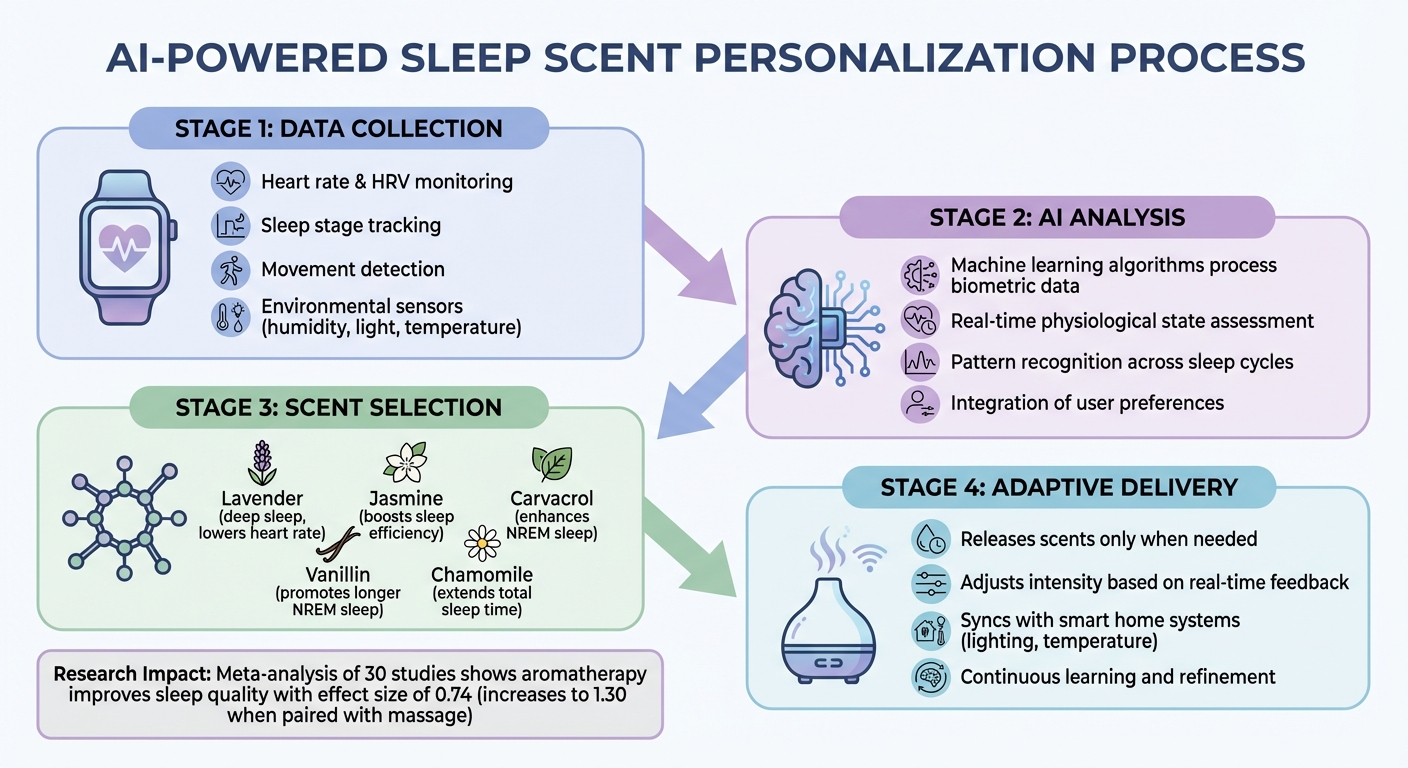
How AI Personalizes Sleep Scents: From Data Collection to Adaptive Scent Delivery
The Science Behind Scent and Sleep
How Scents Affect Sleep Quality
Our sense of smell is unlike any other. While senses like vision and hearing rely on the brain's main sensory relay station (the thalamus), the olfactory system takes a direct route. Scent molecules travel straight from the olfactory bulb to areas like the piriform cortex and limbic centers, including the amygdala and hippocampus [7][8]. This direct link to the brain's emotional and memory hubs explains why a simple scent can evoke powerful memories or alter your mood in an instant. This unique pathway also allows scents to subtly influence sleep.
This direct neural access plays a key role in how scents affect our sleep. Analyzing these responses often involves behavioral data in health agent workflows to optimize outcomes. Airborne molecules can work on a subconscious level to impact your overall well-being [6]. During deep, slow-wave sleep, the piriform cortex becomes less sensitive to external odors. However, the connection between the olfactory cortex and the limbic system actually strengthens during this stage [9]. This heightened connectivity supports memory consolidation and may even allow the brain to "replay" scent experiences. Beyond memory, olfactory inputs interact with sleep-regulating areas in the hypothalamus and basal forebrain, influencing how quickly you fall asleep, how long you stay asleep, and the depth of your restorative rest [8]. Some scent molecules even interact with GABA-related signaling, nudging the brain into relaxation (Alpha waves) or deeper sleep states (Theta and Delta waves) [1]. These fascinating neural mechanisms are the backbone of research into personalized wellness with AI agent protocols that adapt to your physiological needs in real time.
Research Evidence on Sleep-Enhancing Aromas
Science has pinpointed specific scents that can measurably improve sleep. Lavender stands out as the most studied, with research showing it promotes deep sleep, lowers heart rate, and reduces blood pressure [11]. It has shown benefits for people with insomnia and those undergoing medical treatments [10]. Jasmine has been found to boost sleep efficiency - the percentage of time spent asleep while in bed - and decrease movements during sleep [10][11]. Damask rose has demonstrated its ability to improve sleep quality, particularly in hospital settings like coronary care units [11]. Similarly, Roman chamomile has been shown to extend total sleep time and alleviate anxiety, especially in older adults [11].
A meta-analysis reviewing 30 studies revealed that aromatherapy significantly improves sleep quality, with an effect size of 0.74. When paired with massage, the effect size jumps to 1.30 [12]. These benefits are rooted in the way scents influence neural processes, particularly by modulating GABA-related pathways, which are central to relaxation and sleep regulation [10][5].
How AI Personalizes Sleep Scents
AI Integration with Sleep Trackers and Sensors
AI-powered scent systems are now bridging the gap between wearables, smart home devices, and your sleep environment to create a more personalized experience. For instance, devices like Kimba analyze biometric data - such as heart rate, HRV, and sleep stages - to release scents at just the right moments [1][2]. Imagine your heart rate spiking in the middle of the night; the system can automatically diffuse calming scents to help you relax and drift back to sleep [3].
These systems don’t stop at tracking your body. They also use environmental sensors to monitor factors like humidity, light, and temperature. This allows the AI to adjust the type and intensity of the scent for a truly tailored experience [1][3]. Some solutions, like Sleep.ai's Sleep Sense, even turn your smartphone into a sleep sensor by analyzing motion and light data. This approach complements wearable data and makes sleep tracking more accessible, which is important given that only 10% to 15% of adults consistently monitor their sleep [13][14].
Machine learning takes this data and fine-tunes the process in real time, making the system smarter with every use.
Adaptive Scent Diffusion Using Machine Learning
Machine learning algorithms play a key role in creating your personalized "scent profile." They continuously adapt based on real-time feedback. A February 2026 study led by Dr. Dachuan Zhang at the National University of Singapore highlighted how AI can identify sleep-enhancing compounds from thousands of aromatic molecules, showcasing the potential of this technology [5].
Brands are already putting these advancements to work. In December 2025, Jo Malone London introduced an AI Scent Advisor powered by Google Cloud's Gemini models. This tool uses natural language processing to interpret user descriptions - like “the freshness of an orchard” or “cozy spices” - and turn them into personalized scent recommendations [4]. According to Jo Dancey, Global Brand President, this AI-driven tool doubled purchase rates compared to traditional online shopping methods [4]. In retail trials, where EEG headsets were used to measure responses, 95% of participants preferred AI-recommended fragrances over their original choices [4].
These systems function on a closed-loop feedback model. They collect data from sleep statistics, user preferences, and behavioral patterns to refine future recommendations [2][4]. Over time, the system adapts to changes in seasons, shifts in sleep patterns, and evolving individual needs, ensuring it remains aligned with your lifestyle.
Applications of AI Sleep Scent Technology
Examples of AI Sleep Scent Devices
AI-driven scent personalization is making its way into bedrooms across the U.S., offering a fresh take on improving sleep quality. Take the Kimba Sleep System, for example. Launched in April 2025 by CEO Ben Fuxbruner, this device connects to wearables to track biometric signals like heart rate, movement, and sleep depth. What sets it apart? Instead of running continuously, it activates only when necessary - like during heart rate spikes - releasing calming scents to stabilize sleep and enhance heart rate variability [15].
Another standout is the ScentSync Diffuser, which uses a multi-cartridge system to create custom scent blends in real time. It transitions seamlessly from "Morning Focus" (featuring mint and rosemary) to "Evening Calm" (lavender and chamomile), adapting to your mood and the surrounding environment. The ScentSync team explains their philosophy best:
"Scent must adapt - it learns from you" [3].
Unlike traditional diffusers, these devices respond dynamically to biometric and environmental data, offering a level of personalization that feels almost intuitive [3][15]. These advancements hint at a future where scent-based technology becomes a natural part of smart home ecosystems.
Integration with Smart Home Systems
AI scent systems are also stepping into the broader smart home landscape, working alongside other technologies to create a fully synchronized sleep environment. Picture this: as your wearable detects you entering a light sleep phase, the diffuser releases a calming scent, the smart lights dim, and the thermostat adjusts to the perfect temperature - all in harmony. This coordinated approach, sometimes called a "sensory dialogue", ensures your sleep environment evolves in sync with your body's needs throughout the night [3].
sbb-itb-f5765c6
The Role of BondMCP in Sleep Scent Optimization

BondMCP as a Context Layer for Scent Personalization
Most systems work independently, but BondMCP brings them together. It merges data from wearables, environmental sensors, lab analyses, and scent devices into one adaptable platform. This integration builds on AI-driven scent diffusion, providing the missing piece that ensures all these components work seamlessly.
For example, imagine your wearable detects light sleep while your thermostat notes a temperature shift. BondMCP steps in, releasing a customized scent blend like carvacrol or vanillin - compounds known to promote longer NREM sleep [5]. If lab data highlights specific sleep challenges, the platform adjusts its approach on the spot. Using real-time biometric feedback, BondMCP fine-tunes scent delivery to match your unique neurophysiological needs.
This system doesn’t just personalize your sleep experience. It also serves as a powerful tool for researchers, developers, and clinicians, offering solutions that go beyond individual use.
Benefits for Researchers, Developers, and Clinics
By combining data from various sources, BondMCP expands the possibilities of AI-powered scent personalization into research, clinical care, and product development.
- For researchers, it provides a scalable way to study the effects of thousands of volatile organic compounds (VOCs) on sleep. Its specialized health-focused framework makes molecular-level studies easier to replicate and expand.
- For developers, BondMCP offers ready-to-use integration with existing biometric systems. This creates a seamless loop where calming scents are released as soon as stress is detected, eliminating the need to build new systems from scratch [2][3].
- For clinics, it brings precision to large-scale operations. By automating tasks like sleep staging and respiratory event scoring, it helps identify unique sleep disorder subtypes and delivers targeted interventions. As Dr. Cathy A. Goldstein from the University of Michigan Sleep Disorders Center explains:
"AI is expected to provide new insights to inform the clinical care of sleep disorders and advance our understanding of the integral role sleep plays in human health" [16].
BondMCP’s ability to integrate and adapt makes it a game-changer, not just for enhancing sleep but for advancing the broader understanding of sleep health.
Marianna Obrist: Designing Smell, Touch & Taste - And the Future of Multisensory Technology
Conclusion and Future Outlook
AI-powered scent personalization is reshaping how we think about sleep optimization. Take DeepScent's Fragrance On Demand, for example - it can create custom scent blends in just three seconds, highlighting the rapid pace of technological progress in this space [17].
One of the most exciting shifts is toward neuroperfumery, where fragrances are crafted to achieve specific cognitive effects. This trend aligns with changing consumer habits, particularly among Gen Z, who are moving away from a single "signature scent" and instead curating "scent wardrobes" for different moments and moods [18]. This approach treats fragrance as an essential part of daily life, not just an accessory, setting the stage for systems that combine diverse data into a seamless, personalized experience.
On top of that, integrated platforms are beginning to unify health data in groundbreaking ways. BondMCP is a prime example, connecting wearables, lab results, and scent devices into one intelligent network. This kind of seamless data exchange makes personalization more dynamic and impactful. For researchers, developers, and healthcare providers, tools like BondMCP create the foundation to scale precision interventions for sleep and mental health, transforming fragmented data into actionable insights in real time.
Looking forward, the integration of AI with environmental sensors, smart home technologies, and advanced neuroscience will only deepen. The fragrance industry, projected to grow at a 5.5% CAGR through 2029, will see AI driving both innovation and delivery [18]. As these technologies come together, platforms like BondMCP will enable adaptive environments that anticipate and respond to your body's needs, offering a glimpse into a future where personalization reaches entirely new levels.
FAQs
How does AI know which scent to release while I’m asleep?
AI can now personalize scents during sleep by analyzing real-time biometric data and environmental cues. It tracks factors like your mood, stress levels, and even the time of day to determine what scent would benefit you most at any given moment. For instance, it might release calming lavender to ease stress or cedarwood to promote relaxation. By tailoring scents to your specific needs, this approach uses targeted olfactory stimulation to help you relax and improve your overall sleep quality.
Is it safe to use adaptive scent diffusion all night?
Using scent diffusion systems continuously throughout the night isn't typically advised. Extended exposure, particularly in closed spaces, can sometimes cause issues like respiratory irritation, reduced sensitivity to scents, or discomfort in the mucous membranes. To avoid these potential problems, it's a good idea to use these systems sparingly and ensure the area is well-ventilated.
Do I need a wearable, or can my phone work for this?
Smartphones can double as AI-powered sleep trackers, with some apps transforming them into accurate sleep sensors. Studies suggest these apps are a practical choice for monitoring sleep at home. However, wearables tend to deliver more precise results. Your choice ultimately depends on how detailed you want the data to be and what suits your personal preferences.