
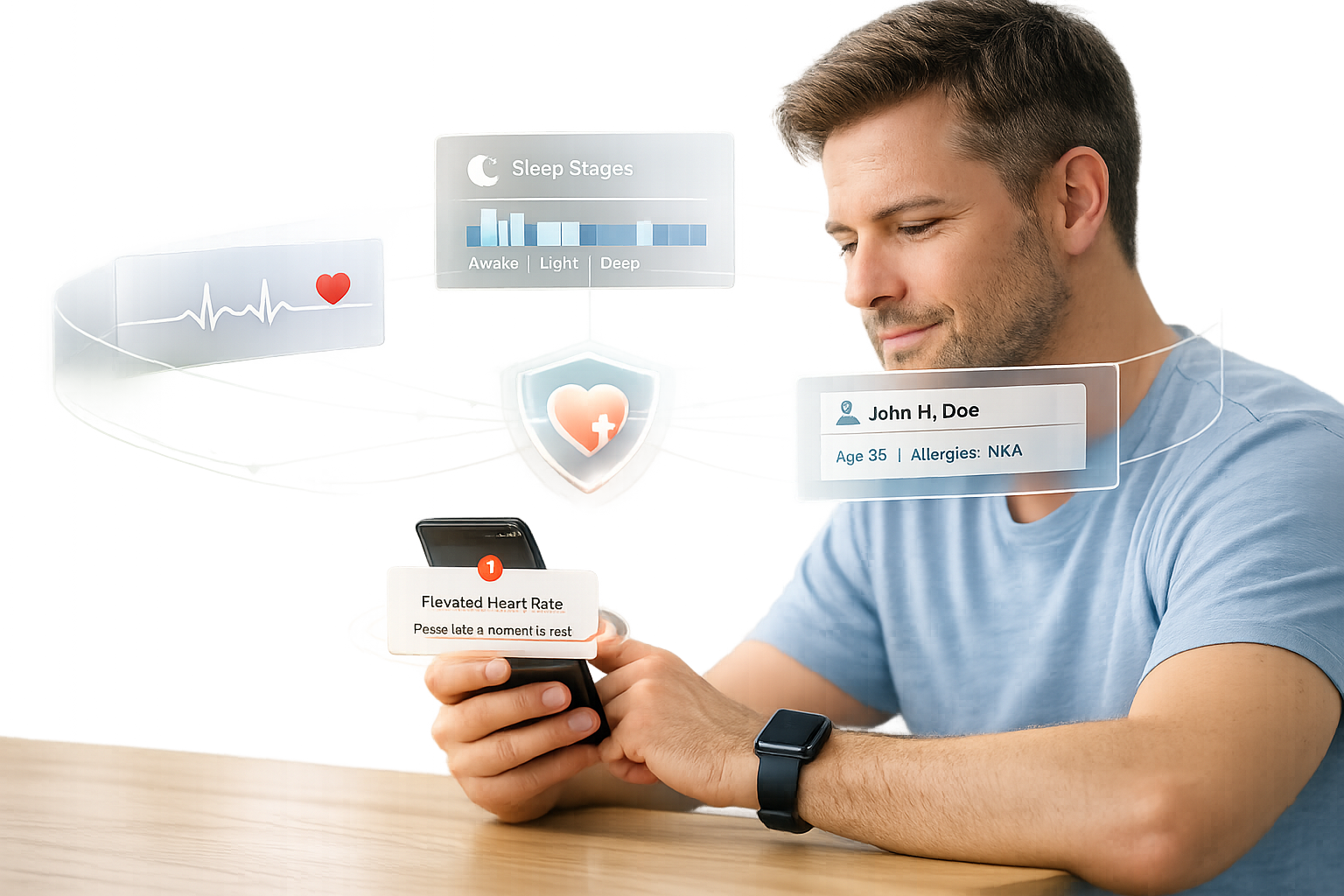
AI is transforming healthcare by predicting health risks before symptoms appear. By analyzing continuous data from wearables, medical records, and sleep patterns, AI identifies early warning signs for conditions like sepsis, strokes, and Parkinson’s disease. For example, tools like Stanford’s SleepFM can predict over 130 diseases using sleep data, while systems like BondMCP unify scattered health data for precise insights.
Key Insights:
- AI detects risks early: Sepsis prediction 6 hours sooner (83% accuracy), strokes in under 4 minutes (97% accuracy).
- Personalized baselines: AI tailors predictions to each individual’s normal health patterns, unlike generic thresholds.
- Data integration matters: Fragmented health systems waste $1 trillion annually. Unified platforms like BondMCP reduce errors and improve care.
- Real-time alerts save lives: AI-driven systems reduce hospital admissions by 23% and clinician alert fatigue by 45%.
AI isn’t just about prediction - it’s helping healthcare professionals act faster and smarter. With tools that connect and analyze your health data, you can stay ahead of potential issues and improve long-term health outcomes.
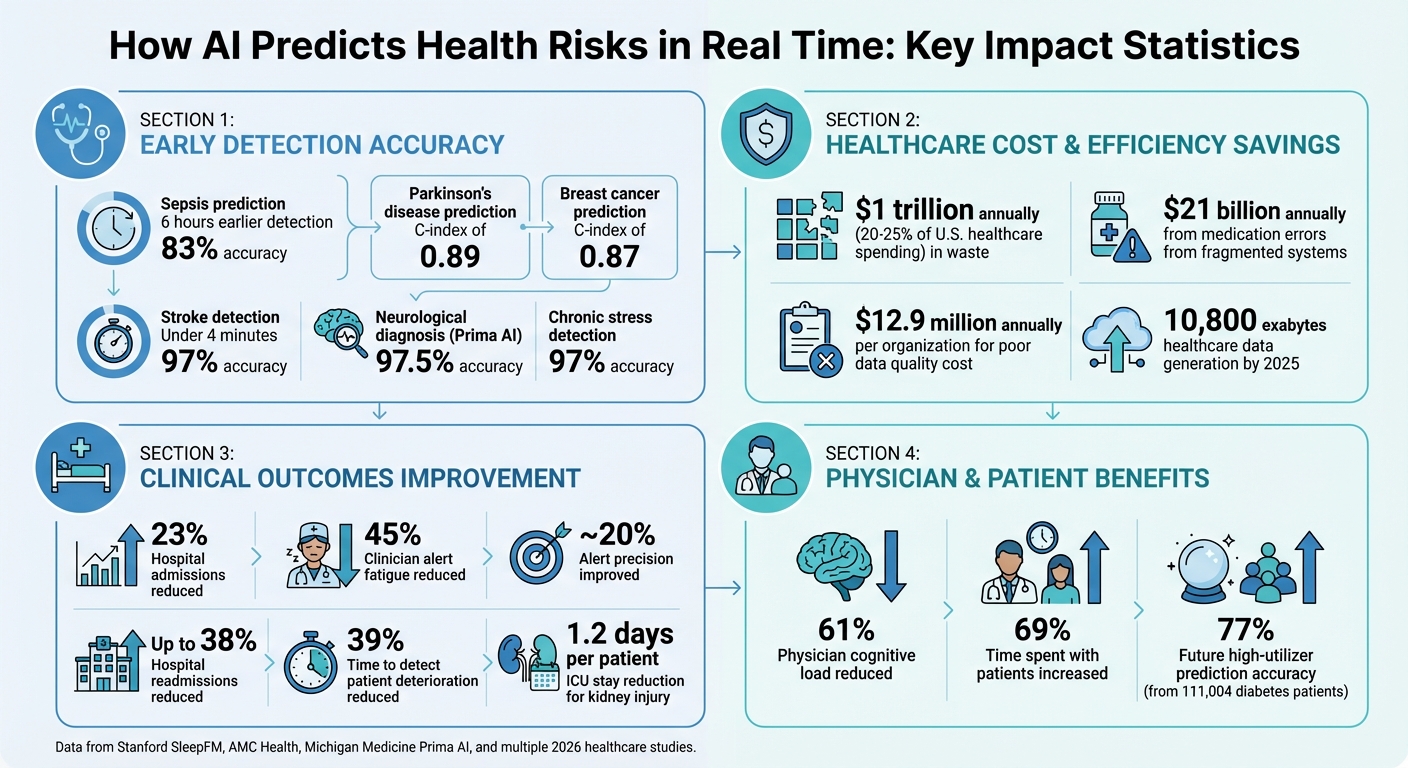
AI Health Prediction Impact: Key Statistics and Outcomes
Step 1: Collect and Connect Health Data Sources
Where Health Data Comes From
Health data comes from a mix of clinical systems and consumer devices. Clinical sources include electronic health records (EHRs), medical imaging, lab results, and medication histories [1][9]. On the consumer side, wearable devices monitor metrics like heart rate, blood pressure, oxygen saturation (SpO2), activity levels, and even real-time blood sugar levels through continuous glucose monitors [1]. Advanced tools such as polysomnography and AI-powered sleep detection provide detailed insights into brain activity, heart rhythms, and breathing during sleep [4][7].
By 2025, healthcare will generate an estimated 10,800 exabytes of data [1]. While this is an enormous amount, the real challenge lies in integrating this information, which is often scattered across incompatible systems.
Problems with Disconnected Data
Disconnected data creates significant barriers. For example, your fitness tracker doesn’t communicate with your lab results, and your supplement plan operates independently of recent health tests. This lack of integration means AI systems can’t access a complete picture of your health, reducing their ability to accurately predict risks.
The financial impact of fragmented data is massive. In the U.S., 20-25% of healthcare spending - about $1 trillion - is wasted, and more than half of this could be saved with better data sharing [11]. Additionally, medication errors caused by fragmented systems cost over $21 billion annually [10]. A Chicago-based medical group with over 650 physicians implemented a unified data platform in June 2025, leading to a 61% reduction in physician cognitive load and a 69% increase in time spent directly with patients [10].
"If experienced physicians struggle with fragmented data infrastructure, AI copilots - which depend entirely on comprehensive data access - become unreliable and potentially dangerous." - Team Gravity, Innovaccer [10]
To address these challenges, a unified data system is critical.
How BondMCP Connects Your Health Data
BondMCP tackles data fragmentation by creating a shared intelligence layer that integrates diverse health data sources. Instead of juggling multiple apps with inconsistent information, BondMCP builds a cohesive system where your sleep tracker informs your fitness coach, your lab results adjust your supplement plan, and your longevity goals influence real-time decisions.
For developers, BondMCP offers a protocol and SDK to create context-aware, interoperable AI agents. For clinics and health platforms, it provides a scalable solution to unify siloed data streams. This creates a comprehensive view of health data, enabling more accurate AI predictions and delivering better personalization and automated health management.
sbb-itb-f5765c6
Step 2: Prepare Data for AI Analysis
Cleaning and Standardizing Data
Health data in its raw form is often chaotic - riddled with inconsistent formats, mismatched timestamps, and varying measurement units. Missing data is a major issue too, with key clinical variables missing over 20% of the time, costing organizations an average of $12.9 million annually due to poor data quality[1][12][13].
AI systems tackle these challenges through error correction and harmonization. A great example is Stanford's SleepFM model, which used leave-one-out contrastive learning to unify diverse data types, resulting in highly accurate predictions[2][7].
"One of the technical advances that we made in this work is to figure out how to harmonize all these different data modalities so they can come together to learn the same language." - James Zou, Associate Professor of Biomedical Data Science, Stanford University[2]
Standardizing data also means converting raw physiological recordings into uniform, manageable segments - often five-second intervals. This ensures that AI models can process the data consistently. Standards like SMART on FHIR are commonly used to synchronize data from various sources, such as smartwatches, electronic health records, and medical apps[1][12].
Once the data is unified, the next step is identifying the most relevant health indicators to improve prediction accuracy.
Selecting Health Indicators for Predictions
After cleaning and standardizing, the focus shifts to selecting the right health markers, as this step significantly boosts AI's predictive power. Models perform best when focused on indicators tied to specific health risks. For example:
- Cardiovascular markers like heart rate variability (HRV) and blood pressure are key for predicting arrhythmias and sepsis.
- Metabolic markers such as glucose and creatinine levels help forecast diabetes-related complications and kidney injuries.
- Neurological signals from EEG readings assist in detecting conditions like Parkinson's disease and dementia[1][4].
Dr. Mignot's research revealed that comparing signals that are out of sync - like a brain appearing to sleep while the heart remains active - can provide deeper insights. This approach allows models to analyze relationships between different signals rather than relying on isolated outlier readings[7].
Step 3: Use Machine Learning to Detect Health Risks
Supervised Learning for Risk Prediction
Supervised learning uses labeled datasets with known outcomes to train AI models to recognize patterns that signal specific health events. Hospitals rely on thousands of patient records to teach these systems how to detect warning signs in real time.
For example, a February 2026 analysis of 111,004 diabetes patients applied ensemble machine learning to predict 77% of future high-utilizers, highlighting opportunities for cost savings[14]. This method works because it learns from real patient data instead of relying on assumptions.
Foundation models like Stanford's SleepFM, introduced in January 2026, are pushing the boundaries of what's possible. SleepFM can predict over 130 diseases using just five-second increments of physiological signals. Trained on 585,000 hours of sleep data from 65,000 participants, the model achieved a C-index of 0.89 for Parkinson's disease and 0.87 for breast cancer[7].
"The most information we got for predicting disease was by contrasting the different channels. Body constituents that were out of sync - a brain that looks asleep but a heart that looks awake, for example - seemed to spell trouble." - Emmanuel Mignot, MD, PhD, Professor in Sleep Medicine, Stanford Medicine[7]
These models excel at identifying specific, known risks based on historical data. For instance, AI tools for acute kidney injury can predict issues up to 48 hours before symptoms appear, potentially reducing ICU stays by 1.2 days per patient. Sepsis detection models identify risks six hours earlier than traditional methods with 83% accuracy, while stroke detection achieves 97% accuracy in under four minutes[1].
While supervised learning is powerful, anomaly detection takes things further by identifying personalized health insights from wearable anomaly data.
Anomaly Detection for Early Warnings
Anomaly detection focuses on identifying deviations from a person’s baseline without requiring labeled data. It analyzes continuous data streams - such as heart rate, respiratory rate, and sleep patterns - to flag out-of-sync signals that traditional fixed thresholds might overlook.
In January 2026, AMC Health introduced a time-series alerting framework based on over six years of longitudinal data, covering 15 million readings. By using individualized percent-change baselines instead of static thresholds, the system is projected to reduce clinician alert burden by 45% while lowering hospital admissions by 23%[8]. The AI establishes a "normal" baseline from your first few days of data and adjusts dynamically in real time.
This approach was validated in a February 2026 study on stress monitoring. Researchers used the Stress-Predict dataset from 35 participants to train an autonomous AI system with a Random Forest model. The system achieved 97% accuracy in detecting chronic stress and autonomously generated medical reports when stress exceeded personalized thresholds - all without pre-labeled training data[6].
"Agentic AI in healthcare will be like a skilled medical assistant working 24/7 - continuously learning, adapting and supporting healthcare professionals in ways we've never imagined possible." - Emily Tullett, Senior Industry Marketing Manager, SS&C Blue Prism[1]
Anomaly detection is particularly useful for identifying unknown risks or rare conditions where labeled examples are scarce. It enables early warning systems that catch subtle changes before they escalate, reducing the time to detect patient deterioration by 39%[1].
The strengths of these methods become even clearer when comparing their unique capabilities.
Comparing Machine Learning Techniques
Different machine learning methods serve distinct purposes in health monitoring. The choice depends on whether you're targeting a known risk or scanning for unusual changes.
| Technique | Data Requirements | Strengths in Real-Time Prediction | Healthcare Use Cases |
|---|---|---|---|
| Supervised Learning | Labeled datasets (EHR, vitals) | High precision for specific, known risks | Sepsis, stroke, cancer, Parkinson's[7][1] |
| Unsupervised Anomaly Detection | Unlabeled data | Identifies unknown risks and early shifts | Irregular heart rhythms, stress spikes, rare disease signals[1][6] |
| Foundation Models | Massive multimodal datasets | Versatile; can predict multiple conditions | Parkinson's, dementia, mortality from sleep[7][4] |
| Ensemble Stacking | Multiple model outputs | Combines strengths of different algorithms | Predicting high-cost patients with complex needs[14] |
Supervised learning is ideal when you have a specific outcome in mind and plenty of historical data. It’s the best choice for predicting conditions like sepsis or diabetes complications.
Anomaly detection, on the other hand, shines in continuous monitoring scenarios. It’s perfect for spotting individual variations, where what’s normal for one person might be abnormal for another.
Foundation models represent a newer approach, capable of understanding human physiology across multiple data streams. They can predict a wide range of conditions from the same dataset, making them incredibly versatile.
New AI model predicts disease risk during sleep monitoring sessions
Step 4: Create Real-Time Health Alerts
With advanced data analysis in place, AI turns insights into accurate, real-time alerts that enable timely and effective care.
Building Useful Alerts
Effective alerts depend on personalization and accuracy. Instead of using one-size-fits-all thresholds, AI systems create a unique baseline for each individual. These baselines take into account factors like age, gender, medical history, and lifestyle[1].
In January 2026, AMC Health introduced an advanced alerting framework built on six years of data from 15 million readings. Unlike traditional fixed thresholds, the system uses individualized percent-change baselines. This method is expected to cut down clinician alert fatigue by 45% and improve the accuracy of alerts by nearly 20%[8].
"This new alerting framework... positions our clinical teams to operate with greater focus, efficiency, and impact, especially at a time when the healthcare industry faces significant clinician shortages." - Nesim Bildirici, President and CEO, AMC Health[8]
By tracking consistent deviations across multiple vital signs and behavioral patterns - like more frequent self-monitoring - the system reduces false alarms while identifying early signs of health deterioration[8]. BondMCP’s unified data system powers these tailored alerts, ensuring notifications are driven by personalized health data. This refined approach is already leading to better patient outcomes in practical settings.
Real-World Alert Examples
AI-powered alerts are already making a difference in clinical environments. For instance, in February 2026, researchers at Michigan Medicine launched the "Prima" AI system, trained on 200,000 MRI studies and 5.6 million imaging sequences. Prima can analyze brain scans in seconds and has achieved 97.5% accuracy in diagnosing neurological conditions. When it detects critical issues like hemorrhages, it immediately notifies stroke neurologists or neurosurgeons for urgent intervention[15].
"Accuracy is paramount when reading a brain MRI, but quick turnaround times are critical for timely diagnosis and improved outcomes." - Yiwei Lyu, Postdoctoral Fellow, University of Michigan[15]
These systems not only identify risks and prioritize them based on severity but also ensure alerts are routed to the right specialists promptly[15]. Beyond speed, clinicians report that AI-powered alerts improve workflow efficiency and ease mental strain by delivering actionable, context-specific notifications instead of generic warnings[1][8].
Step 5: Use BondMCP for Agent Coordination and Shared Context
After AI systems generate real-time alerts, the next challenge is bringing together diverse data sources and AI agents. BondMCP steps in as a unified intelligence layer, linking wearables, lab results, fitness data, and supplement protocols.
How BondMCP Enhances Real-Time AI Predictions
Traditional health systems often rely on REST APIs to exchange basic data strings. BondMCP takes a different approach by transmitting "reasoning context" instead of raw data. Keith Dutton, VP of Engineering at Artera, explains:
"MCP isn't just another version of a REST API... You aren't just passing strings; you're passing reasoning context." [16]
This added depth allows AI agents to work with context-rich data. For example, in March 2026, Artera rolled out an MCP-based medication retrieval tool that organizes drug data into eight categories. This ensures AI agents only process the necessary information, avoiding data overload while improving prediction accuracy.[16]
BondMCP also maintains a server-side session state, which acts as an independent and reliable source of truth. By validating actions against real-world data - like cross-checking dates with actual calendars - it minimizes errors during critical tasks like dosage adjustments or appointment scheduling. In January 2026, Wolters Kluwer introduced "Medi-Span Expert AI", an MCP-powered server that integrates expert-reviewed drug data and dosing safeguards. This innovation significantly sped up clinical decision-making processes by seamlessly embedding validated logic into AI workflows.[17]
Another key advantage of BondMCP is its ability to enable multi-agent orchestration. It transforms clinical data services into reusable tools, allowing multiple AI agents to access and coordinate insights across various health domains simultaneously.[9]
With these precise predictions, BondMCP takes personalization a step further by automating tailored health interventions.
Automating Personalized Health Actions
BondMCP doesn’t just stop at coordination - it also drives action. By leveraging predictive insights, the platform automates personalized interventions. It creates "smart cohorts", which are dynamic groups identified through real-time data and shifting health behaviors, rather than static diagnoses. This enables AI agents to automatically send medication reminders, schedule follow-ups, or connect patients to telehealth services before issues escalate.[18]
As Anmol Madan, CEO and Founder of RadiantGraph, puts it:
"AI agents can function as that connective tissue between data and empathy, between insight and action." [18]
A compelling example comes from February 2026, when the Mayo Clinic Platform used BondMCP in a deep learning project to predict Major Adverse Cardiovascular Events after liver transplantation. By analyzing structured EHR data for 15,000 patients, the system trained predictive models in just 10 minutes. These insights streamlined post-transplant care protocols, automating routine tasks while ensuring safety through clear escalation pathways to human clinicians for complex decisions.[19]
This combination of precise coordination and automated action is transforming how healthcare adapts to individual patient needs in real time.
Step 6: Monitor and Improve Predictions Over Time
For real-time health predictions to remain effective, they must be continuously accurate. Just like the personalized alerts discussed earlier, AI models require ongoing updates through regular feedback and monitoring. This process ensures they stay aligned with real-world health patterns.
Using Feedback to Improve AI Models
The most effective AI systems don't just make predictions - they learn from them. Every interaction, whether it's a user adjusting medication, scheduling a doctor visit, or dismissing an alert, feeds back into the system. This feedback loop helps refine future predictions.
A study published in February 2026 in the International Journal of Computational Intelligence Systems highlights this concept. Researchers developed a multi-agent stress monitoring system that analyzed PPG sensor data from 35 participants. It used a memory module to store historical stress levels, enabling it to track long-term patterns instead of recalculating baselines each time. With this approach, the system achieved an impressive 97% accuracy in distinguishing acute stress from chronic stress using a Random Forest classifier [6]. These findings underline the importance of regular audits and updates to maintain high performance over time.
By incorporating feedback and historical data, AI systems can adapt to changing health patterns, offering more precise and personalized risk assessments.
Maintaining Model Accuracy
To ensure feedback-driven improvements are effective, systematic monitoring is essential. Factors like sensor recalibration or shifts in user behavior can impact accuracy, making regular audits a critical part of the process.
For example, in January 2026, AMC Health introduced an AI-driven clinical alerting framework that analyzed over 15 million physiometric readings collected over six years. Under the leadership of CEO Nesim Bildirici, the system used patient-specific, longitudinal baselines to identify patterns spanning multiple days. The results were striking: a 45% reduction in total alert volume and a 23% decrease in all-cause hospital admissions [8].
| Metric | Traditional Thresholds | AI-Driven Framework (AMC Health) |
|---|---|---|
| Alert Precision | ~24% | Improved by ~20% |
| Alert Volume | High (100%) | Reduced by 45% |
| Baseline Type | Fixed/Static | Individualized/Longitudinal |
Audits also play a role in ensuring fairness across demographics. Models that are trained on limited datasets - such as one age group or ethnicity - might underperform for other populations. Ongoing risk assessments help prevent disparities and ensure equitable outcomes for diverse user groups [5].
Another important tool is explainable AI (XAI). Instead of operating as a "black box", explainable AI provides insights into how predictions are made. For instance, it can show which data points - like heart rate, brain activity, or respiratory patterns - contributed to a specific alert. This level of transparency builds trust among clinicians and patients while making it easier to identify and correct any reliance on irrelevant factors.
Conclusion and Key Takeaways
Real-time risk prediction is changing healthcare by moving from occasional checkups to continuous monitoring. This approach catches potential health issues early, turning raw data into actionable insights that can save lives. These advancements aren't just small steps forward - they're making a huge difference, like reducing hospital readmissions by up to 38% and cutting the time to detect patient deterioration by 39% [1].
What's Next for Real-Time Health Monitoring
The future of precision health is all about AI systems acting as around-the-clock medical assistants, constantly learning and adapting to individual health profiles. As Satya Nadella, CEO of Microsoft, aptly put it:
"AI is perhaps the most transformational technology of our time, and healthcare is perhaps AI's most pressing application" [1].
Take Stanford's SleepFM as an example - it can predict over 100 health conditions from just one night's sleep, achieving C-indexes above 0.8 [3][7]. The real game-changer here is multi-modal analysis, which compares data from different physiological systems. By identifying when the brain, heart, and metabolism aren’t in sync, these systems can provide powerful early warnings for potential health issues [2].
Platforms like BondMCP are paving the way for this transformation by addressing the problem of fragmented health data. Imagine no longer needing to juggle multiple apps with conflicting advice. BondMCP integrates everything - your sleep tracker can inform your fitness routine, lab work can guide your supplements, and your long-term health goals can shape real-time decisions. This unified system ensures AI tools work together, offering clarity and personalization that disconnected systems can't match. It's a shift that empowers both healthcare professionals and individuals to take meaningful, proactive steps.
Taking Control of Your Health with Technology
You can take charge of your health today by starting with wearables and connected platforms. Look for devices that track metrics like heart rate variability, sleep quality, and activity levels to establish a baseline for your health [1]. Focus on long-term trends rather than one-off readings - AI is particularly skilled at detecting gradual changes that might indicate underlying risks. Make sure your devices and platforms communicate seamlessly by choosing systems that adhere to interoperability standards, such as SMART on FHIR, so your wearables, lab results, and electronic health records work together smoothly [1].
Using platforms like BondMCP, you can combine all your health data streams to receive clear, personalized recommendations. This shift to proactive, AI-powered health monitoring puts control firmly in your hands. The technology is already here. The real question is: will you use it to enhance your healthspan and stay ahead of potential problems?
FAQs
What data do I need for real-time health risk predictions?
Real-time health risk predictions rely on blending several key data sources: physiological signals like heart rate, blood pressure, and activity levels; electronic health records; genetic information; and lifestyle factors. Together, these elements help deliver precise, personalized insights and timely warnings about potential health concerns.
How does AI set my personal baseline instead of using generic thresholds?
AI works to establish a personal health baseline by studying your unique data trends over time, like your heart rate or sleep patterns. Instead of relying on one-size-fits-all thresholds, it focuses on spotting meaningful changes in your usual metrics. This helps cut down on false alarms. By understanding your specific health patterns, AI can provide precise, real-time alerts about potential risks, paving the way for timely care and interventions designed specifically for you.
How does BondMCP connect my wearables, labs, and EHR data for better alerts?
BondMCP brings together data from your wearables, lab results, and electronic health records (EHR) by enabling real-time sharing across these platforms. This seamless integration allows AI agents to analyze your combined health information, delivering precise alerts and tailored insights to help you manage and improve your health more effectively.