

Contextual data models are transforming how health AI systems work by adding depth and personalization to healthcare. Unlike older systems that rely on static data, these models analyze health information in real time, considering factors like timing, lifestyle, and long-term trends. This approach enables AI to provide more precise care, predict potential issues earlier, and adjust recommendations dynamically.
Key Insights:
- Dynamic Analysis: Contextual models track health events alongside conditions like stress, sleep, and environment for tailored insights.
- Personalized Care: AI systems create treatment plans based on individual health profiles, not generic data.
- Predictive Power: These models can forecast risks (e.g., kidney injury 48 hours in advance) and prevent complications.
- Real-Time Updates: Continuous data from wearables and health records ensures recommendations stay relevant.
Challenges:
- Data Integration: Combining diverse health data sources is complex.
- Privacy Concerns: Safeguarding sensitive patient information is critical.
- Technical Expertise: Many systems lack the resources to manage advanced algorithms.
The future of health AI lies in systems like BondMCP, which unify data streams and enable smarter, context-aware decisions. With these advancements, healthcare is shifting toward more responsive, proactive care.
Frontiers in AI-Enabled Healthcare: Multimodal Data, Contextual Processing & Human-AI Collaboration
Key Parts of Contextual Data Models
Contextual data models bring health data together in a way that creates a full picture of an individual’s health. These models are built around a few key components, which are essential for tailoring health protocols to each person.
Health Data Feature Groups
Health data is often divided into feature groups - categories like lab results, diagnoses, medications, lifestyle habits, and environmental factors. This structure allows AI systems to analyze the data more effectively. For example, a cardiovascular feature group might include blood pressure, cholesterol levels, heart rate variability, exercise routines, and sodium intake. By grouping related data, AI can uncover patterns that impact care decisions. For instance, it might reveal how the timing of a medication interacts with lab results and daily habits, helping AI health coaching systems design more personalized interventions.
Time-Based Relationships in Health Events
The timing and sequence of health events provide essential context that traditional static models often miss. Time-based relationships track when events happen, their duration, and what follows. For example, a study using the MIMIC-3 database demonstrated that patient-specific online adaptation models, which factor in timing, performed better than population-based models in predicting clinical event sequences. These models improved AUPRC (Area Under the Precision-Recall Curve) by 4.2% as they shifted from general population data to individual-focused insights. This temporal awareness allows AI to make precise recommendations, such as identifying subtle shifts in how a patient responds to medication or the ideal timing for exercise, enabling timely and customized interventions.
Long-Term Data for Complete Health Pictures
Long-term data collection addresses the gaps left by traditional healthcare methods, which often relied on sporadic check-ins like annual exams. With continuous monitoring tools like wearables, healthcare providers now have access to a steady stream of data, leading to better prevention and timely interventions [3]. This approach is particularly crucial given that noncommunicable diseases account for 41 million deaths annually, representing 74% of global mortality [1]. Over time, AI can detect trends that short-term data might miss - such as gradual changes in inflammation levels or links between sleep quality and cognitive health. This empowers patients to take a more active role in managing their health while giving providers a deeper understanding of long-term patterns [2].
How Contextual Data Models Create Personalized Care
Contextual data models bring together genetics, lifestyle habits, and real-time biometrics to create highly personalized healthcare solutions. By combining these diverse data sources, AI systems can deliver care that adjusts to a person's changing health needs. This approach paves the way for precise treatment strategies tailored to each individual.
Custom Treatment Plans
These advanced AI systems design treatment plans based on a person's full health profile, steering away from one-size-fits-all approaches. Instead of relying on general population data, they analyze how various factors interact within an individual's unique circumstances. For instance, a diabetes management plan might integrate blood sugar trends with meal schedules, stress levels, physical activity, and sleep patterns.
One example of this precision comes from a lung cancer screening model that combined polygenic risk scores, CT scan image patterns, and air quality data from patients' ZIP codes. This model identified individuals with a threefold higher risk compared to the baseline [4]. Such tailored insights empower healthcare providers to target specific risk factors and deliver interventions that truly matter to the patient.
These plans also evolve as patients' needs change. If biomarkers shift unexpectedly or lifestyle factors like diet and exercise habits are altered, the AI can revise its recommendations automatically. This ensures treatment stays relevant and effective, avoiding the pitfalls of static, outdated protocols.
Predictive Analytics for Early Intervention
Contextual models don't just customize treatments - they also predict potential health issues before they arise. With the healthcare industry projected to generate 10,800 exabytes of data by 2025, these models help AI sift through the noise to forecast health events [4]. This marks a shift from reactive care to proactive healthcare, where problems are addressed before they escalate.
"Predictive analytics is like giving your data a voice and a sense of foresight." – Alexandr Pihtovnicov, Delivery Director at TechMagic [4]
The power of predictive analytics is already evident in real-world applications. For example, an AI tool designed for acute kidney injury (AKI) can identify risks 48 hours in advance, leading to fewer severe cases and reducing ICU stays by an average of 1.2 days per patient [4]. Early warnings like these allow medical teams to intervene before significant damage occurs, potentially saving lives and cutting costs.
In chronic disease management, predictive models are equally impactful. A health system using AI-generated polygenic risk scores for heart disease achieved a 25% reduction in adverse events over three years among high-risk patients who received proactive coaching and monitoring [4]. Such systems spotlight individuals most in need of preventive care, leading to measurable improvements in health outcomes.
For conditions like type 1 diabetes, predictive analytics can significantly enhance patients' quality of life. By analyzing continuous glucose monitor (CGM) data alongside electronic health records and lifestyle factors, AI systems have reduced hypoglycemic episodes by nearly 40% [4]. This level of foresight allows patients to better manage their glucose levels while minimizing unexpected complications.
Real-Time Data Integration
To complement tailored care and predictive insights, real-time data integration ensures treatment plans remain dynamic. By continuously processing information from wearables, lab results, patient updates, and environmental sensors, AI systems can adapt to a person’s health needs as they change throughout the day or over longer periods.
This real-time adaptability transforms static plans into flexible systems. For instance, if a patient's heart rate variability and sleep tracking indicate high stress and poor rest, and their activity monitor reveals reduced movement, the AI can connect these dots. It might then recommend adjusting medication timing, introducing stress-reduction techniques, or modifying exercise plans to address the issue immediately.
As of 2024, 65% of U.S. hospitals report using predictive models, laying the groundwork for more advanced real-time data integration [4]. This infrastructure allows AI to create a comprehensive, continuously updated view of patient health by pulling data from various touchpoints.
AI systems also excel at making sense of unstructured data in real time. Using natural language processing, they extract insights from physician notes, patient messages, and other text-based sources, combining this information with structured data from medical devices and lab results.
Companies like BondMCP simplify the complexity of real-time integration by unifying diverse health data streams. Instead of juggling multiple apps and conflicting advice, users benefit from a coordinated system. For example, sleep data can inform workout plans, lab results can refine supplement recommendations, and long-term health goals can guide daily decisions. This holistic approach ensures that adjustments are based on a full understanding of the individual’s health, not just isolated data points.
AI Agents Using Contextual Models for Health Decisions
AI agents go beyond traditional algorithms by combining multiple data streams and adjusting their recommendations based on a patient’s evolving condition. Acting as autonomous decision-makers, these agents adapt to new information in real time, creating opportunities to unify fragmented healthcare systems.
Take, for instance, NYUTron, a tool implemented at NYU Langone Health. It predicts hospital readmission risks, length of stay, in-hospital mortality, and even insurance claim denials - all directly within the electronic health record system [5]. This example shows how AI agents can seamlessly integrate into existing workflows, offering actionable insights. With investments in agent-driven AI expected to grow significantly, healthcare is steadily moving toward systems that are increasingly aware of context [8].
Connecting Multiple Data Sources
One of the biggest hurdles in healthcare has been the existence of data silos, which limit the flow of critical patient information. AI agents tackle this issue by accessing multiple data sources - such as electronic health records, imaging systems, wearable devices, and medical databases - simultaneously. This approach creates a more complete picture of a patient’s health.
At St. John’s Health, for example, AI agents assist physicians by listening during patient visits and automatically extracting key details for billing and continuity of care. These agents generate concise summaries that integrate directly into existing records, streamlining the process [7].
The architecture of these agents is designed to dynamically discover tools and databases using metadata, allowing healthcare providers to add new data sources without overhauling the system. Different types of AI agents - like image-based agents for disease diagnosis, predictive agents for risk forecasting, conversational agents for patient communication, and natural language processing (NLP) agents for analyzing clinical notes - work together to create a unified, patient-centered system. At Dana-Farber Cancer Institute, for instance, the GPT4DFCI system securely connects diverse data sources to enhance research, clinical documentation, and administrative workflows. AI-assisted diagnoses have also shown improved accuracy, with rates of 61.4% compared to 46.5% for traditional internet search-based methods [5].
One framework stands out as an example of how this unified approach can be achieved.
BondMCP: A Framework for Context-Aware AI Agents
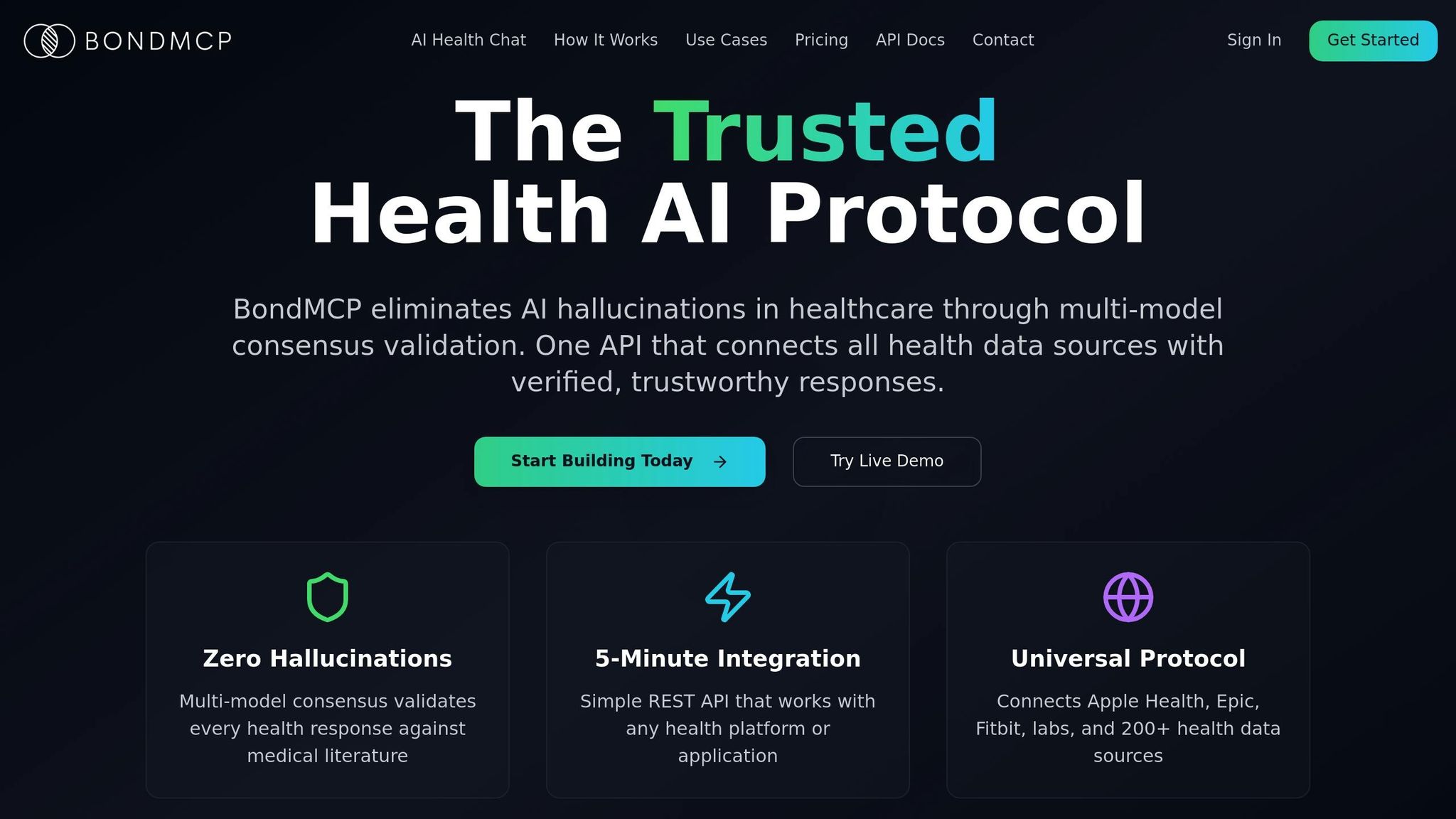
Among the many solutions available, BondMCP stands out for its ability to standardize communication between data sources and AI models. It unifies data from wearables, labs, and clinical records, helping optimize healthcare outcomes. The Model Context Protocol (MCP) addresses a critical challenge in healthcare AI by defining clear interfaces between AI models and external systems, ensuring seamless communication [6]. As Joshua Kelly, Co-founder of Flexpa, explains:
"MCP should standardize tool use interfaces between our data sources - such as FHIR servers - and LLMs" [9].
BondMCP offers a structured software development kit (SDK) tailored for health-focused AI agents. This framework ensures agents are context-aware, interoperable, and equipped with health-specific knowledge, significantly shortening development time while maintaining consistent performance across various applications.
By using a shared context layer and a health-specific ontology, BondMCP enables plug-and-play AI agent orchestration. Healthcare organizations report that these context-aware agents reduce administrative burdens, allowing professionals to dedicate more time to patient care and complex decision-making [7]. Additionally, robust governance measures - such as traceability for every decision, escalation protocols for ambiguous cases, and thorough context documentation - are critical for maintaining safety and audit readiness [8].
The power of BondMCP lies in its ability to standardize data communication and ensure that AI agents can work together seamlessly. For example, INTEGRANIUM’s AgentCare AI, launched in May 2025, demonstrates the practical benefits of standardized protocols. This system integrates with Epic and Oracle Health platforms using SMART on FHIR and OAuth2 for authentication, accessing a range of clinical and research databases to transform patient records into structured clinical notes [9].
Ultimately, the success of context-aware AI agents depends on thoughtful design and clearly defined capabilities. These agents must act as intelligent collaborators, enabling healthcare organizations to identify meaningful use cases, implement strong safeguards, and build scalable, reliable systems for patient-focused AI-driven care [8].
sbb-itb-f5765c6
Benefits and Challenges of Contextual Data Modeling
Contextual data modeling brings significant advantages to healthcare, such as more tailored care and better predictive insights. However, it also introduces a set of challenges that require careful navigation, particularly in resource allocation and system integration.
One major benefit is enhanced personalized care, where AI recommendations are fine-tuned by considering a wide array of factors - symptoms, medical history, vitals, lab results, medications, and even social determinants of health. This holistic approach helps create a more complete clinical picture.
Another advantage is improved predictive accuracy. By analyzing patterns across multiple data streams, these models can foresee potential health issues before they escalate. For instance, contextual variables have been shown to account for over 83% of patient outcomes [13].
But the road to implementing contextual data models isn’t without obstacles. Technical complexity is a significant barrier. Combining data from various sources while maintaining consistent quality and managing advanced algorithms demands expertise that many healthcare facilities may lack. Data interoperability is another sticking point. Healthcare systems, devices, and platforms often use incompatible formats, making it difficult to create unified models.
Privacy concerns further complicate the process. Ensuring that patient data is shared and used only with explicit consent is critical, especially when sensitive information flows across multiple providers and systems [10].
Comparison Table: Benefits vs. Challenges
| Benefits | Challenges | Mitigation Strategies |
|---|---|---|
| Personalized Care – Recommendations tailored to individual needs | Data Interoperability – Fragmented formats limit integration | Standardize data formats and adopt industry-wide standards |
| Predictive Accuracy – Early detection of risks through pattern analysis | Privacy Concerns – Managing consent for sensitive data sharing | Implement strict privacy protocols and secure patient consent |
| Real-Time Integration – Continuous updates from new data | Technical Complexity – Advanced algorithms require skilled teams | Provide training and education for healthcare professionals |
| Proactive Intervention – Addressing health issues before they worsen | Regulatory Uncertainty – Ambiguities around AI decision liability | Establish clear governance and accountability structures |
| Comprehensive Insights – Inclusion of contextual variables for better outcomes [13] | Algorithmic Bias – Risk of unequal outcomes across populations | Use diverse datasets and monitor systems for bias regularly |
These challenges highlight the need for frameworks that can effectively unify diverse health data through frameworks like the Model Context Protocol. One recurring issue is the opaque nature of some AI algorithms, which can make it hard to ensure transparency and accountability. Workforce readiness is another hurdle, as healthcare professionals must undergo extensive training to adapt to these systems and the evolving nature of their roles [11]. Additionally, validation remains a weak point. Only 6% of 516 studies on AI algorithms for medical imaging conducted external validation, raising concerns about how well these models perform across different populations and settings [12].
Despite these difficulties, some promising strategies are emerging. For example, federated learning allows healthcare systems to draw insights from diverse data sources while maintaining patient confidentiality. Organizations that focus on data transparency, implement strong governance frameworks, and invest in workforce training tend to see better results.
Conclusion: The Future of Contextual Data Models in Health AI
Contextual data models are reshaping healthcare by bridging the gaps that have long fragmented the industry. With 86% of healthcare organizations already leveraging machine learning and over 80% of leaders actively planning for AI adoption [14], it's clear that the momentum is building.
Throughout this guide, we've explored how contextual data models bring together diverse data sources - like wearables, lab results, lifestyle factors, and medical history - to create a complete picture of health. This approach doesn't just enhance accuracy; it changes the very foundation of healthcare delivery, making it smarter and more integrated.
A key player in this transformation is BondMCP, which provides the infrastructure needed to scale contextual health AI. Acting as a universal translator, BondMCP connects disparate AI systems and health data sources, solving the fragmentation problem that has hindered progress in healthcare technology. By establishing a shared context layer with health-specific ontology and plug-and-play orchestration, BondMCP removes the barriers that prevent healthcare AI from reaching its potential.
The benefits are already becoming evident. Efficiency improvements seen in other industries suggest that similar advancements in healthcare could lead to better patient outcomes. This integration of data and AI isn't just about streamlining processes; it's about enabling personalized, proactive care. With agent-based health optimization, AI can continuously monitor, analyze, and adjust health strategies in real time, moving away from reactive treatments based on limited data.
The healthcare sector is at a tipping point. Organizations that embrace contextual data models and frameworks like BondMCP will be equipped to deliver the precision and personalization that modern patients demand. Those that cling to siloed systems and disconnected data will likely struggle to keep pace.
As we've seen, the future lies in AI that understands context, learns from comprehensive data, and integrates seamlessly into healthcare systems. Contextual data models, supported by advanced frameworks like BondMCP, are turning this vision into reality today.
FAQs
How do contextual data models improve the accuracy and effectiveness of health AI systems?
Contextual Data Models in Health AI
Contextual data models are transforming health AI systems by pulling in and analyzing real-time data from a variety of sources - think wearables, lab results, and even lifestyle habits. This method helps AI not only spot patterns but also predict potential health risks and suggest personalized interventions with a precision that traditional models often can't match.
With these context-driven insights, AI can detect health issues earlier, deliver more accurate diagnoses, and create tailored health plans. The outcome? A system that adjusts to each person's unique needs, making health management more precise and taking much of the guesswork out of improving overall well-being.
What challenges do healthcare providers face when integrating contextual data models into their systems?
Healthcare providers face several hurdles when trying to integrate contextual data models into their systems. A significant obstacle lies in the lack of standardized data formats and communication protocols, which complicates the ability of various systems and devices to work together smoothly. This often results in difficulties with data sharing and system interoperability.
Another major issue is the fragmentation of data sources. Information is scattered across wearables, lab results, medical devices, and administrative platforms, making it challenging to consolidate everything into a single, actionable framework. On top of that, many current workflows and infrastructures aren’t built to accommodate the dynamic demands of contextual models, leading to inefficiencies and mismatches.
These challenges can create data silos and add unnecessary complexity, ultimately limiting the potential to deliver personalized and adaptive care. Overcoming these issues calls for solutions that emphasize interoperability, automation, and a unified approach to managing health data.
How does real-time data from wearables and health records improve personalized care in health AI?
Real-time data from wearables and health records is transforming personalized care by allowing for continuous monitoring and early detection of health concerns. Devices like fitness trackers and health monitors gather information on key metrics such as heart rate, blood sugar levels, and sleep patterns. AI systems then analyze this data to spot trends and predict potential risks before they develop into more serious issues.
This technology enables healthcare providers to deliver customized recommendations and take proactive steps to address health concerns, ultimately leading to better patient outcomes. By combining data from various sources, AI-driven systems can craft care plans tailored to each individual, making healthcare more responsive and aligned with personal needs.