
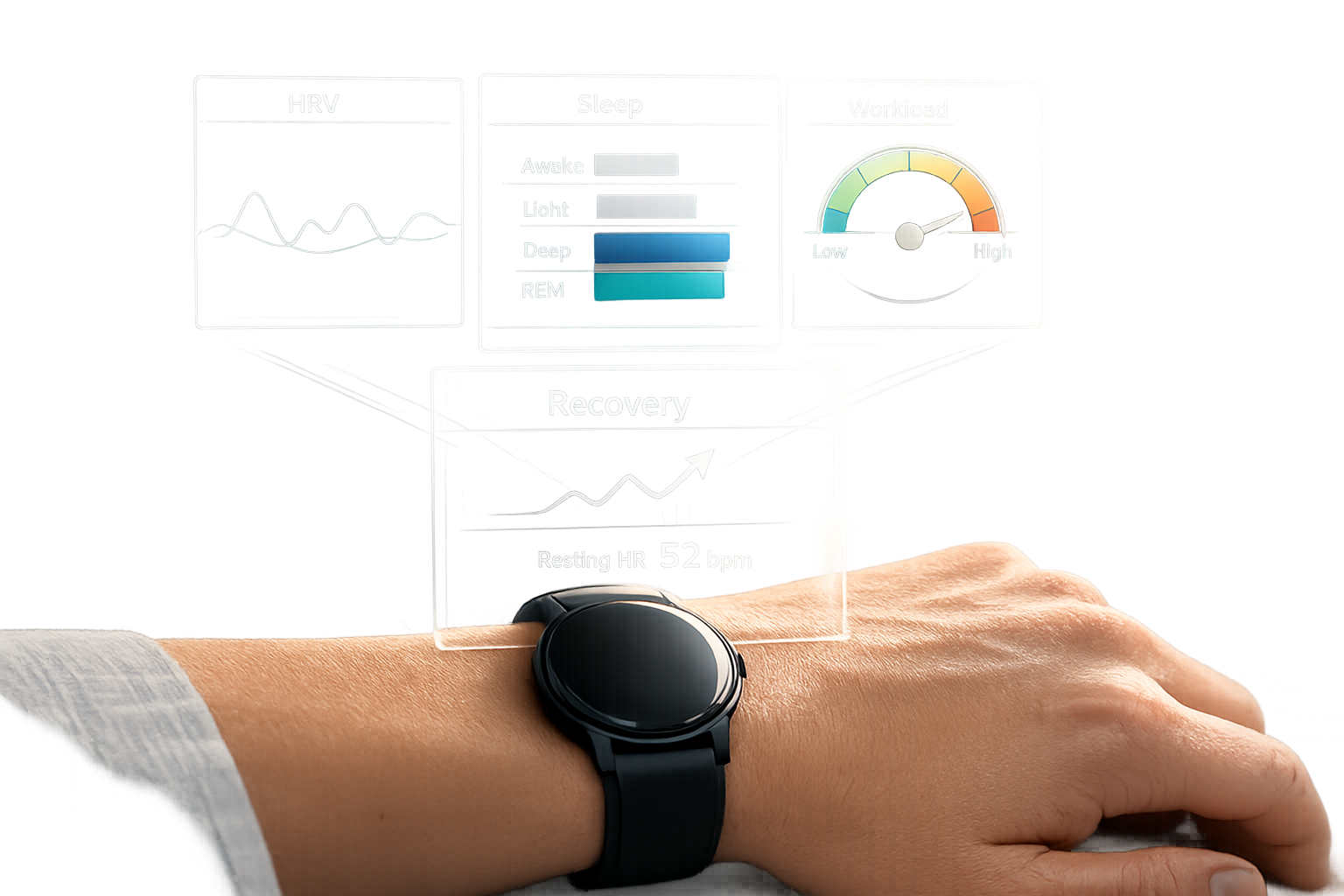
Wearable devices are transforming how people manage recovery and performance. Here's what you need to know:
- Recovery Tracking: Modern wearables monitor metrics like heart rate variability (HRV), resting heart rate (RHR), and sleep patterns to guide recovery decisions.
- Faster Recovery: Studies show daily wearable use improves sleep consistency by 4.6% and reduces resting heart rate by 3.77 bpm, leading to better recovery outcomes.
- Injury Prevention: Tools like the Acute-to-Chronic Workload Ratio (ACWR) help identify overtraining risks, reducing injury chances by up to 4x.
- Personalized Insights: Devices like the Polar Vantage V2 and Oura Ring provide tailored recovery data, helping users adjust training intensity based on their body's needs.
- Unified Data Platforms: Solutions like BondMCP integrate data from various wearables, offering a complete view of recovery metrics for smarter decisions.
Wearables are not just gadgets - they're tools for optimizing health, reducing injuries, and improving resilience.
Study Overview: How Researchers Tested Recovery Wearables
What These Studies Aimed to Measure
Researchers focused on two main areas: external workload (metrics like distance, speed, and acceleration tracked through GPS and accelerometers) and internal workload (factors such as heart rate, HRV, and SmO2) [2].
The primary goals were to shorten recovery time, reduce the risk of overuse injuries, and provide actionable performance insights. To achieve this, studies followed a structured approach. They began with a baseline training phase to establish normal metrics, moved into an overload phase to induce fatigue, and concluded with a recovery phase to observe how quickly the body returned to its normal state [1]. A key tool in these studies was the Acute-to-Chronic Workload Ratio (ACWR), which compares current workload to a four-week average. Researchers found that an ACWR above 1.5 could increase injury risk by 2 to 4 times [2].
"Monitoring nightly recovery can help in recognizing individual responses to training and assist in optimizing training prescriptions." - MDPI Sensors [1]
These methodologies guided the selection of wearable devices designed to capture relevant metrics.
Wearable Devices Used in the Research
To align with the study's goals, researchers selected wearables capable of collecting both raw data and processed insights. Each device was chosen based on its ability to measure specific metrics. For instance, the Polar Vantage V2 was used in a study conducted at the University of Jyväskylä in January 2025. This device monitored 24 recreational runners using its proprietary "ANS Charge" metric, which integrates heart rate, HRV, and breathing rate during sleep [1]. Meanwhile, the Oura Ring was featured in studies involving youth triathletes for its focus on readiness and sleep tracking. Additionally, Catapult PlayerTEK sensors were utilized during the 2019 fall season at Case Western Reserve University to track 28 NCAA Division III soccer players, leveraging tri-axial accelerometers for movement analysis [4].
Researchers divided the devices into three categories:
- Biometric Wearables: Focused on physiological data like HRV and sleep quality.
- Location-Based Wearables: Used to track movement patterns and assess injury risk.
- Performance Wearables: Measured metrics such as power output and speed [2].
This categorization ensured that the devices addressed the study's emphasis on recovery and injury prevention. Sleep-focused wearables were particularly important, as sleep provides a stable environment for collecting autonomic data [1]. Devices like Polar's "ANS Charge" and Oura's "Readiness Score" were valued for combining raw data with user-friendly metrics and custom dashboards, making it easier for athletes and coaches to interpret and act on the information.
The Science (and Myths) of Health Tech: VO2 Max, Wearables & Longevity with Dr. Todd Schroeder
Key Findings: How Wearables Affect Recovery Times
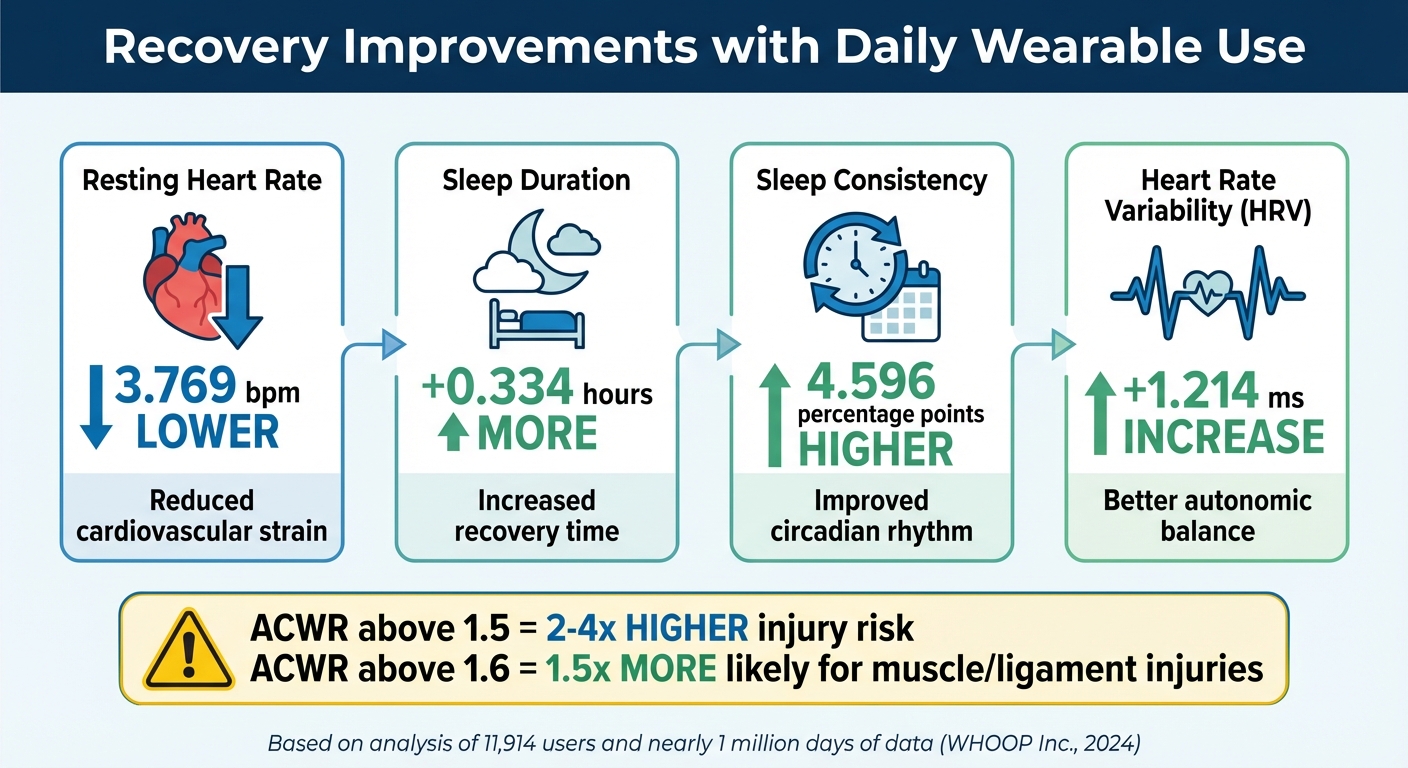
Impact of Daily Wearable Use on Recovery Metrics: Key Statistics
Faster Recovery Through Real-Time Monitoring
Recent research highlights that wearables offering real-time monitoring can significantly improve recovery rates. A study conducted in January 2025 by the University of Jyväskylä examined 24 recreational runners over six weeks using the Polar Vantage V2. The device's "ANS Charge" feature, which tracks heart rate, heart rate variability (HRV), and breathing rate during sleep, proved effective in predicting performance changes during periods of training overload[1].
"Monitoring nightly recovery can help in recognizing individual responses to training and assist in optimizing training prescriptions." – O.-P. Nuuttila, Faculty of Sport and Health Sciences, University of Jyväskylä[1]
A broader study by WHOOP Inc. analyzed nearly a million days of data from 11,914 users between January and November 2024. It found that users who wore their devices daily gained an extra 0.334 hours of sleep and achieved 4.596 percentage points higher sleep consistency compared to those using wearables less frequently. Daily wearers also showed a 3.769 bpm lower resting heart rate, a marker of improved cardiovascular recovery[5].
These findings underline how wearables not only speed up recovery but also improve overall biometric health.
Better Recovery Metrics Across the Board
Data from frequent wearable users reveal improvements in key recovery metrics. For example, users during high engagement periods experienced a 1.214 ms increase in HRV and a 3.769 bpm reduction in resting heart rate, both indicators of enhanced autonomic and cardiovascular recovery[5].
Sleep consistency has emerged as a particularly important factor. Rather than focusing solely on total sleep duration, maintaining regular sleep and wake times appears to have a stronger impact on recovery and overall well-being[5].
| Recovery Metric | Improvement with Daily Wear | Primary Indicator |
|---|---|---|
| Resting Heart Rate | 3.769 bpm lower | Reduced cardiovascular strain |
| Sleep Duration | 0.334 hours more | Increased recovery time |
| Sleep Consistency | 4.596 percentage points higher | Improved circadian rhythm stability |
| Heart Rate Variability | 1.214 ms increase | Better autonomic nervous system balance |
These metrics highlight how wearables can promote better physiological health while reducing the risk of overtraining or injury.
Lower Injury Risk During Recovery
Enhanced recovery metrics also translate into a lower risk of injury. Wearable technology helps manage training loads by calculating the Acute-to-Chronic Workload Ratio (ACWR), which compares an athlete's current workload to their four-week average. Research shows that an ACWR above 1.5 can double or quadruple the risk of injury in the following week[2]. Additionally, athletes with an ACWR exceeding 1.6 are 1.5 times more likely to suffer myotendinous or ligament injuries[4].
For example, during the 2019 fall season, Case Western Reserve University tracked 28 NCAA Division III male soccer players using Catapult PlayerTEK sensors. The data revealed that match workloads (432.9 ± 47.7) were nearly double the training workloads (252.9 ± 23.3). Coaches identified week 8 as a high-stress period and adjusted training to prevent overuse injuries[4].
In youth elite soccer, players who logged over 9,254 accelerations within three weeks faced a 5.11 times higher risk of non-contact injuries. This underscores the importance of leveraging wearable data for early intervention and injury prevention[2].
sbb-itb-f5765c6
What This Means for Health Optimization
Building on earlier research, let's dive into how wearable technology is shaping personalized recovery strategies and long-term fitness planning.
Creating Custom Recovery Plans
Wearable devices are changing the game for recovery by offering data-driven, individualized strategies. Recovery isn't one-size-fits-all - research from the University of Jyväskylä highlights how metrics like Heart Rate Variability (HRV) and Autonomic Nervous System (ANS) charge reveal significant differences in how individuals recover from identical workloads [1]. This means generic recovery protocols are becoming a thing of the past.
By monitoring both physiological and objective metrics, wearables help fine-tune training intensity. For example, if a device flags a low ANS charge or issues a "nightly recharge" alert, it’s a clear sign to scale back on intensity or postpone high-effort sessions to avoid overreaching [1][2]. This proactive approach is further enhanced by AI tools for cognitive stress recovery that provide real-time support for mental well-being.
The key to effective recovery tracking lies in using 7-day rolling averages rather than relying on single-day data [1]. This method smooths out daily variations, offering a more accurate picture of recovery status. For instance, if your weekly HRV average is trending downward despite good sleep, it could signal accumulated fatigue that needs addressing.
These individualized recovery plans not only improve short-term performance but also create a foundation for long-term fitness and well-being.
Connecting Recovery to Fitness and Longevity Goals
Recovery isn't just about bouncing back from a tough workout - it’s a cornerstone of long-term health and performance. Wearables bridge the gap between daily recovery decisions and broader goals, such as maintaining peak performance, preventing injuries, and promoting personalized longevity.
The concept of "marginal gains" perfectly illustrates this connection. British Cycling Coach Dave Brailsford once said:
"It might not seem much, but if a cyclist can save one second every lap, it can make all the difference." [3]
Small, consistent improvements - whether in sleep quality, HRV, or movement efficiency - can add up to significant benefits over time.
Recovery data also plays a critical role in managing training loads for sustained progress. Tools like the Acute-to-Chronic Workload Ratio (ACWR) serve as an early warning system. Athletes with an ACWR above 1.6 are 1.5 times more likely to suffer myotendinous or ligament injuries [4]. By keeping weekly training increases below 1.5 times the chronic average, wearables help reduce injury risks, ensuring steady, long-term progress in fitness and health.
BondMCP: Connecting Wearable Data for Better Recovery

Wearable devices churn out a wealth of recovery-related data, but much of it stays locked within individual apps. By 2024, more than half of the population in many countries will own a wearable device. However, these devices often rely on proprietary systems that don't communicate with one another, leaving recovery insights fragmented and incomplete [6].
Bringing Wearable Data Together
BondMCP tackles this issue head-on by merging data from various sources into a single, cohesive platform. It integrates information from major players like Garmin, Apple Health, Polar, Oura, WHOOP, and others, offering users a unified view of their recovery metrics [8].
What sets BondMCP apart is its ability to combine external workload metrics - such as distance and velocity - with internal responses like heart rate, heart rate variability (HRV), and muscle oxygen saturation. This creates a more detailed picture of recovery needs [2][7]. Considering that 86% of wearable health scores already rely heavily on heart rate and HRV, this integration is a game-changer [6].
AI-Powered Recovery Recommendations
With all this data in one place, BondMCP’s AI agents provide tailored recovery insights. The platform calculates your autonomic nervous system (ANS) charge by analyzing heart rate, HRV, and breathing rate, offering a clear view of how your body responds to training stress [1]. It also tracks your Acute-to-Chronic Workload Ratio (ACWR), flagging when your training intensity surpasses your fitness baseline. Research shows that athletes with an ACWR above 1.5 are 2 to 4 times more likely to sustain an injury within a week [2].
Conclusion
Recent research highlights how wearables are reshaping recovery strategies. Metrics like heart rate variability, resting heart rate, and workload ratios consistently outperform subjective measures in predicting recovery and performance. For instance, a study analyzing nearly one million days of data found that daily wearable use is linked to a 3.77 bpm lower resting heart rate and an 11.4% improvement in sleep consistency. These changes not only reduce cardiovascular risks but also promote overall health [5].
However, raw data on its own doesn’t tell the full story. The real power lies in combining insights from multiple sources. Take collegiate soccer as an example: match workloads are 1.5 to 1.8 times greater than training loads [4], and athletes with an acute-to-chronic workload ratio above 1.6 are at a 1.5x higher risk of injury [2]. By integrating these metrics into a unified framework, wearables can help optimize recovery and reduce risks.
This is where BondMCP steps in, offering a solution that consolidates data from devices like Garmin, Apple Health, Oura, and WHOOP into a single, intelligent system using the Model Context Protocol. Instead of switching between apps, you gain AI-driven insights that link your recovery metrics with training intensity, sleep patterns, and long-term health goals. Wearable data becomes actionable when it’s part of a connected system designed to enhance both health and performance.
FAQs
How can wearables help speed up recovery after workouts?
Wearables play a crucial role in speeding up recovery by monitoring essential metrics such as sleep quality, heart rate variability (HRV), and training load. These devices provide users with detailed insights, helping them tailor their routines to ensure they get the right balance of rest and activity.
Research has shown that wearables are highly effective in tracking recovery. They deliver actionable data that can help prevent overtraining, improve sleep patterns, and adjust workout intensity. With this information, individuals can align their recovery plans more closely with their fitness targets, cutting down recovery times and boosting overall performance.
What is the Acute-to-Chronic Workload Ratio, and why does it matter?
The Acute-to-Chronic Workload Ratio (ACWR) is a metric used to compare short-term (acute) training load with long-term (chronic) training load. It’s a tool that helps gauge whether an athlete’s training workload is balanced, potentially flagging risks of overtraining or injury.
Keeping the ACWR within a healthy range can lower the chances of injuries and support better performance. It offers critical insights for adjusting training programs, promoting recovery, and maintaining steady progress in fitness or sports activities.
How does BondMCP connect and unify data from different wearables?
BondMCP serves as a central hub that brings together data from different wearables like fitness trackers, sleep monitors, and health sensors. By enabling these devices to interact, it creates a unified system where all your health data is combined into a single, easy-to-understand view.
This streamlined approach not only provides tailored insights but also ensures your wearables collaborate to boost recovery, performance, and overall well-being. BondMCP takes the hassle out of juggling fragmented data, making it simpler to monitor and improve your health without extra effort.