
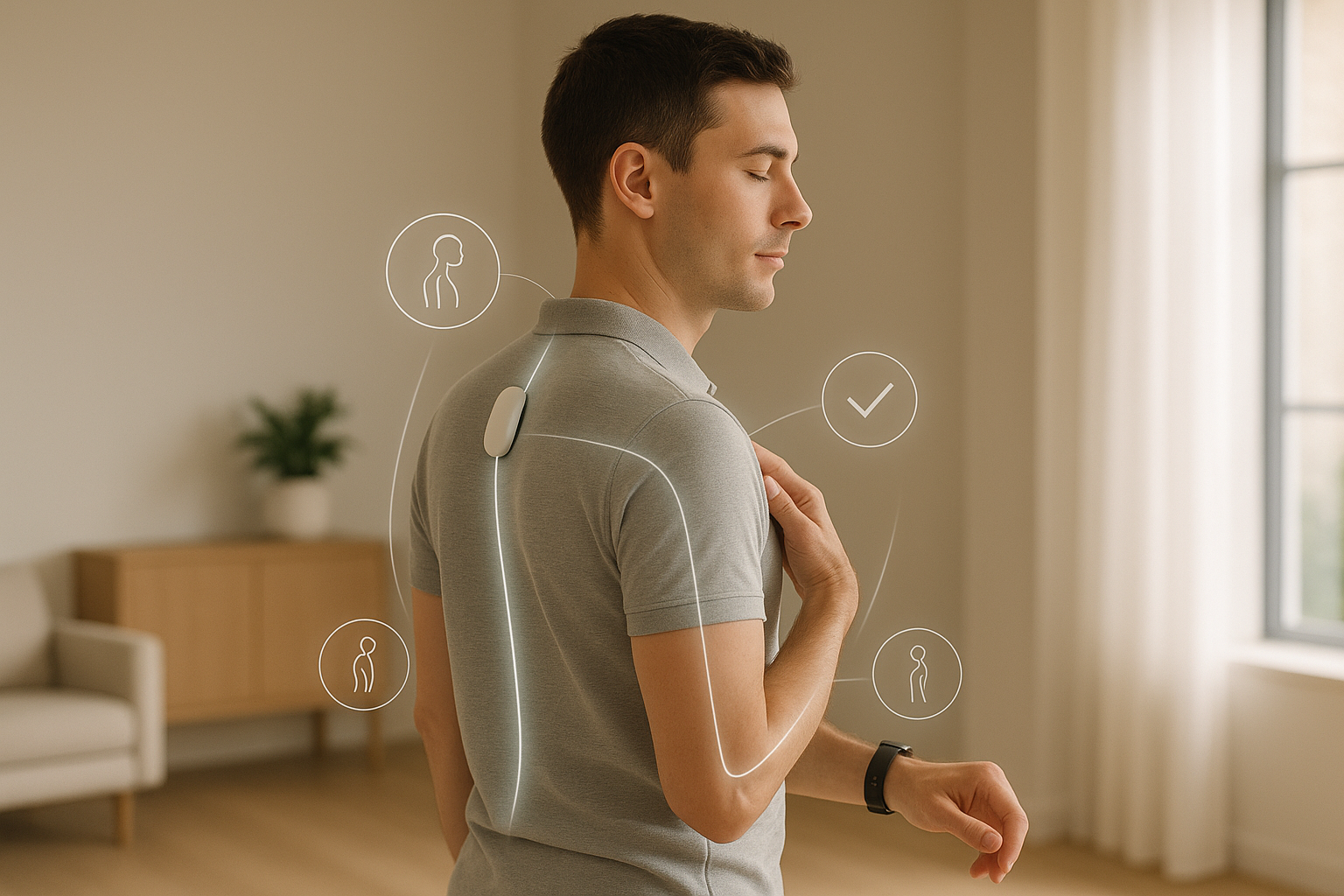
Poor posture is a leading cause of musculoskeletal disorders (MSDs), accounting for 30% of workplace injuries in the U.S. Real-time posture analysis offers a way to address this issue by continuously monitoring body alignment using wearable sensors or computer vision. These systems provide instant feedback - like vibrations or app alerts - when posture deviates, helping users correct their alignment before strain leads to chronic pain.
Here’s how it works:
- Wearable Sensors: Devices use accelerometers, gyroscopes, and magnetometers to track spinal movements in 3D.
- Data Processing: Sensor fusion algorithms analyze posture and detect risky movements. This technology mirrors real-time biomarker monitoring used to track internal health changes.
- Feedback: Alerts via vibration, visual cues, or audio help users make immediate adjustments.
- Applications: Office workers, manual laborers, athletes, and clinicians can use these tools to improve posture and reduce injury risks.
Two main types of devices are available:
- IMU-Based Wearable Garments: Provide detailed 3D motion data but require proper fit and calibration.
- Discrete Wearable Devices: Compact, affordable, and ideal for everyday use, though less detailed.
When integrated with broader health metrics - like sleep, activity, and recovery - posture data becomes a powerful tool for preventing injuries and improving movement habits. Systems like BondMCP streamline this integration, creating a unified health ecosystem.
Real-time posture analysis is transforming how we approach spinal health, offering continuous insights to improve well-being and productivity.
How AI-Powered Pose Estimation is Transforming Healthcare | Real-Time Form & Posture Correction
Core Technologies Behind Real-Time Posture Analysis
Real-time posture analysis relies on a combination of sensors, algorithms, and feedback systems to monitor spinal movements and provide alerts when your posture needs adjustment. Let’s break down how each component works to deliver timely corrections.
How Inertial Measurement Units (IMUs) Work
Most posture wearables use an Inertial Measurement Unit (IMU) to track three-dimensional movements. These units typically combine three types of sensors: accelerometers, gyroscopes, and sometimes magnetometers.
- Accelerometers measure linear acceleration, including gravity. For example, when you lean forward at your desk, the accelerometer on your upper back detects changes in the gravity vector, allowing the system to calculate your trunk inclination - a key slouching indicator.
- Gyroscopes track rotational speed. If you twist to grab something or bend to lift an object, the gyroscope captures these rotational movements.
- Magnetometers detect the Earth's magnetic field, providing a fixed directional reference. This helps correct the drift that gyroscopes can develop over time, ensuring long-term accuracy.
In commercial wearables, these sensors operate at frequencies between 50–200 Hz. Accelerometers typically measure ranges from ±2 g to ±8 g, while gyroscopes handle rotational speeds from ±250°/s to ±2000°/s, depending on the application. For instance, the SPoMo system uses two 6-axis IMUs (each with a 3-axis accelerometer and gyroscope) placed on the upper and lower back. Validation studies for SPoMo showed impressive accuracy, with a mean square error of just 0.001 to 0.05 for spinal angle estimations during sitting [1].
Sensor Fusion and Data Processing
No single sensor is flawless, but combining their data creates a more reliable estimate of posture. Each sensor has its strengths and weaknesses:
- Accelerometers provide stable, long-term orientation data but may confuse gravity with actual movement during dynamic activities.
- Gyroscopes are great for short-term responsiveness but tend to drift over time.
- Magnetometers offer an absolute heading reference but can be disrupted by nearby metals or electronics.
Sensor fusion algorithms overcome these challenges by blending data from all sensors for a more accurate and stable orientation estimate. Common techniques include:
- Complementary filters, which merge low-pass filtered accelerometer and magnetometer data with high-pass filtered gyroscope data.
- Kalman filters, which account for sensor noise and system dynamics for precise measurements.
Once the system calculates the 3D orientation of each body segment, biomechanical models are applied to derive meaningful posture metrics. For example, comparing the pitch of sensors on the pelvis and upper back can indicate trunk flexion, while yaw and roll differences reveal twisting or lateral bending.
These calculations are typically handled by embedded processors in the wearable device or a connected smartphone, often with processing times under 100 milliseconds. The system then compares joint angles to ergonomic thresholds to determine if your posture is safe. For instance, trunk flexion angles between 30° and 60° during lifting tasks may be flagged as risky, while neck flexion beyond 20° to 30° could trigger alerts for office workers. Some systems rely on simple rules, like flagging trunk flexion over 45° sustained for more than 5 seconds, while others use machine learning models trained on labeled posture data.
Real-Time Feedback Mechanisms
Detecting poor posture is just the first step - effective feedback is crucial for encouraging realignment. Most posture wearables use three main feedback channels: haptic, visual, and auditory.
- Haptic feedback is the most common. A small vibration motor in the wearable buzzes gently against your skin if you maintain a risky posture for a set time, such as 30 seconds. This subtle alert grabs your attention without being disruptive.
- Visual feedback is usually provided through companion apps on smartphones or desktops. These apps might show your current joint angles, a stick-figure representation of your posture, or color-coded indicators (green for good posture, yellow for caution, and red for risky posture). These visuals help you understand why an alert was issued and how to adjust your alignment.
- Auditory feedback, such as beeps or voice prompts, is less common due to its potential to disrupt social or professional settings. However, it can be useful in industrial environments or training sessions where noise is already controlled.
To ensure the feedback feels immediate and relevant, the system must keep latency under 200 milliseconds, so the alert is clearly linked to your movement. Equally important is the accuracy of these alerts - minimizing false positives and negatives prevents alert fatigue and helps maintain user trust.
The Data Processing Workflow
Posture wearables transform raw sensor signals into meaningful feedback through a streamlined data pipeline. Each step builds on the last, converting noisy signals into corrective alerts in less than a second.
Data Acquisition and Preprocessing
Data collection begins as soon as you put on the device. IMUs (inertial measurement units) sample data at rates fast enough to capture natural movements while optimizing power use and wireless data transfer.
The placement of these sensors is key to accurate posture tracking. Most devices position IMUs on the upper back (near the T1–T4 vertebrae) to monitor slouching and thoracic flexion, and on the lower back (L3–L5 or sacrum) to detect trunk bending, twisting, and lateral movements that can strain the lower back. Additional sensors on the shoulders, thighs, or upper arms can provide a more complete view of body alignment across multiple areas.
Before analysis begins, the system calibrates itself to your neutral posture. This usually involves standing upright for a few seconds so the device can establish a zero-angle reference for key joints. Some systems also guide you through movements like bending or rotating to fine-tune sensor alignment. This calibration minimizes drift and adjusts for individual differences in how the device is worn.
Once data is collected, preprocessing cleans up the raw signals. Time synchronization aligns IMU readings for accurate angle calculations. Low-pass Butterworth filters (2nd–4th order; 5–20 Hz) smooth out sensor noise, while high-pass filters correct gyroscope drift.
Sensor fusion then combines data from accelerometers and gyroscopes (and sometimes magnetometers) using complementary or Kalman filters. Accelerometers provide stable orientation data over time, while gyroscopes capture rapid changes. Together, these inputs create reliable 3D orientation estimates for each body segment. This cleaned and synchronized data lays the groundwork for extracting posture insights.
Feature Extraction and Pattern Recognition
With clean orientation data, the system identifies features that describe your posture in practical terms. These features typically fall into a few key categories:
- Static posture metrics: Average joint angles over short periods, along with measures like standard deviation or the percentage of time spent exceeding certain thresholds (e.g., more than 20° or 45° of forward bend).
- Dynamic movement metrics: Angular velocity, acceleration, peak flexion angles, range of motion, and the rate of transitions between postures.
- Temporal features: Duration of sustained postures, frequency of posture changes, and cumulative time spent in non-neutral alignments.
- Composite ergonomic features: Combined angles (like trunk flexion plus rotation) or asymmetry indices comparing the left and right sides.
Machine learning models, such as LSTM networks, analyze short sliding windows (2–5 seconds) of these features to classify postures like standing neutrally, stooping, squatting, lifting, or prolonged slouching while seated. Simpler models like decision trees or random forests may use handcrafted features to distinguish between good and poor posture. These models are trained on labeled datasets provided by experts, enabling them to adapt to different users and tasks. The extracted features then guide risk evaluations and trigger corrective feedback.
Risk Assessment and Feedback Triggers
Risk assessment translates posture classifications and exposure metrics into standardized risk levels based on ergonomic guidelines. Many systems use categories inspired by tools like RULA or REBA. For instance, trunk flexion might be classified as low risk (0–20°), moderate risk (20–60°), or high risk (greater than 60°). By combining these angle ranges with data on movement frequency and duration, the system generates a composite score reflecting cumulative strain on the body.
Duration thresholds set by experts are crucial. For example, the system might flag a posture as high risk if a trunk flexion of more than 45° is held for too long. These metrics can be summarized into simple categories - like low, moderate, or high risk - or expressed as percentages (e.g., "time in safe posture").
Feedback systems aim to balance responsiveness with user comfort. Alerts, such as vibrations or app notifications, are typically triggered only when a risky posture persists beyond a set duration, reducing false alarms from brief, harmless movements. Feedback is delivered quickly - within 200 to 500 milliseconds - so you can adjust your posture in real time. This speed is achieved through efficient on-device or edge processing.
In addition to real-time alerts, many systems provide summaries and dashboards that track daily or weekly trends, such as time spent in risky postures or improvements over time. Some even integrate posture data with broader health metrics via platforms like BondMCP, offering a more comprehensive view of overall wellness.
sbb-itb-f5765c6
Types of Posture Analysis Wearables
Posture wearables generally fall into two main categories. Whether you’re looking for a subtle nudge to maintain good posture at your desk or detailed biomechanical data for professional assessments, understanding these options can help you make an informed choice. Let’s break down how each type works and what they’re best suited for, followed by a side-by-side comparison.
IMU-Based Wearable Garments
IMU-based garments incorporate multiple inertial measurement units directly into clothing like smart vests, shirts, belts, or straps. These sensors are strategically placed along the spine - and sometimes on the shoulders, hips, or limbs - to provide a comprehensive view of your posture. For example, a smart vest can track bending, twisting, and tilting movements, offering three-dimensional motion analysis. This setup not only detects slouching but also measures the degree of trunk flexion, rotation, or lateral leaning.
These garments are particularly useful in clinical settings, workplace ergonomics evaluations, and sports performance analysis. Professional-grade systems often feature multiple sensors to collect the detailed data required for these applications.
However, this level of precision comes with some trade-offs. Proper sizing is crucial to ensure the sensors are correctly aligned, and users must perform specific calibration movements to get accurate readings. Additionally, these garments can feel warmer than regular clothing and require careful washing to protect the embedded electronics. They’re also on the pricier side, with costs ranging from a few hundred to several thousand dollars - making them more suitable for clinics, researchers, or specialized occupational use. A 2024 review of workplace posture wearables highlighted that inertial sensors dominate this category, thanks to their ability to capture continuous, three-dimensional motion data during real-world tasks [2].
Discrete Wearable Devices
Discrete posture devices take a simpler approach. These compact, standalone sensors - roughly the size of a matchbox - can clip onto clothing, stick to the upper back, or attach with a strap. With a single IMU, they monitor the angle of your trunk or neck relative to an upright position.
Once clipped on and calibrated using a companion app, these devices provide real-time feedback. If you slouch beyond a preset threshold, they deliver a gentle vibration to remind you to straighten up.
These devices shine in settings like offices, home workstations, or light industrial environments. Their small size allows for discreet wear under clothing, and many models boast several days of battery life. Companion apps often translate sensor data into easy-to-understand metrics, such as the percentage of time spent in good posture or the number of slouching incidents. Some even use machine learning to customize feedback based on your posture habits.
While effective for promoting posture awareness, their single-sensor design has limitations. For instance, a device focused on the upper back won’t capture lumbar flexion, hip angles, or side-to-side imbalances. Still, for those aiming to build better posture habits with minimal hassle, these devices are an affordable option, typically costing between $60 and $150 in the U.S.
Comparison of Wearable Types
Choosing between IMU-based garments and discrete devices depends on your goals, budget, and environment. Here’s a quick comparison of their key features:
| Feature | IMU-Based Wearable Garments | Discrete Wearable Devices |
|---|---|---|
| Sensor Count | Multiple sensors across spine and limbs | Single sensor |
| Measurement Detail | 3D spinal angles and segmental motion | Basic trunk or neck angles |
| Accuracy | High precision for clinical and research use | Moderate for everyday tracking |
| Use Cases | Clinical, ergonomic, and sports assessments | Office work, daily posture reminders |
| Setup Complexity | Requires proper fit and calibration | Quick setup via app |
| Comfort | Can feel warmer and bulkier | Lightweight and discreet |
| Data Output | Detailed, exportable data | Simple metrics and alerts |
| Price Range (U.S.) | $200–$3,000+ | $60–$150 |
| Maintenance | Specialized care for laundering | Basic cleaning and charging |
| Scalability | Best for clinics or enterprises | Perfect for individuals and small teams |
For office workers or anyone aiming to improve posture habits, discrete devices strike a good balance between ease of use, comfort, and affordability. On the other hand, professionals like physical therapists, ergonomists, and sports coaches often prefer IMU-based garments for their detailed data and comprehensive analysis.
Both types of wearables now commonly sync with cloud platforms and mobile apps. These integrations allow posture metrics to be combined with other health data, like activity levels, sleep patterns, or heart rate variability. For example, BondMCP connects posture data with fitness, lab results, and recovery metrics, offering a unified approach to health tracking.
Posture Data in a Complete Health Ecosystem
Integrating posture monitoring into a broader health system can significantly enhance its usefulness. When combined with other health metrics, posture data provides actionable insights to help prevent injuries, improve workouts, and promote overall well-being.
Combining Posture Data with Other Biometrics
Pairing posture data with additional health metrics - like sleep quality, training load, or heart rate variability - transforms raw data into practical guidance. For example, office workers tracking forward-head posture alongside sedentary time can uncover patterns contributing to discomfort. Similarly, athletes who notice spinal rounding during heavy lifts, combined with a drop in heart rate variability, might receive clear signals to scale back their workload to avoid injury.
For manual laborers, monitoring trunk flexion and twisting along with workload metrics - such as tasks per shift - can pinpoint high-risk periods. If deep trunk flexion repeatedly occurs late in a shift when heart rate is elevated, the system flags the situation as a potential musculoskeletal injury risk and recommends task rotation.
Work-related musculoskeletal disorders often arise from the interplay between mechanical load, posture quality, and recovery. By correlating posture deviations with pain reports, sleep data, and stress markers, systems can differentiate between fatigue-induced form breakdown and genuine ergonomic issues, enabling precise interventions.
Sleep data adds another layer of insight. If poor sleep leads to more time spent in risky spinal positions during daily activities, it suggests that inadequate recovery is affecting movement control. This creates a feedback loop that connects rest quality with physical performance.
| Biometric Combination | What It Reveals |
|---|---|
| Posture + Activity (steps, workout volume) | Links time in risky postures with workload, helping identify overuse patterns and fine-tune training or ergonomics. |
| Posture + Heart Rate/HRV | Highlights how stress and fatigue affect technique, guiding rest periods and adjustments. |
| Posture + Sleep Quality | Shows how poor sleep impacts postural control, encouraging recovery when form declines. |
| Posture + Pain/Function Scores | Tracks how posture interventions or ergonomic adjustments influence pain and function over time. |
| Posture + Environmental Context (time of day, workstation) | Pinpoints high-risk situations, supporting targeted ergonomic redesigns or training. |
To make these connections seamless, a unified integration system is key.
Using BondMCP for System Integration

One major hurdle in combining posture data with other health metrics is the lack of communication between devices and apps. Your posture tracker might store data in one app, your sleep tracker in another, and your workout log in yet another - making manual integration tedious and prone to errors.
BondMCP simplifies this by acting as an intelligent integration layer. Instead of requiring custom connections for each device or app, BondMCP uses a structured protocol and SDK to standardize data from various sources, including posture metrics, sleep data, training logs, and lab results.
For instance, your posture wearable streams data into BondMCP, which organizes it using a health-specific framework. This unified approach allows AI systems within your health ecosystem to access and act on the data - whether that means reducing heavy lifting when lumbar strain is detected or identifying ergonomic issues across users.
Beyond data organization, BondMCP enhances personalization. By tracking long-term metrics like posture, training, and sleep, it enables AI systems to learn your individual patterns. Over time, these systems adjust thresholds and recommendations to fit your specific needs, offering proactive suggestions such as taking breaks, lightening training loads, or implementing targeted interventions.
Applications in Training and Recovery
Integrating posture data into a comprehensive health system supports continuous performance improvement and injury prevention. During strength training, sensors detecting spinal rounding, knee valgus, or improper shoulder alignment - combined with data on bar speed, reps, and heart rate - can trigger automatic adjustments in load or suggest alternative exercises when form deteriorates.
For runners and field-sport athletes, analyzing trunk lean, pelvic tilt, and limb alignment alongside pace, ground-contact time, and perceived exertion can reveal when technique begins to falter. This allows for immediate modifications to training intensity or the inclusion of technique-focused drills.
Long-term tracking offers valuable insights into progress. For example, maintaining better lumbar control at a given squat load compared to earlier sessions signals technical improvement. This information helps plan recovery periods, such as deload weeks or targeted training blocks, ensuring strength gains while managing fatigue effectively.
Posture data also sharpens recovery strategies. By monitoring awkward postures alongside soreness, heart rate variability, sleep quality, and workload, systems can detect early signs of potential injuries. Personalized recovery plans might then include specific mobility or strengthening exercises, adjustments to work or training routines, or changes to sleep and stress-management habits - promoting long-term musculoskeletal health.
Conclusion
Real-time posture analysis has come a long way, evolving from specialized lab equipment to wearable devices that can monitor and adjust posture throughout the day. These devices use advanced sensors to track body movements, classify them as safe or risky, and provide continuous feedback - whether you're sitting at a desk, working in a warehouse, or exercising at the gym.
The biofeedback provided by these tools is a game-changer for posture correction. Through vibrations, app notifications, or visual prompts, users are reminded to adjust their posture when slouching or unsafe movements are detected. For office workers, this means fewer hours hunched over a laptop, while manual laborers can avoid repetitive, hazardous lifting positions. In fitness and rehab settings, these devices enable precise coaching, reducing overuse injuries and improving performance.
Different devices cater to different needs. Some are designed for high-level monitoring in clinical or athletic environments, while others are built for everyday office use. When choosing a device, it's important to look for validated accuracy and real-time feedback that fits your lifestyle. Products that integrate with platforms like BondMCP add even more value, allowing posture insights to inform training routines, ergonomic improvements, and clinical care instead of being isolated data points.
The real power of posture devices lies in their integration within a broader health system. Tools like BondMCP - Health Model Context Protocol - act as a bridge, connecting posture wearables with other health technologies like sleep trackers, training apps, and recovery tools. For instance, if posture data reveals prolonged bending or heavy lifting during the workday, BondMCP can recommend lower-back exercises, adjust recovery protocols, or modify training plans for the following day - all without switching between multiple apps. This integration transforms posture monitoring into a seamless part of a larger, AI-driven health system, offering users personalized insights while improving scalability for clinics and employers.
While many posture wearables have shown strong accuracy in controlled studies, there’s still work to be done. Research into long-term use, comfort, adherence, and real-world effectiveness is ongoing. Challenges like sensor drift, battery limitations, placement errors, and user acceptance remain critical areas for improvement.
For individuals in the U.S. who are prioritizing longevity, productivity, and proactive health, posture offers a valuable window into daily spinal and musculoskeletal stress. When paired with a protocol like BondMCP, posture data can guide decisions on training intensity, work-rest balance, mobility exercises, and fatigue management. Instead of reacting to back pain, users can take a proactive approach to optimize movement patterns across work, exercise, and recovery.
As technology continues to advance, real-time posture analysis is poised to become a standard part of everyday health systems. Integrated with AI, these tools will help create personalized interventions automatically, making healthier movement second nature rather than an afterthought.
FAQs
How do real-time posture analysis systems work with other health data to enhance overall wellness?
Real-time posture analysis systems tap into cutting-edge technology to link posture data with various health metrics, offering a more comprehensive view of your overall well-being. By combining information from wearables, lab results, sleep habits, nutrition, and physical activity, these systems deliver tailored insights and actionable recommendations.
Platforms like BondMCP make this integration effortless by ensuring all your health data communicates seamlessly in real time. This means your posture data doesn't just stand alone - it can help fine-tune your workout plan, enhance your sleep quality, and contribute to creating a more balanced and healthier lifestyle.
What’s the difference between IMU-based wearable garments and discrete wearable devices for posture analysis?
IMU-based wearable garments and discrete wearable devices both use sensors to monitor posture, but they come with distinct designs and purposes. IMU-based wearable garments incorporate sensors like accelerometers and gyroscopes directly into the fabric, seamlessly blending technology with clothing. This setup enables full-body posture tracking, making them a great option for activities that demand precise motion analysis, such as athletic training or physical rehabilitation.
In contrast, discrete wearable devices are standalone gadgets, such as clips or bands, that attach to specific body parts, like the back or shoulders. These devices are compact and easy to use, but their tracking is limited to the area they’re placed on, providing less comprehensive data compared to garments.
Choosing between the two depends on your priorities - garments are better for detailed, full-body insights, while discrete devices are more practical for monitoring specific areas.
How does sensor fusion improve the accuracy of real-time posture tracking?
Sensor fusion improves real-time posture tracking by merging data from various sensors like accelerometers, gyroscopes, and magnetometers. By combining these inputs, the system creates a clearer and more precise picture of your posture, minimizing errors that could occur if relying on just one type of sensor.
This approach enables wearable devices to pick up on even the smallest shifts and adjustments in your alignment, delivering accurate feedback. The outcome? A dependable posture analysis that can help refine your form, reduce the risk of injuries, and support your overall health objectives.