
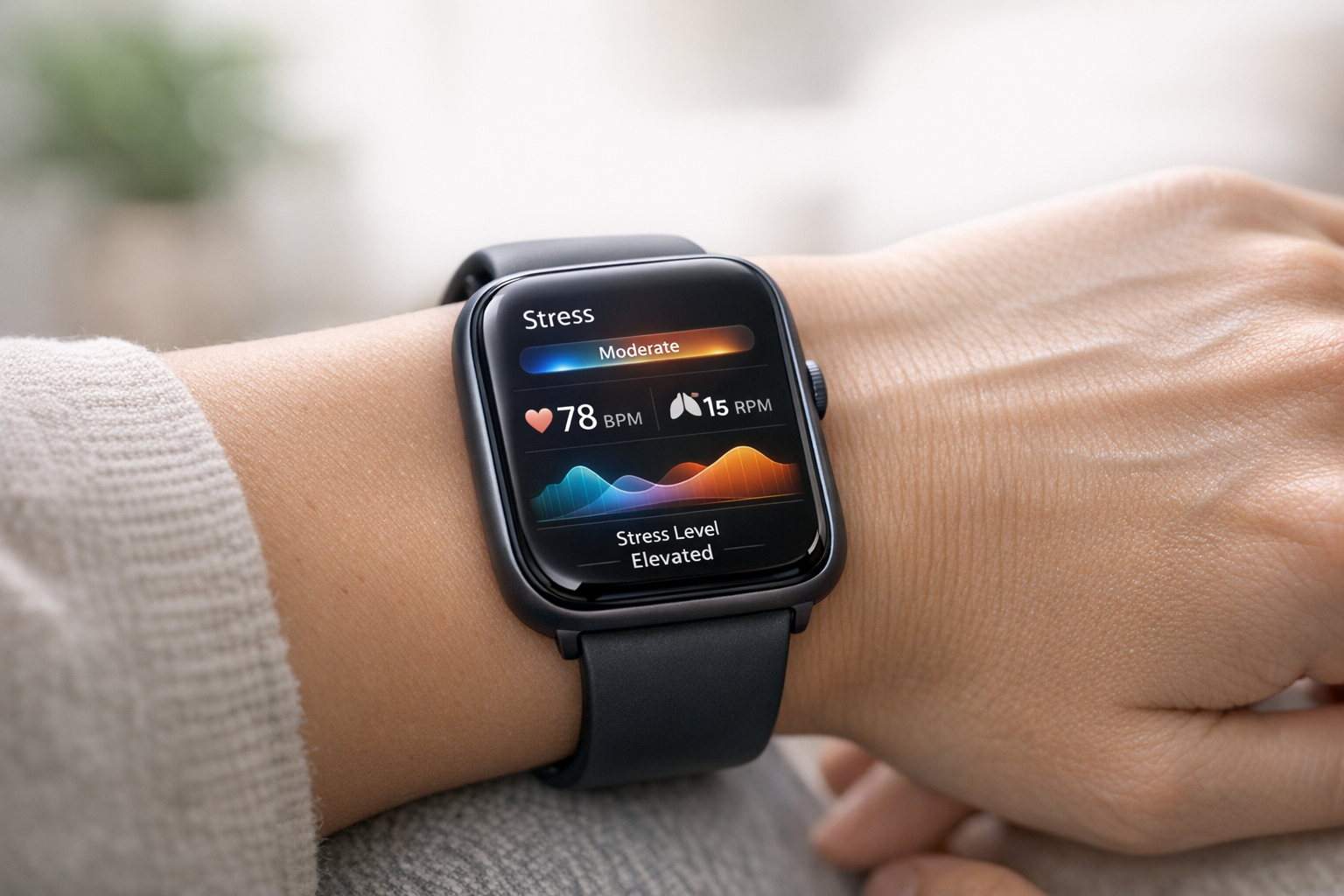
AI-powered stress tracking is changing how we manage stress by combining wearable sensors and machine learning to monitor your body's signals through the Model Context Protocol in health optimization like heart rate variability (HRV), skin temperature, and electrodermal activity (EDA). This technology identifies stress in real time, provides personalized baselines, and offers interventions like guided breathing or mindfulness exercises. With around 90% accuracy, it can even distinguish between physical and emotional stress, making it easier to respond effectively.
Key Takeaways:
- How It Works: AI uses data from wearables to track stress through HRV, EDA, and other metrics.
- Personalized Insights: Systems establish personalized baselines tailored to your body over 14–30 days.
- Real-Time Actions: Alerts and recommendations (e.g., breathing exercises) are triggered when stress is detected.
- Advanced Tools: Devices like Fitbit Sense 2 and WHOOP integrate multiple metrics for precise stress monitoring.
- Challenges: Requires consistent use for calibration and raises privacy concerns, but encryption and safeguards are in place.
AI stress tracking is making stress management more efficient by turning physiological data into actionable insights, helping you address stress before it becomes a bigger issue.
How AI Detects Stress in Real Time
Data Sources for Stress Detection
AI stress monitoring pulls information from a variety of sources to get a detailed understanding of your stress levels. The foundation lies in physiological biometrics like heart rate variability (HRV), resting heart rate, respiratory rate, and blood pressure. These metrics, combined with respiratory and blood pressure data, help AI establish personalized baselines and identify changes connected to your body's "fight-or-flight" response [9][10][12].
In addition to these core metrics, AI systems now incorporate biochemical markers from lab tests. Key indicators like cortisol (the primary stress hormone), epinephrine, and glucose levels provide insights into "allostatic load", which refers to the cumulative impact of stress on your body over time [12][13]. Devices like the Oura Ring monitor over 20 biometrics through a single finger, while platforms like WHOOP integrate these readings with blood biomarker data for a more complete health snapshot [11][13].
Another critical layer comes from behavioral signals. Smartphones, for instance, track "digital biomarkers" such as how you type - measuring the force and duration of each keystroke. AI can even analyze click patterns and where your eyes linger during screen use to assess cognitive stress [5]. Some systems go further, using Bluetooth to monitor social interactions, gauging stress and loneliness based on proximity to others [5]. Audio sensors pick up on vocal tone and speech patterns, while accelerometers and GPS data help differentiate physical exertion from emotional stress by providing context about your movements and location [5][13].
By combining these diverse inputs, AI systems can identify patterns and anomalies with impressive accuracy.
AI Processing and Pattern Recognition
Once the data is collected, AI relies on advanced algorithms to decode stress signals. First, the system establishes a personalized baseline - typically calibrated over 30 days - to reflect individual stress tolerance and variations [9][12]. This creates a unique "stress fingerprint" by analyzing patterns over time.
AI is particularly skilled at integrating multiple data streams. By combining signals like heart rate, electrodermal activity (EDA), and facial expressions, algorithms can distinguish stress from other high-arousal states, such as excitement [14]. For example, in July 2025, researchers at South-Central MINZU University used the WESAD dataset to analyze data from 15 participants. They transformed inputs like blood volume pulse (BVP), ECG, EDA, and three-axis acceleration into RGB images for deep learning. Their model achieved a 91.67% F1-score, with acceleration data playing a key role in separating physical activity from emotional stress [17].
Different neural network architectures handle specific types of data. Convolutional Neural Networks (CNNs) process spatial data like facial micro-expressions, while Recurrent Neural Networks (RNNs) and LSTMs are better suited for time-series data, such as HRV changes over time [14][16]. Capsule Networks (CapsNets) have further improved accuracy, achieving 99.82% on the WESAD dataset for binary stress classification, outperforming traditional CNNs [15]. For instance, a sudden drop in typing speed - from 40 words per minute to 20 - could indicate mental strain, which AI flags as a deviation from your baseline [14].
"At their core, these techniques transform raw signals - heartbeats, voice, gestures - into an evolving 'stress score,' triggering targeted coping tools." - Narotam Singh, LinkedIn [14]
Motion data is also crucial for reducing false positives. Both emotional stress and physical exertion can elevate heart rate and skin conductance, but AI uses accelerometer readings to differentiate between the two. High acceleration values typically indicate physical activity, while low acceleration during heightened physiological arousal suggests emotional stress [17][18]. This context is key to ensuring accurate stress detection.
Track Your Mental Wellness with W The EEG Wearable for Your Brain | TechCrunch Battlefield Winner
Biometric Indicators for Stress Tracking
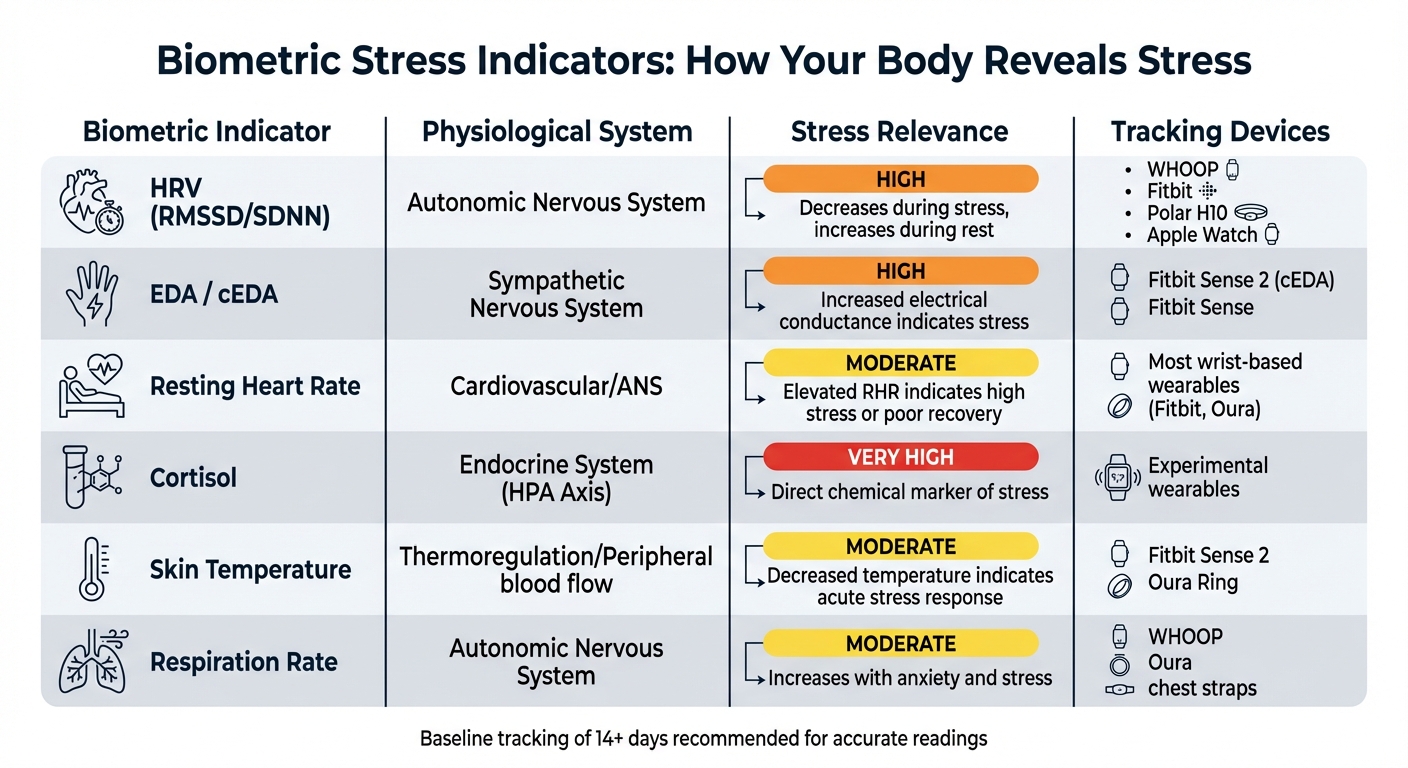
Biometric Stress Indicators Comparison Chart
Heart Rate Variability (HRV) and Its Significance
Heart Rate Variability (HRV) measures the variation in time intervals between consecutive heartbeats (R-R intervals) and serves as a non-invasive way to assess how well the autonomic nervous system is functioning [3]. It essentially reflects the balance between the body's "fight or flight" (sympathetic) and "rest and digest" (parasympathetic) responses.
When stress takes over, the sympathetic system dominates, leading to a more consistent heart rhythm and a drop in HRV. This makes HRV a widely recognized standard for monitoring stress levels without invasive methods [2].
"A high HRV indicates that the body is responsive to signals from the nervous system and can adapt to change when necessary. A lower HRV could indicate that the body is under excessive stress." – WHOOP [21]
Different HRV metrics provide unique insights. For example, RMSSD (root mean square of successive differences) and pNN50 (percentage of successive intervals differing by more than 50ms) are key indicators of parasympathetic activity [3]. In March 2023, WHOOP rolled out its "Stress Monitor" feature, which calculates a real-time stress score (ranging from 0 to 3). This tool compares current heart rate and HRV data against a personalized 14-day baseline and uses motion sensors to distinguish between physical exertion and mental stress [7].
Other biometric signals complement HRV, offering a broader view of how the body responds to stress.
Additional Stress Indicators
A range of other metrics adds depth to stress tracking:
- Electrodermal Activity (EDA): Also called Galvanic Skin Response (GSR), EDA measures tiny electrical changes on the skin caused by "micro-sweating", which is closely tied to the sympathetic nervous system [4]. In June 2023, Fitbit introduced its "Body Response" feature for the Sense 2, utilizing a continuous electrodermal activity (cEDA) sensor alongside HRV, heart rate, and skin temperature. This system uses machine learning, trained on data from stress-inducing scenarios like mock interviews, to detect autonomic arousal in real time [4].
- Resting Heart Rate (RHR): This metric often rises during periods of high stress or inadequate recovery, serving as a day-to-day stress indicator [19].
- Skin Temperature: Acute stress can cause a drop in skin temperature as the body redirects blood flow to support a "fight-or-flight" response [4]. Fitbit's Body Response feature, for instance, sends alerts when heart rate increases and skin temperature drops, signaling potential stress. As Elena Perez, Group Product Manager at Fitbit, explains:
"When your heart rate increases and your skin temperature decreases, the Body Response feature is likely going to send a notification alerting you of potential stress." [4]
- Cortisol Levels: Cortisol, a key stress hormone, is released through the hypothalamic-pituitary-adrenal (HPA) axis [2]. While traditionally measured in labs, wearable devices are now exploring real-time cortisol tracking through sweat and interstitial fluid. Studies have shown that sweat cortisol levels (ranging from 0.02–0.4 μM) closely align with concentrations in saliva and blood [20].
- Respiration Rate: Stress and anxiety often lead to faster breathing. Interestingly, techniques like cyclic sighing - prolonged exhalation - can lower respiratory rates and improve mood more effectively than traditional meditation [7].
- Motion and Activity Levels: Wearables equipped with accelerometers use AI to differentiate between physical activity and emotional stress [7].
Together, these metrics create a comprehensive stress profile, making it possible to analyze stress in real time and tailor interventions accordingly.
Comparison of Biometric Indicators
| Biometric Indicator | Physiological System | Stress Relevance | Tracking Tools/Devices |
|---|---|---|---|
| HRV (RMSSD/SDNN) | Autonomic Nervous System | High; decreases during stress, increases during rest | WHOOP, Fitbit, Polar H10, Apple Watch [3] |
| EDA / cEDA | Sympathetic Nervous System | High; increased electrical conductance indicates stress | Fitbit Sense 2 (cEDA), Fitbit Sense [4] |
| Resting Heart Rate | Cardiovascular/ANS | Moderate; elevated RHR indicates high stress or poor recovery | Most wrist-based wearables (Fitbit, Oura) [19] |
| Cortisol | Endocrine System (HPA Axis) | Very high; direct chemical marker of stress | Experimental wearables [2] |
| Skin Temperature | Thermoregulation/Peripheral blood flow | Moderate; decreased temperature indicates acute stress response | Fitbit Sense 2, Oura Ring [4] |
| Respiration Rate | Autonomic Nervous System | Moderate; increases with anxiety and stress | WHOOP, Oura, chest straps [7] |
To ensure accurate readings, it’s crucial to establish a baseline by tracking these metrics over at least 14 days. Since "normal" values for HRV and RHR vary widely between individuals, this baseline helps identify meaningful changes [7]. When these indicators point to elevated stress, simple techniques like cyclic sighing can help activate the parasympathetic system and restore balance [7].
sbb-itb-f5765c6
Real-Time Analysis and Personalized Interventions
Baseline Establishment and Adaptive Insights
AI-driven stress tracking starts by creating a personalized baseline, helping to distinguish your normal state from moments of heightened stress. To do this, most systems need consistent data collection over a period of time - usually between 14 days and a month. For example, WHOOP's Stress Monitor, introduced in March 2023, uses a rolling 14-day baseline based on heart rate and heart rate variability (HRV). Similarly, Fitbit's Body Response algorithm takes about a month to calibrate to your unique patterns [4][7].
Once your baseline is in place, the system keeps an eye out for specific signals, like a rise in heart rate paired with a drop in skin temperature, which often indicate autonomic arousal [4]. WHOOP provides a real-time stress score on a scale from 0 (low) to 3 (peak) throughout the day [7].
"Over the first month of being on your wrist, the algorithm uses more and more of your data to determine your baseline activity to more accurately detect acute changes from that baseline." – Elena Perez, Group Product Manager, Fitbit [4]
With this foundation, the system can act quickly, offering targeted interventions as soon as it detects deviations from your baseline.
Actionable Interventions and Recommendations
When stress levels spike, AI systems are designed to respond immediately with practical, science-backed strategies. This process follows a detection-intervention-reflection framework [6]. WHOOP, for instance, incorporates breathing exercises developed with Stanford neuroscientist Dr. Andrew Huberman. These include techniques like cyclic sighing - prolonged exhalations to promote calmness - and cyclic hyperventilation to enhance alertness [7]. Research supports the effectiveness of cyclic sighing in improving mood and lowering respiratory rates [7].
Fitbit takes a slightly different approach, offering guided breathing exercises, reminders to take walks, and prompts to log your emotional state [4][6]. This feedback loop allows the AI to adapt, distinguishing between distress and positive stress (eustress) based on your input [4][6]. In a fascinating development, researchers at Ruhr University Bochum demonstrated a prototype in September 2025 that streamed HRV data into GPT-4. This enabled the AI to adjust its conversational tone and the complexity of its feedback in real time [3].
Integration with BondMCP for Context-Aware Stress Management

Taking stress management to the next level, integrating stress data with broader health metrics creates a more comprehensive approach. BondMCP serves as a central intelligence layer, connecting stress data with other factors like sleep quality, lab results, supplement usage, and fitness routines [22]. Its Consensus Super AI uses over 10 medically trained AI models that must agree before making any recommendation, ensuring 99.8% accuracy with response times under three seconds [22]. Each recommendation is accompanied by a cryptographic Trust Certificate for added reliability [22].
By combining data on training load, nutrition, and recovery, BondMCP transforms isolated stress metrics into actionable insights for addressing the root causes of stress. This integration allows for proactive and context-aware health management.
"The challenge isn't collecting data... The challenge is making that data actionable in the moment it matters most." – Maria Chatzou Dunford, CEO, Lifebit [23]
Benefits and Challenges of AI Stress Tracking
This section builds on earlier discussions of technical insights and intervention strategies, focusing on the advantages and hurdles of AI-based stress tracking systems.
Benefits of AI Stress Tracking
AI-powered stress tracking systems can detect stress early, potentially preventing serious health issues. These systems boast around 90% accuracy in differentiating between normal brain activity and conditions like PTSD [1]. This is crucial because stress-related chronic conditions contribute to 75% of U.S. healthcare costs [8]. By catching stress early, these tools can stop temporary anxiety from snowballing into long-term problems.
Another major plus? Passive monitoring. Unlike traditional methods that rely on self-reported surveys, AI-driven wearables and sensors collect real-time physiological data without requiring any effort on your part [1]. This means you're getting a more accurate picture of your stress levels based on actual changes in your body.
These systems also provide personalized interventions exactly when you need them. For instance, if your heart rate variability drops and your skin temperature rises, the system might suggest a breathing exercise or encourage you to take a walk. Research even shows that cyclic sighing can improve mood more effectively than mindful meditation [7]. These tailored responses match your body's current state, making them far more effective than generic advice.
Despite these benefits, AI stress tracking isn't without its challenges, and addressing them is key to maximizing its potential.
Challenges and Mitigation Strategies
Stress signals can sometimes overlap with other physiological responses, like excitement or physical activity [4][6]. Fitbit tackled this issue in June 2023 by updating its Body Response feature on the Sense 2 smartwatch. The algorithm now disables stress tracking during exercise and requires a full month of baseline data before generating alerts [4].
"In order to effectively cope with stress and set healthy boundaries for yourself around stress triggers, you need to be able to recognize what stress feels like in your body and mind, identify those triggers and see what strategies work for you to manage stress." – Dr. Megan Jones Bell, Clinical Director of Consumer Health, Google [6]
Privacy is another significant concern. Biometric data, protected under regulations like GDPR and HIPAA, demand strict safeguards [24]. These systems manage massive amounts of data - tracking metrics like heart rate variability (HRV), sleep stages, and stress markers in real time [24]. To address this, developers use end-to-end encryption, granular API access controls, and data minimization, ensuring only essential information is collected and processed.
Baseline dependency poses another challenge. Most systems need 14 to 30 days of consistent use to establish a personalized baseline [4]. During this initial period, alerts may not be as reliable. However, once the baseline is set, the system becomes much more accurate, outperforming generic population averages in detecting stress.
Comparison Table: Benefits vs. Challenges
| Aspect | Benefit | Challenge | Solution |
|---|---|---|---|
| Detection Timing | Detects stress before you notice it | Requires consistent use during calibration [4] | Commit to wearing the device consistently during the calibration phase. |
| Data Collection | Continuous, hands-free monitoring [1] | Privacy risks with sensitive data [24] | Use end-to-end encryption and strict access controls. |
| Accuracy | 90% accuracy for abnormal brain states [1] | Can confuse exercise with stress [4][6] | Disable tracking during physical activity automatically. |
| Interventions | Real-time, tailored recommendations | Relies on a well-established baseline | Combine data from HRV, sleep, activity, and social patterns for accuracy. |
| Health Integration | Links stress data with broader health metrics | Isolated metrics may miss root causes | Systems like BondMCP unify wearable, lab, and lifestyle data. |
Conclusion
AI-driven stress tracking has taken a major leap forward, offering tools that not only detect early stress indicators but also analyze biometric patterns and provide quick, effective relief. In fact, 95% of users report feeling less stressed after using AI-guided breathing exercises [10].
By connecting data points like heart rate variability, sleep quality, and more, these systems eliminate the confusion caused by fragmented insights from separate apps and devices. Instead of conflicting advice, users receive a unified approach that turns scattered signals into clear, actionable guidance.
Take systems like BondMCP, for example. They combine data from wearables, lab results, and lifestyle inputs, achieving an impressive 99.8% accuracy by cross-validating multiple AI models - all within just 3 seconds [22]. Imagine your wearable detecting stress and adjusting your training plan, while lab results fine-tune your recovery protocol, and sleep data helps shape your daily routine. It’s a seamlessly connected experience.
The benefits are tangible: users of AI-integrated systems report an 11% increase in HRV, gain an extra 19 minutes of deep sleep per night, and improve focus by 25% [25]. These improvements lead to better sleep, sharper thinking, and reduced anxiety - enhancing overall well-being.
AI is quickly becoming a smart health coach, offering personalized, automated, and context-aware solutions. This connected ecosystem ensures you get the right intervention exactly when you need it most.
FAQs
How does AI tell the difference between physical and emotional stress?
AI distinguishes between physical stress and emotional stress by examining a mix of physiological and behavioral indicators.
- Physical stress is identified through metrics like heart rate variability, skin conductivity, and movement patterns, which can signal physical exertion or strain.
- Emotional stress is detected through behavioral changes, such as shifts in voice tone, speech patterns, or even typing speed.
By analyzing these combined signals, AI systems can offer a clearer picture of your stress levels and suggest interventions tailored to the specific type of stress you're dealing with.
How do AI stress trackers protect my privacy?
AI stress trackers collect sensitive health data like heart rate, HRV, and cortisol levels, which makes privacy a top priority. Here's how they ensure your information stays secure:
- Encrypted Data Transmission and Storage: All data is protected with encryption, blocking unauthorized access during transfer and storage.
- Anonymization of Personal Information: Before processing, your identity is removed from the data, keeping your personal details private.
- Secure Cloud Systems: These devices use cloud platforms with role-based access controls, ensuring only authorized personnel can access your data.
- Compliance with U.S. Privacy Laws: They adhere to strict regulations like HIPAA to meet health privacy standards.
By combining encryption, anonymization, secure systems, and legal compliance, AI stress trackers protect your health data while delivering precise and useful insights.
How quickly can AI create a personalized stress baseline?
The time required for AI to establish a personalized stress baseline depends on the system and the type of data it gathers. Generally, the AI needs to observe your stress patterns over time to get a clear picture of how you respond to various situations. This process can take anywhere from a few days to a couple of weeks, influenced by how often you interact with the system and the range of data it collects, such as metrics from wearable devices or self-reported information.
More advanced platforms that combine data from multiple sources - like fitness trackers, wearables, and even lab results - can streamline this process. These systems are often able to provide quicker, more precise insights tailored to your health and daily habits.