
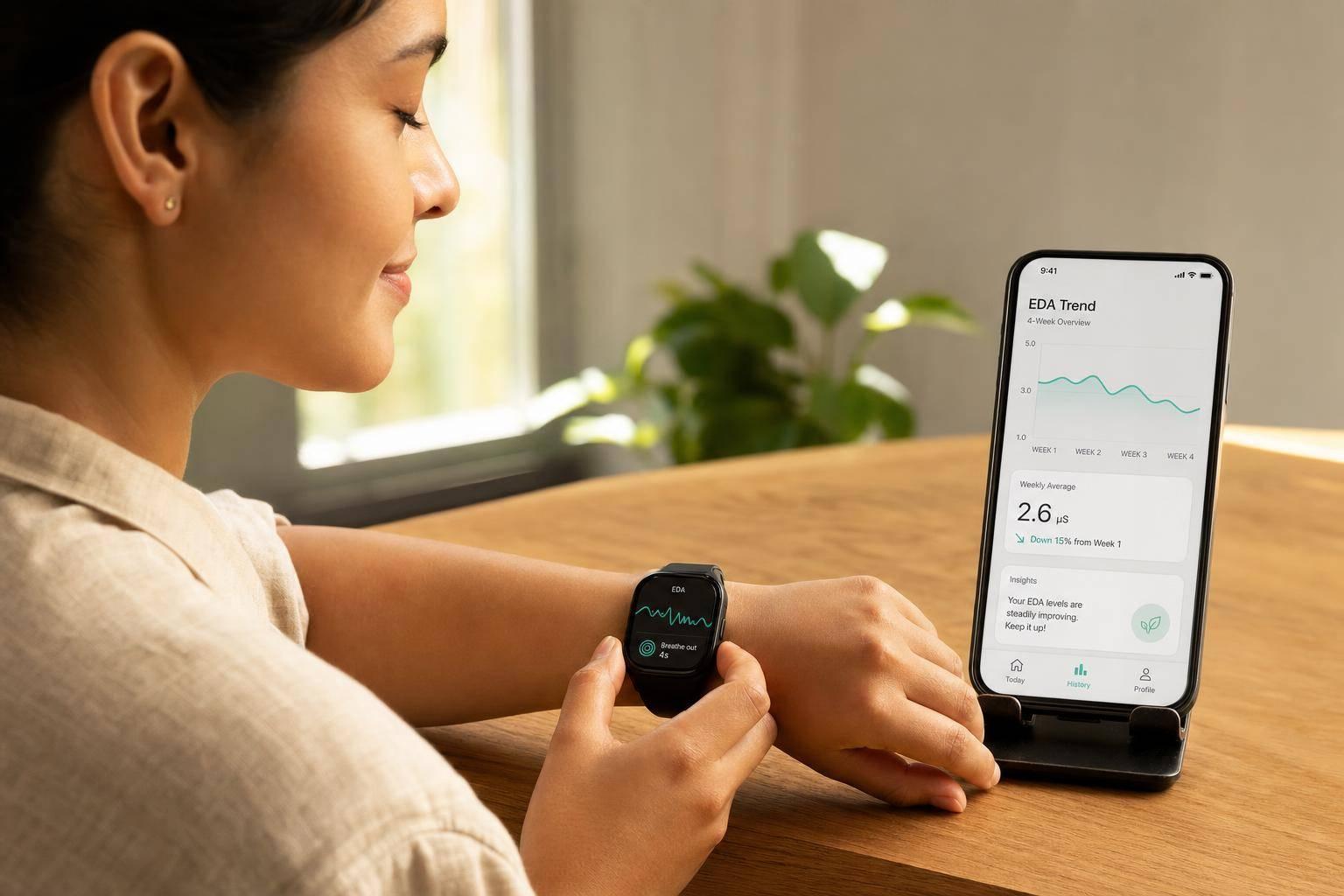
Stress can show up in your body before you notice it in your mind. Skin conductance sensors track tiny skin changes linked to sweating, which can show when your arousal level goes up in about 1 second. That gives me a simple way to spot patterns, test calming habits, and look at stress trends over days or weeks.
Here’s the short version of what these sensors help me do:
- Track stress in the moment instead of guessing later
- Get feedback based on my own baseline, not a generic score
- Spot likely triggers like meetings, commutes, or poor sleep
- Use biofeedback to try breathing or relaxation and watch the signal change
- Review long-term trends to see if stress load is going up or down
They also have limits. A spike can come from heat, exercise, pain, or emotional arousal, not just stress. So I’d use the data as a check-in tool, not as proof of what I’m feeling or a health diagnosis.
Quick Comparison
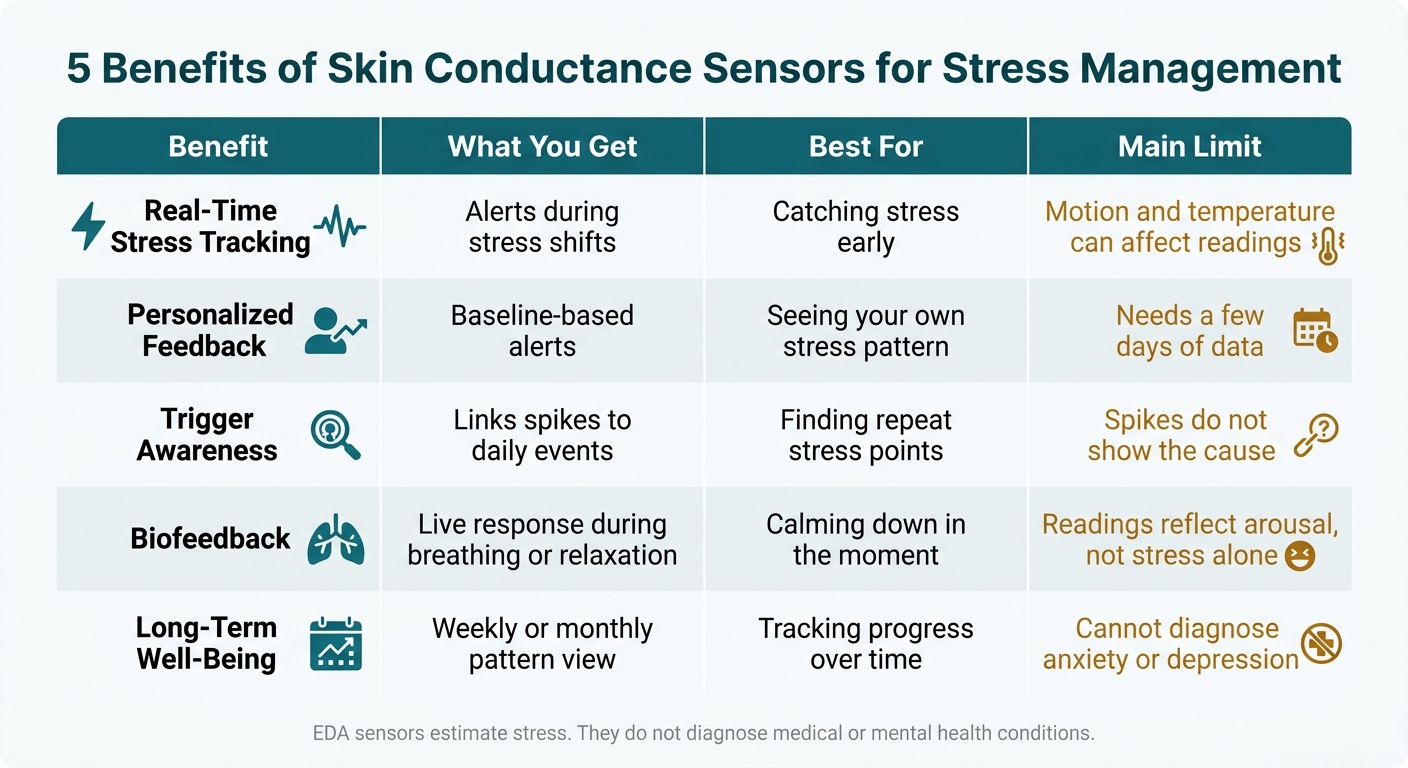
5 Benefits of Skin Conductance Sensors for Stress Management
| Benefit | What I get | Best for | Main limit |
|---|---|---|---|
| Real-time stress monitoring | Alerts during stress shifts | Catching stress early | Motion and temperature can affect readings |
| Personalized feedback | Baseline-based alerts | Seeing my own stress pattern | Needs a few days of data |
| Trigger awareness | Links spikes to daily events | Finding repeat stress points | Spikes do not show the cause |
| Biofeedback | Live response during breathing or relaxation | Calming down in the moment | Readings reflect arousal, not stress alone |
| Long-term well-being | Weekly or monthly pattern view | Tracking progress over time | Cannot diagnose anxiety or depression |
Bottom line: if I pair EDA data with context like sleep, mood, caffeine, and daily notes, AI can predict stress and help turn it from something vague into something I can act on.
sbb-itb-f5765c6
What Skin Conductance Sensors Measure
Stress switches on eccrine sweat glands through the sympathetic nervous system. When that happens, skin resistance goes down and conductance goes up. Skin conductance sensors pick up that shift and turn it into a signal you can read. That's why EDA readings tend to climb when stress climbs. [3][14][1]
EDA has two parts: a tonic level, which is your baseline conductance when you're calm, and phasic responses, which are short spikes that rise fast and fade within seconds. [4][11] Put those together, and you get a picture of how your body reacts across the day.
How electrodermal activity changes with stress
As stress or other emotional arousal goes up, sweat gland activity increases, skin resistance drops, and conductance rises. The change is fast, often showing up within about a second. That speed is a big reason EDA can track shifts in arousal as they happen.
Where wearables usually measure skin conductance
Most consumer wearables measure EDA at the wrist so they can track it throughout the day. Fingers and palms usually give stronger, cleaner signals because they have a higher density of sweat glands. Still, the wrist is the most common spot for continuous monitoring. [18][19][3][9]
Wrist signals are smaller, but a snug fit can still make them useful for watching changes over time. The catch is simple: a higher reading shows arousal, but not why it happened.
What the readings can and cannot tell you
A spike points to arousal, not its cause. Exercise, heat, pain, and excitement can produce similar patterns, so it's best to treat EDA as a cue to check what's going on around you, not as a diagnosis. [9][2][1][12] That's also what makes it so useful for real-time stress tracking: it reacts fast, even if you still need context to interpret the signal.
1. Real-Time Stress Tracking
EDA shifts within seconds, so wearables can spot stress while it’s happening. Skin conductance sensors can flag stress as it climbs, which gives you a chance to catch it in the moment instead of piecing it together later.
What real-time tracking actually gives you
You’re not stuck guessing what wore you down. You get a live signal. Some wearables turn EDA data into a simple daily stress score, which makes the numbers easier to use when you still have time to do something about them.
Best use cases for everyday wearers
For day-to-day use, real-time EDA tracking works well when you want to see which part of your workday keeps setting off your arousal, notice when back-to-back meetings shove you into a higher-stress zone, or track how your body reacts during a tense commute. AI coaching can take that alert and turn it into one clear next step.
Key limitations to keep in mind
That said, treat EDA as a cue, not proof. It tracks arousal, not cause. Motion, poor skin contact, and temperature can also skew the reading. So each alert should be read as a prompt, not a diagnosis.
2. Personalized Feedback
Once a device can track stress in real time, the next job is making that feedback personal. A generic stress threshold doesn't work very well because your baseline may look nothing like someone else's. Skin conductance sensors learn your usual EDA pattern over time, then flag changes against your norm. That means the feedback is tied to your own baseline, not a one-size-fits-all score.
What personalization looks like in practice
The device tracks EDA during daily routines like commuting or sitting in meetings, then learns what "normal" looks like for each one. You can also add context tags such as "presentation" or "gym" when you notice a spike. Over time, that helps the system connect repeat stress responses to certain situations. The upside is simple: each alert becomes more relevant than a generic stress score.
Best use case for everyday wearers
This matters most when stress starts building before you even notice it. A study of 381 office workers linked EDA data with perceived stress in everyday settings, not just labs.[15] For professionals, students, or anyone trying to keep up with a packed schedule, a personal stress map can show patterns that are hard to catch on your own. Healify can combine EDA with sleep, heart rate, and lifestyle data to turn those patterns into a simple action plan.
Key limitations to keep in mind
Personal models get better with time, but they need enough data first. During the first few days, feedback is less precise because the device hasn't learned your baseline yet. Consistent wear helps too. If there are gaps in the data, the system takes longer to learn.
Those patterns make it easier to spot your main triggers.
3. Better Awareness of Stress Triggers
It’s usually easy to tell when you feel stressed. The harder part is figuring out what set it off. Skin conductance sensors help close that gap by tracking EDA shifts across the day. When a spike shows up, you can match it to what was happening at that moment, like a back-to-back meeting block or a long commute.
Once you know when those spikes happen, you can start tying them to the situations around them.
What the sensor detects
Phasic peaks show short bursts of stress. Tonic levels show your baseline arousal.
How trigger awareness helps day-to-day
When you can connect spikes to specific situations, you can change the routine instead of just noticing the stress. That’s what makes EDA useful here: it helps show which parts of your day keep pushing arousal higher and which ones don’t.
In plain terms, it gives you something more concrete than “I had a rough day.” You can look at the pattern and spot the friction points.
Best use case for the wearer
This is especially helpful for people who feel drained but can’t tell why. Say a professional isn’t sure whether meetings or email overload is the bigger problem. They can check their EDA timeline and see which parts of the day lead to the most phasic activity.
From there, small changes become easier to test. You might add a 5-minute breathing break before a known high-stress block, tweak part of your routine, and then watch whether the spike changes over the next week.
Key limitations to keep in mind
EDA doesn’t respond only to stress. Excitement and physical activity can also increase skin conductance, so a spike is not always a stress spike. [22][6][13]
That’s why context matters. Pairing sensor data with a quick note about what was happening at the time can help separate likely stressors from other sources of arousal. [10][23][24] That context also makes it easier to choose the right response in the next section.
4. Biofeedback Tools for Staying Calm
Once you know your triggers, EDA gives you a live signal you can use right away. That’s where biofeedback comes in. Skin conductance sensors turn your body’s arousal signal into something you can see, like a simple live graph or alert, so you can spot your stress response and try to bring it down.
What the sensor detects
The sensor measures electrodermal activity (EDA) in real time. As arousal goes up, skin conductance tends to go up too. When you calm down, the reading tends to drop.
How biofeedback supports daily stress management
Here’s the basic idea: notice a spike, use a calming method, and watch the reading come back down. Research backs this up. One study found a 50% drop in self-reported stress with electrodermal biofeedback games, and another found that a 10-minute session reduced state anxiety.[27][17]
The methods that line up best with this kind of feedback include:
- Paced breathing at about 4 to 6 breaths per minute
- Progressive muscle relaxation
- Brief mindfulness check-ins [8][7][26]
That direct feedback loop can make stress work feel less abstract. You’re not guessing whether something helped. You can see the shift happen.
Best use case for the wearer
This works best for people who want to respond to stress in the moment, not just look back at a daily score.[8][28] Say you use the sensor before a high-stakes meeting or right after a tense call. You slow your breathing, watch the EDA curve settle, and then get back to your day.
Over time, that can give you a much clearer sense of what helps your body, not just what tends to help people in general. Healify can combine EDA with sleep, heart rate, and lifestyle data to suggest when to pause and which recovery habit to try.
Key limitations to keep in mind
EDA biofeedback can be a good training tool, but it is not a diagnostic. The sensor picks up sympathetic arousal, not stress on its own, so a spike during an exciting conversation can look a lot like one during a tense one.[21][16][20]
Readings can also get thrown off by movement, room temperature, and sensor placement.[25][16][5] So it helps to treat the data as a prompt to check in with yourself, not a final judgment about your mental state.
With repeated practice, each check-in can become more automatic. That’s often where the longer-term payoff starts.
5. Better Mental Well-Being Over Time
Real-time biofeedback can help in the moment. But long-term EDA trends tell you something else: whether your overall stress load is actually getting lower.
What the sensor detects
Over time, EDA can show your baseline arousal, how often spikes happen, and how fast you recover after them. That makes it a helpful signal for seeing whether stress is easing up or staying high.
How long-term data supports mental well-being
Long-term patterns matter. Studies in office workers and in day-to-day settings link higher tonic EDA with more anxiety and depressive symptoms [29][30]. Regular biofeedback practice can also reduce anxiety and stress over time [31][32].
Apps like Healify can bring EDA, heart rate, sleep, and mood notes into one trend view. That matters because a single stress spike doesn't say much on its own. A week or a month of patterns? That's where things start to click.
Best use case for the wearer
This works best for people who want to track progress, not just react to daily spikes. If you review weekly EDA trends alongside sleep and mood notes, you can see whether changes like earlier bedtimes, lighter caffeine use, walks after work, or screen limits at night are helping lower your stress load.
In plain English: it turns stress tracking into something you can use. Not just data on a chart, but a simple action plan.
Key limitations to keep in mind
EDA measures arousal, not mental health status. So it can't diagnose anxiety or depression. Sensor noise, movement, and temperature can also distort single readings [33][16].
Use long-term EDA trends as one input, not a verdict. Pair them with mood tracking, sleep data, and professional support when needed.
Those trends matter most when they lead to small daily actions.
How to Put Stress Sensor Data to Work Every Day
Collecting stress data is only half the job. The other half is putting that data to use in small actions you can repeat. Once you know what your numbers look like, the next step is using them in everyday life.
Spot patterns in your daily routine
Meetings, commutes, caffeine, and poor sleep can all show up in your EDA data.
Modern wearables are getting better at separating non-exercise stress from exercise-related spikes [34]. That makes it easier to tie a reading to a specific part of your day instead of guessing what caused it.
Spend a few minutes each evening writing down what was happening during your biggest spikes. After 1–2 weeks, those notes can turn stress from something vague into something specific you can act on. That extra context also makes each spike easier to deal with in the moment.
Use stress spikes as a cue for short breaks
When your wearable flags a spike, treat it like a prompt to reset. Try slow breathing, a short walk, or a quick stretch.
These small resets may seem minor, but they can stack up over time. The point isn't perfection. It's getting back to baseline sooner.
Review weekly trends instead of single readings
One spike on a Tuesday afternoon doesn't tell you much on its own. But a full week of spikes around the same meeting, commute window, or nights of poor sleep? That's where things start to click.
Look at each week's spikes, stress, recovery and sleep alongside caffeine use to find repeat patterns. Healify can pull your EDA, heart rate, sleep, and activity data into one trend view and help flag patterns you might miss on your own. Over time, that turns EDA readings into a simple weekly stress routine.
Quick Benefit Snapshot
Here’s a compact look at the five benefits. It’s a simple way to compare them side by side.
| Benefit | What It Does | Why It Matters |
|---|---|---|
| Real-Time Stress Tracking | Shows stress as it rises | Helps you catch stress before it peaks, so you can pause sooner |
| Personalized Feedback | Adapts guidance to your baseline | Tailored guidance is more likely to stick |
| Awareness of Stress Triggers | Highlights times, places, or tasks linked to your biggest stress-related spikes | Makes it easier to change the routines that drive repeated spikes |
| Biofeedback for Staying Calm | Uses live feedback to support breathing or relaxation | Lets you test calming techniques in real time |
| Better Mental Well-Being Over Time | Tracks long-term trends to show progress and warning signs | Shows whether your overall stress load is trending down |
These sensors estimate stress. They do not diagnose medical or mental health conditions. What they can do is turn raw sensor readings into clearer day-to-day choices.
Taken together, these five benefits make stress data easier to use in everyday life.
Conclusion
Skin conductance sensors won’t make stress disappear. What they can do is spot it early by turning a hidden body response into a clear signal that stress is starting to build. That only matters, though, if the signal leads to a change in what you do.
Research shows wearable EDA can track stress, but the point isn’t just to collect data. The point is to use that signal to shape your next move. Real-time tracking, pattern recognition, and better self-management only matter when awareness turns into small, steady actions: taking a short breathing break after a spike, adjusting your schedule after you notice repeated behavioral patterns, or doing a weekly check-in on how your stress load is trending.
Once the signal means something, personalization makes it easier to use. Personalized feedback turns sensor data into steps that match your baseline. Healify can combine wearable signals with sleep and activity data to turn stress trends into simple next steps.
These tools can help with day-to-day choices, but they don’t replace medical judgment. Skin conductance is a support tool, not a diagnosis. If stress symptoms are persistent or severe, talk with a healthcare professional. Used well, these sensors can help you notice problems earlier, respond sooner, and build better habits over time.
FAQs
How accurate are skin conductance sensors for stress?
Skin conductance sensors, also called electrodermal activity (EDA) sensors, are a solid way to detect stress, especially as part of a multimodal AI system.
On their own, they track changes in sweat gland activity, which tends to shift when stress kicks in. But the bigger win comes when EDA data is paired with other signals like heart rate variability, skin temperature, and motion data.
In that setup, accuracy can reach 92% to 98.6%.
These systems also learn a personal baseline over time. That makes it easier to tell the difference between emotional stress and normal physical activity or everyday movement.
How long does it take to learn my baseline?
Usually, this takes just a few minutes.
AI-powered tools and wearable devices track your physiological data over time to figure out your usual stress levels and set a baseline.
Can skin conductance data help build better stress habits?
Yes. Skin conductance data, often measured as Electrodermal Activity (EDA) or Galvanic Skin Response (GSR), can help you build better stress habits because it shows real-time shifts in arousal tied to your nervous system’s fight-or-flight response.
That matters because stress doesn’t always announce itself in obvious ways. Sometimes your body reacts before your mind catches up. Skin conductance helps surface those moments, so you can spot patterns instead of just guessing what set you off.
Healify uses this data alongside other biometrics to find stress triggers, set a personalized baseline, and turn those signals into clear next steps when you need them most.