
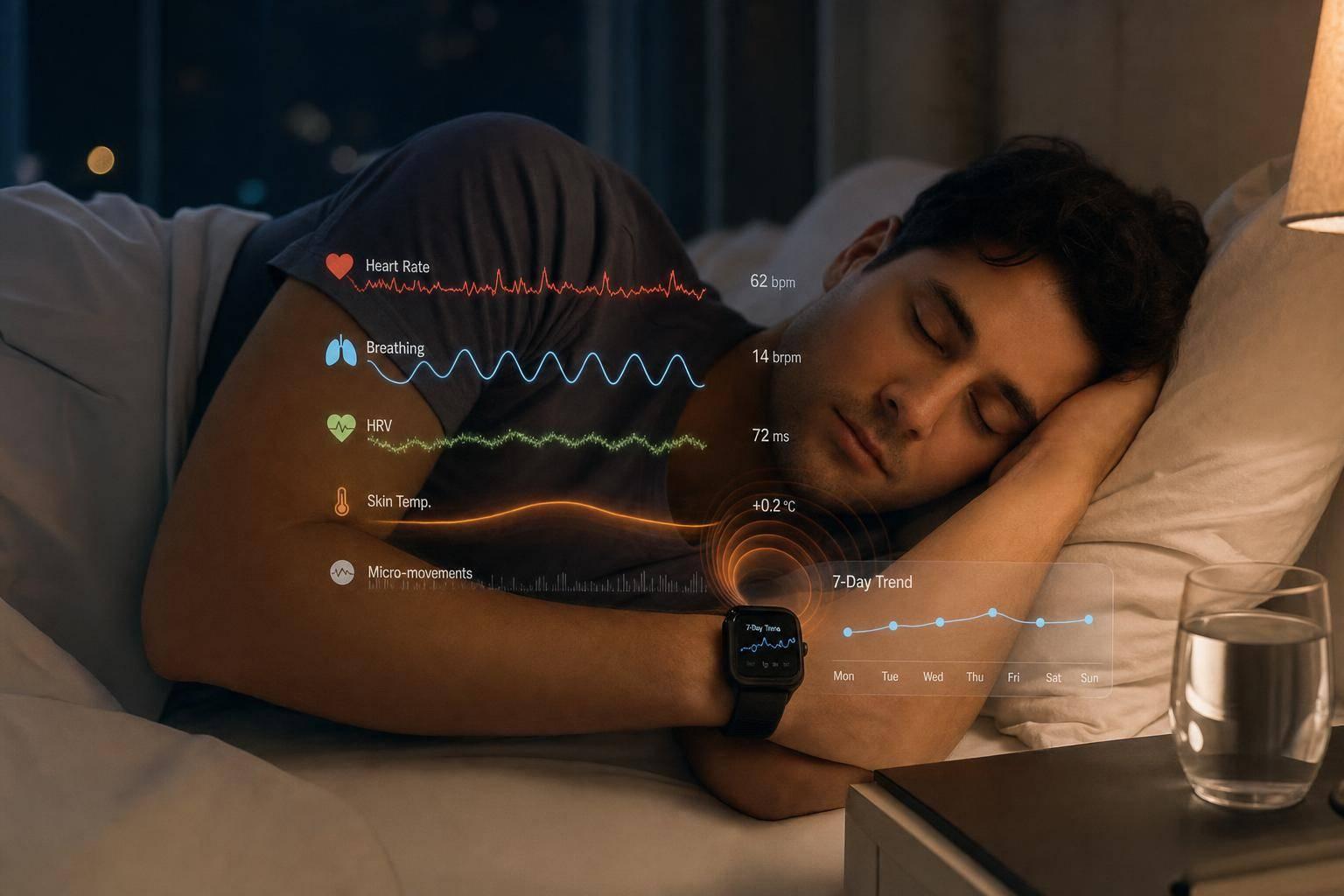
Your watch or ring does not measure sleep stages the way a sleep lab does. It estimates REM and deep sleep from movement, heart rate, HRV, breathing, and sometimes skin temperature. That’s why wearable sleep data is best for trends over time, not one-night judgments.
Here’s the short version:
- REM sleep usually makes up 20%–25% of sleep and often shows up more in the second half of the night.
- Deep sleep usually makes up about 10%–23% and tends to cluster in the first few hours after you fall asleep.
- Consumer wearables use indirect signals, not brain waves.
- Sleep labs use EEG, EOG, and EMG to score sleep in 30-second epochs.
- Wearables are often good at sleep vs. wake, but much less exact at sleep stage scoring.
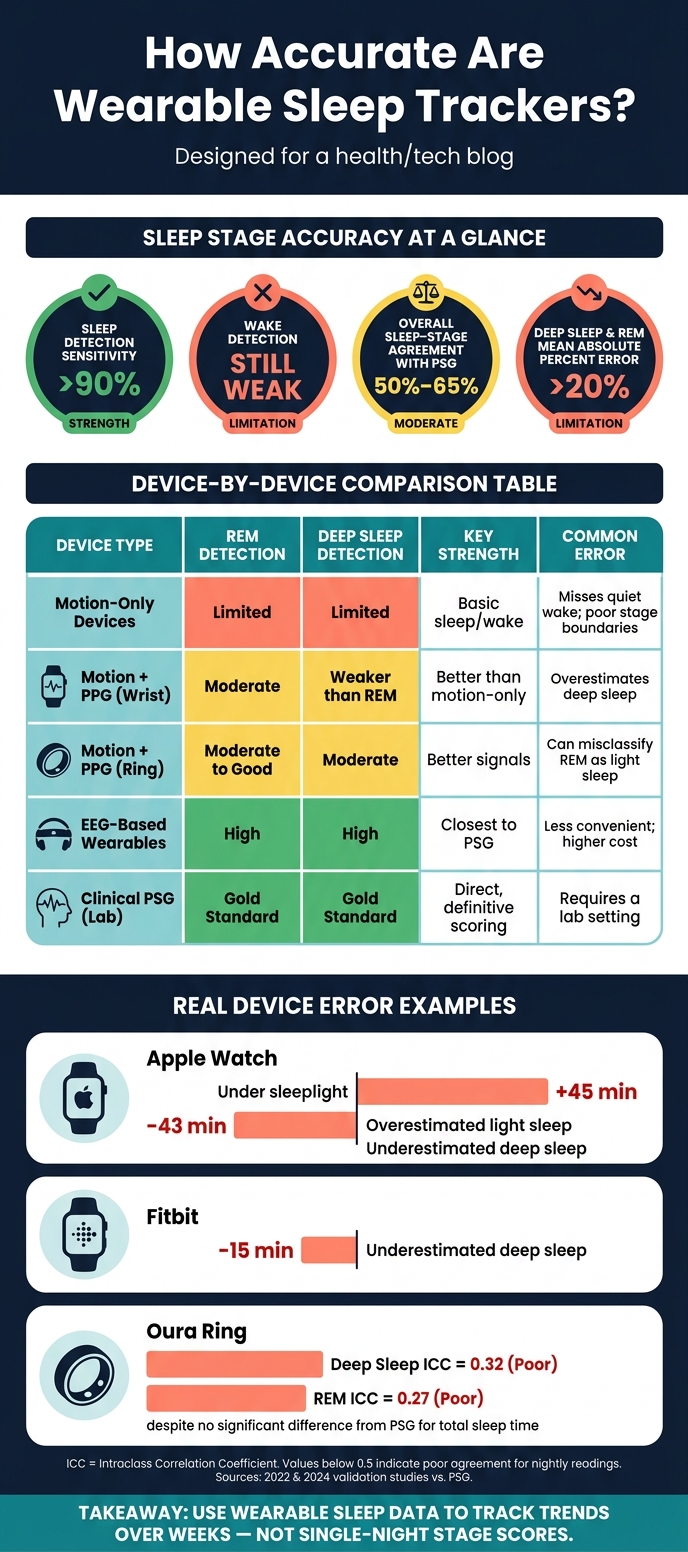
- Studies in the article show stage agreement with sleep lab results often lands around 50%–65%, and REM/deep sleep errors above 20% are common.
- REM is often a bit easier for devices to estimate than deep sleep because deep sleep is defined by slow brain waves, which wearables cannot read directly.
If I look at the data the right way, the takeaway is simple: use sleep trackers to spot patterns in total sleep, schedule, and stage trends across weeks. Don’t treat a single low-REM or low-deep-sleep night like a hard diagnosis.
| What the device uses | What it helps estimate | Main limit |
|---|---|---|
| Movement | Sleep vs. wake, rough stage clues | Quiet wake can look like sleep |
| Heart rate + HRV | REM vs. non-REM patterns | Stress, alcohol, illness, and late workouts can skew results |
| Breathing rate | More clues for REM and deep sleep | It is still an estimate |
| Skin temperature | Adds context for stable sleep periods | It does not confirm sleep stage |
| Brain waves in a sleep lab | Actual sleep stage scoring | Not available in most consumer wearables |
So when I read sleep-stage charts, I’d treat them like estimates with some signal, but plenty of noise.
The Sensors Wearables Use to Estimate REM and Deep Sleep
Movement, Heart Rate, and Heart Rate Variability
Wearables estimate sleep stages by reading a small set of body signals that tend to change in predictable ways through the night. In most cases, they rely on movement, pulse, and beat-to-beat variation.[7][10][11]
The accelerometer measures how much you move and how often you shift position. Long periods of almost no movement often line up with deeper sleep. More tossing, turning, or small adjustments usually point to lighter sleep or brief wake-ups. The optical heart rate sensor uses PPG to estimate your pulse and the time between beats, which is then used to calculate HRV.
Those signals don’t look the same in every stage. During deep sleep, heart rate usually falls to its lowest level of the night and stays fairly steady. HRV at that point reflects strong parasympathetic activity. During REM sleep, the body is still mostly still, but heart rate tends to be a bit higher and less steady, and HRV shifts into a more mixed pattern tied to dreaming and autonomic activity. That contrast gives sleep-stage algorithms a way to tell REM and deep sleep apart.[8][9][13]
HRV in wearables does a lot of the heavy lifting here, picking up small nervous system changes that heart rate by itself can miss. That’s also why alcohol, a hard late-night workout, or getting sick can throw off your sleep-stage data even when total sleep time seems normal. Those things can change HRV patterns, which then changes how the algorithm labels each chunk of the night.[5][7]
When the picture isn’t clear, temperature and breathing can help tip the scale.
Secondary Signals: Temperature, Breathing, and More
Some wearables add more signals to the mix, especially skin temperature and respiratory rate. Devices like the Oura Ring and Samsung Galaxy Ring, for example, use skin temperature along with heart rate, HRV, and movement in their sleep-staging models.[8][12][6]
Skin temperature often drops a bit when sleep begins and may stay lower during stable deep sleep. Respiratory rate, which many wearables now estimate from the PPG waveform without a chest strap, tends to slow down and become more regular in deep sleep. During REM, breathing often gets less regular again.[5][12][13]
What’s happening here is simple: the device is stacking clues. A time window with low movement, low heart rate, steady breathing, and stable skin temperature is more likely to be tagged as deep sleep than a window with the same stillness but uneven breathing and changing HRV. More signals can sharpen the estimate, but they still don’t make it exact.[7][9][14]
sbb-itb-f5765c6
How Sleep Algorithms Convert Sensor Data Into Sleep Stages
How Devices Classify Sleep in Short Time Windows
Those sensor signals turn into sleep stages only after the device scores them in short blocks of time.
Most wearables analyze sleep in 30-second epochs. That timing isn't random. Clinical sleep labs also score polysomnography in 30-second epochs, which makes it easier to compare a wearable's estimates with lab results.[15][2]
From there, a machine-learning model trained on lab sleep data classifies each 30-second epoch using inputs such as heart rate, HRV, movement, and estimated breathing rate. It also checks nearby epochs to smooth out stage changes that don't make much sense, like a sudden jump that lasts only a few seconds.
Why REM Is Often Easier to Detect Than Deep Sleep
Some sleep stages are simply easier for an algorithm to spot than others. REM usually stands out more clearly in the signals wearables can measure: very little movement, paired with a more irregular heart rate and breathing pattern than non-REM sleep.[8] That mix gives the model a clearer pattern to work with, so REM is often easier to flag than deep sleep.
Deep sleep is tougher to pin down. Wearables have to infer it from heart-related and movement-based clues, and those signals can overlap across lighter and deeper non-REM sleep. A fit person with naturally high parasympathetic tone, for example, might show a very low heart rate and high HRV even during lighter sleep. That can make it hard for a one-size-fits-all model to draw a clean boundary.
You can see that challenge in device comparisons. In one 2024 comparison of commercial devices, Oura's sensitivity versus PSG was 79.5% for deep sleep and 76.0% for REM, while Fitbit's figures were 73.2% for deep sleep and 73.1% for REM.[1]
Deep sleep is harder to estimate, so the key issue isn't just the chart you see in the app. It's how well the device can tell one stage from another when the signals start to blur, and how you use health data for better sleep quality based on those trends.
Best Wearables for Sleep: Scientific Rankings
How Accurate Wearables Are and Where They Fall Short
Wearable Sleep Trackers vs. Sleep Lab: Accuracy & Signals Compared
What Validation Studies Generally Show
Those signal patterns help, but validation studies show where wearables start to miss the mark.
The big takeaway is pretty simple: wearables are much better at telling whether you're asleep than at telling which stage of sleep you're in. Sleep sensitivity is usually above 90%, while wake detection is still weak.[2][3] That makes these devices useful for tracking total sleep time.
Sleep-stage labeling is a different matter. A 2022 review found that commercial devices are still best used for sleep-wake tracking, not stage-level scoring.[17] In a 2022 comparison, overall sleep-stage agreement with PSG ranged from 50% to 65% across commercial devices.[18] Another 2024 study found that deep sleep and REM mean absolute percent errors were all above 20% across the devices tested.[16]
One pattern shows up again and again: many devices overestimate sleep efficiency and miss short awakenings. So a high sleep score can look great on the screen while stage accuracy is still shaky.
REM vs. Deep Sleep Detection: A Side-by-Side Comparison
The size of the gap changes based on the wearable comparison and the sensors each device uses.
| Category | REM Detection | Deep Sleep Detection | Typical Strengths | Common Errors |
|---|---|---|---|---|
| Motion-only devices | Limited | Limited | Basic sleep/wake estimation | Miss quiet wake; poor stage boundaries |
| Motion + PPG (wrist) | Moderate | Weaker than REM | Better staging than motion-only devices | Overestimate deep sleep; confuse stage transitions |
| Motion + PPG (ring) | Moderate to good | Moderate | Better signals than motion-only devices | Can misclassify REM as light sleep |
| EEG-based wearables | High | High | Closest to PSG-level staging | Less convenient; higher cost |
| Clinical PSG | Gold standard | Gold standard | Direct, definitive stage scoring | Requires a lab setting |
A 2024 study makes the gap easy to see. The Apple Watch overestimated light sleep by 45 minutes and underestimated deep sleep by 43 minutes, while Fitbit underestimated deep sleep by 15 minutes.[4] And even the better-performing Oura Ring tells a more mixed story. It showed no statistically significant difference from PSG for total sleep time, but its deep sleep ICC was 0.32 and its REM ICC was 0.27 - both poor levels of concordance for nightly readings.[4]
That's why REM often tracks a bit more cleanly than deep sleep. Deep sleep is defined clinically by slow brain waves, and wearables can't measure those directly. So deep sleep remains the tougher call.
How to Read Your Sleep Data Without Misreading It
The best way to use this data is to stop treating single-night stage numbers like hard facts and start looking for patterns across weeks. Sleep changes from night to night. That's normal. One low-REM night after a late workout or a glass of wine usually doesn't mean much by itself.
Start with the basics:
- Total sleep time
- Bedtime consistency
- Wake-time consistency
Then treat travel, illness, alcohol, and late exercise as short-term noise. A tracker is more useful when you judge it by trends over several nights, not by one score on one morning.
Those limits help explain why newer wearables are shifting toward more sensors and more personalized models. This shift is part of a broader trend toward using AI for recovery and longevity by interpreting complex biometric data.
Where Sleep Tracking Is Headed Next
Multi-Sensor Tracking and More Personalized Analysis
Stage-level accuracy still has a ceiling. So the next step is pretty simple: use more signals at the same time.
Instead of leaning mostly on movement, sleep trackers are starting to combine movement, heart rate, temperature, and breathing. Then they use machine learning to make better stage estimates. In one study, adding heart-rate and circadian features to movement data lifted 4-stage sleep classification accuracy from 57% to 79%.[19]
There’s another shift happening too: personalization.
Most devices have used one model for everyone. But sleep doesn’t work like that. A person with a naturally low heart rate, broken-up sleep, or an unusual sleep schedule may not fit the average pattern very well. That’s why newer systems are moving toward learning your baseline heart rate, HRV, and sleep timing, then adjusting thresholds over time.
That should help. But it still won’t be the same as measuring brain waves. Wearables are getting better at estimating sleep stages, not directly measuring them. And deep sleep will probably stay the hardest stage to pin down.
How Healify Can Turn Sleep Data Into Action
Better data only helps if you can do something with it.
Healify can take wearable sleep data and turn it into simple next steps by looking for patterns in sleep duration, REM, deep sleep, HRV, resting heart rate, and activity. If late dinners or stressful workdays keep showing up next to lower deep sleep, Anna can spot that pattern and suggest one change to test. This might include using a sleep schedule planner to stabilize your routine.
That’s the part many sleep apps miss. A score is easy to show. A useful habit change is harder - and a lot more helpful.
Conclusion: Track Sleep Stage Trends, Not Single-Night Scores
Wearables infer REM and deep sleep from movement and body signals, not brain waves. Use wearable sleep data to track trends, not single-night scores.
FAQs
How accurate are wearable sleep stages?
Wearable sleep sensors can be handy if you want to watch your sleep patterns over time. But they’re not as exact as clinical polysomnography (PSG), which is still the gold standard for measuring brain activity during sleep.
Here’s the short version: these devices do a decent job telling whether you’re asleep or awake, with accuracy rates that usually fall between 78% and 85%. Sleep stages are a different story. For stages like REM and deep sleep, accuracy tends to drop to about 50% to 70%.
Why the gap? Most wearables don’t measure brain activity directly. Instead, they estimate sleep based on indirect signals like heart rate, heart rate variability, and movement.
Why is deep sleep harder to track than REM?
Wearables mostly rely on movement and heart rate. Those signals hint at sleep state, but they don't measure brain activity directly.
That gap matters. Devices often struggle to tell deep sleep apart from light sleep or quiet wakefulness. As a result, they can misclassify sleep stages, which makes deep sleep harder to track with confidence than REM.
How should I use sleep tracker data?
Use your sleep tracker like a rearview mirror, not a steering wheel. It’s best for looking back and spotting patterns over time, not for judging your sleep based on one night’s score. And it’s worth saying plainly: wearables are not diagnostic tools, and they don’t deliver clinical-grade results.
What they can do well is help you notice your own patterns when you use them consistently. Maybe stress throws off your sleep. Maybe a late-night meal leaves you restless. That kind of data can be useful because it points to what tends to affect your sleep quality.
If you want something more action-focused, Healify can review your biometrics and lifestyle data to give you personalized guidance.