
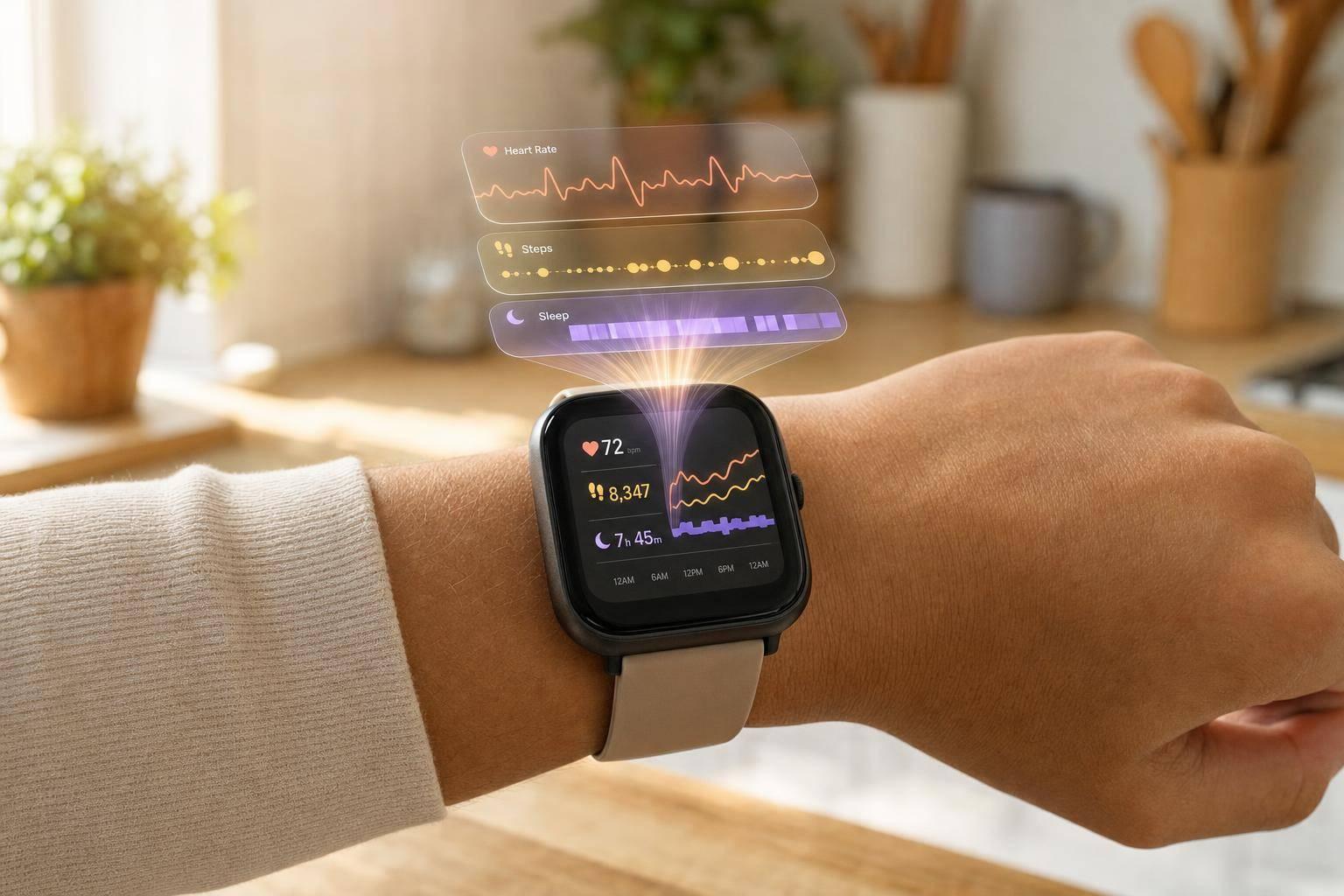
Your wearable is useful, but many of its numbers are still estimates. AI helps by cleaning noisy sensor data, spotting bad readings, filling small gaps, and combining signals like heart rate, motion, and device position before you see the final score.
Here’s the short version:
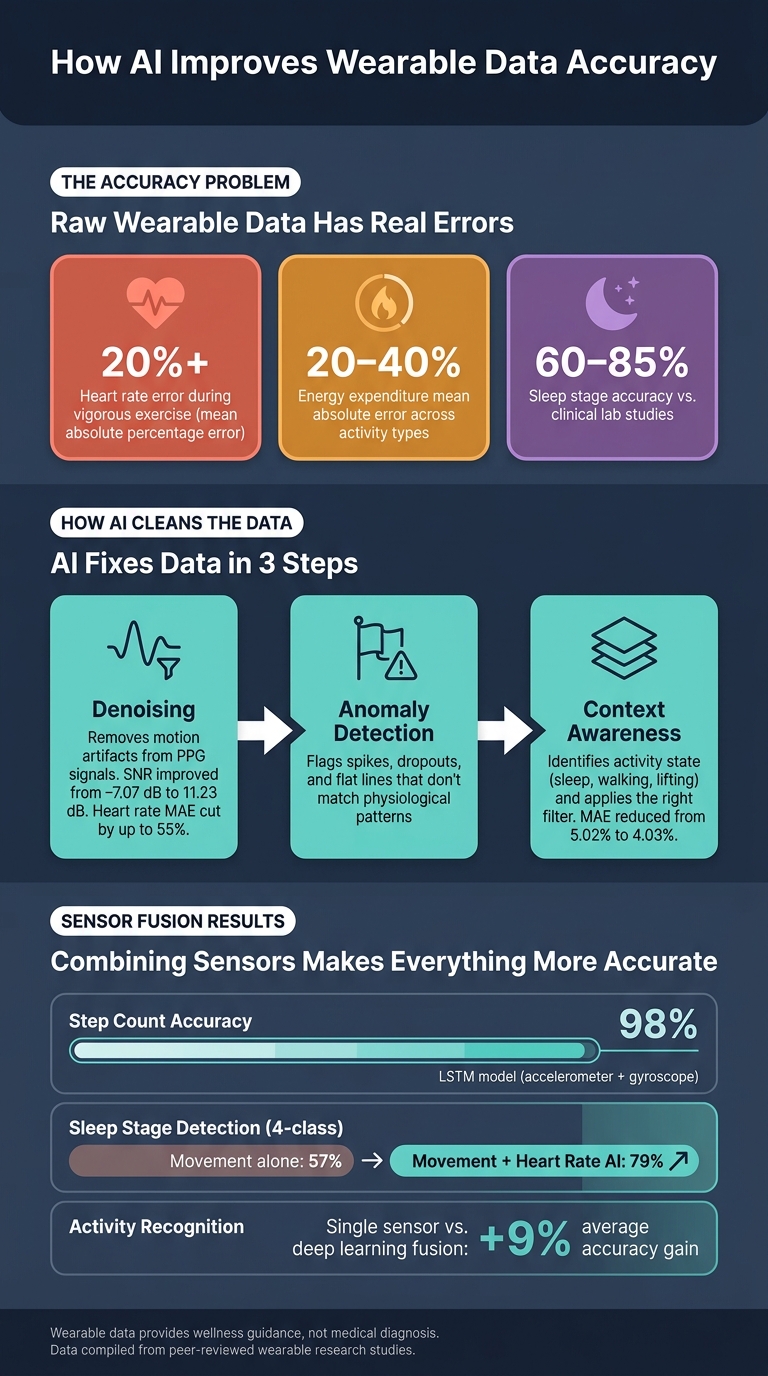
- Heart rate can drift during movement, sometimes by 20%+ or even 30 beats per minute in hard workouts.
- Step counts can be off when arm motion looks like walking.
- Sleep stages are estimates, and some devices land around 60% to 85% against lab sleep tests.
- AI improves accuracy by:
- filtering motion noise
- flagging odd readings
- using context, like whether you’re sleeping, walking, or lifting weights
- combining data streams instead of relying on one sensor alone
- learning your baseline so trends make more sense for you
What this means for you is simple: cleaner data leads to better day-to-day guidance. But wearables still do not diagnose medical problems, and their scores should be used as coaching, not proof.
Bottom line: AI does not make wearable data perfect. It makes it less noisy, more consistent, and more useful for daily health decisions.
How AI Fixes Wearable Data: Key Accuracy Stats
From Fitness Tracker to AI Health Hub: Which Health Metrics Really Matter? | Behind the Numbers
sbb-itb-f5765c6
The main accuracy problems with wearable data
Wearable data usually falls apart in three places: motion noise, data gaps, and modeled estimates. That’s where errors start, and it’s the messy raw input AI has to sort through before anything looks clean on your dashboard.
Motion artifacts, sensor noise, and unstable readings
Most wrist-worn devices use optical sensors that shine light into your skin to track blood flow. That setup works fairly well when you’re still. Once your wrist starts moving, the signal gets messy.
During vigorous exercise, mean absolute percentage errors for heart rate can go past 20% across commercial wearables.[2] And intensity isn’t the main issue here. Movement type matters more. High-intensity motion can shift the device on your wrist and throw off heart-rate readings. There’s also a quieter problem in the background: the algorithm can mistake breathing patterns or arm movement for heart rate.[1][3]
That’s what makes these errors tricky. The numbers can look perfectly believable while still being wrong.
Once the signal gets noisy, the next job is to filter out that distortion.
Missing data, nonwear time, and weak signal coverage
Small habits can bend the data more than people think. If you charge your device every morning, you lose steps and heart-rate data during that stretch, and those gaps can skew your weekly averages.
Sleep is an even bigger trouble spot. If you take the device off before bed now and then, the nights you do wear it can make your sleep look better than it is. The same thing happens with stress and resting heart rate. The data you miss is often the data that matters most. A loose fit, low battery, or Bluetooth drop can also cut into data completeness in ways that won’t stand out in summary stats.[6]
When pieces of the signal are missing, AI has to fill in the blanks from the pattern around them.
Modeled metrics are estimates, not direct measurements
Calories, sleep stages, active minutes, and readiness scores aren’t things a wearable directly sees. They’re model outputs. The device takes raw signals like movement, heart rate, and sometimes skin temperature, then turns them into a number.
That process has limits. Energy expenditure estimates from popular devices have shown mean absolute errors in the 20% to 40% range across different activity types, with systematic overestimation at most intensity levels.[5] Sleep stage classification is still only about 60% to 85% accurate when compared to clinical sleep studies, and devices tend to overestimate total sleep time while underestimating how often you wake up.[7]
That’s why AI starts with the raw signal first. Before it can improve daily metrics, it has to clean the input data you never see.
How AI cleans up raw sensor data before you see the numbers
Wearable metrics go through a cleanup step before they show up in your app. AI strips out noisy signal parts, flags readings that look off, and adjusts for what was happening at the time so the numbers you see are more dependable. Once the signal is cleaned, the system can also check whether each reading makes sense next to the rest of the data.
AI denoising cuts out motion-related signal distortion
Raw PPG signals start getting messy the moment you move. Instead of using only a basic filter, AI denoising models are trained to pull apart the true cardiac signal from motion interference.
The payoff shows up in the data. One motion-artifact reduction method improved signal-to-noise ratio from –7.07 dB to 11.23 dB and cut heart rate mean absolute error by up to 55% on synthetic datasets.[4] Another self-supervised method learns from large databases of clean PPG signals to remove artifacts and rebuild corrupted segments without any hand-labeled motion events.[9]
In plain English, that can turn a shaky heart-rate reading during a walk into something you can actually use.
After that cleanup step, the system still needs to catch readings that don't line up.
Anomaly detection flags readings that do not fit the expected pattern
Not every bad reading looks wildly wrong. Sometimes the issue is subtle: a slow drift from a loose band, or a flat line in the middle of a workout.
AI anomaly detection models learn the usual relationship between heart rate, motion, and waveform signals. Then they flag readings that break those patterns in ways that don't make physiological sense. For example:
- A sudden spike without matching motion data
- A signal dropout while the accelerometer shows activity
- A heart rate that stays flat during exercise
When a reading gets flagged, the system can mask it, fill in a likely value from nearby data, or label it as low-confidence. That way, it doesn't quietly throw off your daily stats.
That same idea carries into activity awareness too. The sensor may be the same, but the situation around it changes everything.
Context-aware models adjust for movement and device position
The same wrist motion can mean very different things depending on what you're doing. Context-aware AI models use accelerometer and gyroscope data to figure out the activity, then read the PPG signal through that lens.
Different activities leave different fingerprints in the signal. Weightlifting creates short, intense bursts of motion. Sleep usually means very little movement, with the occasional shift that shouldn't be read as exercise. When the model spots those states, it can apply the right filtering approach for that moment instead of treating every signal the same way.
One study that integrated physical-activity level into heart rate estimation across multiple wearable devices reduced overall mean absolute error from 5.02 ± 0.64% to 4.03 ± 0.30%, with larger gains at rest and during sleep.[8] That's how context helps the same sensor produce better numbers.
How AI combines multiple signals to build more reliable health metrics
After cleanup, AI brings together motion, heart rate, and rotation data so each reading can be checked against the others. Once the raw signal is cleaned up, the system can compare one sensor with another and catch things a single data stream would miss.
Sensor fusion improves activity recognition and step accuracy
A wrist accelerometer on its own has a hard time telling the difference between typing at a desk and taking a slow walk. Add gyroscope data and heart rate, and the signal becomes much easier to read.
A gyroscope adds rotation data, which helps separate cycling from walking and other similar wrist movements.[11][14] Heart rate adds one more check. Two activities can look alike in motion data but lead to very different cardiovascular responses. One deep learning sensor-fusion model reported average accuracy gains of about 9% compared with single-sensor models, with similar gains in precision and recall.[12]
Fusion also cuts down on false steps from hand gestures and other nonwalking arm movement. When the model checks gait rhythm, whole-body motion patterns, and heart rate response together, those nonwalking movements are more likely to get filtered out.[10][13][14] An LSTM-based model using wrist accelerometer and gyroscope data reached about 98% step-count accuracy.[18]
AI-based sleep analysis uses movement and heart patterns together
Motion-only sleep tracking often mistakes stillness for sleep. That's why consumer wearables that rely only on actigraphy tend to overestimate total sleep time by 2% to 10%.[15]
When wrist movement is combined with heart rate variability (HRV), the picture gets sharper. During deep NREM sleep, heart rate drops and HRV shows high parasympathetic activity. During REM, the body stays mostly still, but heart rate rises a bit and HRV follows a different pattern. AI models trained on these combined signals can sort sleep into wake, light, deep, and REM stages with solid accuracy. One PPG-plus-accelerometer model, SleepPPGNet, reached 78.7% overall accuracy for four-class sleep staging against a sleep study, with 94.1% accuracy for sleep vs. wake detection.[17] Adding heart rate and timing signals to movement data increased four-stage detection accuracy from 57% to 79%.[16]
Personalized baselines make trends more useful over time
Population averages don't say much about one person's health. A resting heart rate that looks normal for one person might be a meaningful shift for someone whose usual baseline is lower.
AI learns your normal range over days or weeks, so recovery and readiness scores are based on your own history instead of a generic chart. For Healify, that means recommendations can reflect your personal baseline rather than a one-size-fits-all target. The result is daily guidance that fits the person wearing the device.
What better accuracy means for personalized health coaching
From corrected data to clearer daily recommendations
Cleaner data changes the kind of advice you get. When AI cuts noise, fills in gaps, and adjusts readings to your own baseline, the guidance becomes specific enough to use. This process allows for personalized health insights from wearable anomaly data that were previously hidden by sensor errors. That could mean a sleep tip based on your recovery pattern or an activity goal that shifts after a hard day.
Digital health programs that personalize around wearable data do better than ones that lean on self-reported inputs. The standardized difference in means was 1.48 (95% CI 0.76–2.19), compared with 0.663 overall.[21] Still, wearable outputs are estimates, not direct measurements. Good coaching treats them as guidance, not certainty.
That only matters if the system can turn cleaner data into something useful in your day-to-day life.
How Healify uses AI to make wearable data easier to act on
Healify puts that idea into practice by turning cleaned wearable data into clear next steps. It takes wearable data, biometrics, bloodwork, and lifestyle inputs, then translates them into plain-language actions through its 24/7 AI coach, Anna.
Personal health LLMs trained on high-quality, cleaned wearable data have shown results statistically similar to expert coaches on structured sleep and fitness topics. On certification-style tests, they scored between 79% and 88%.[20][19] Healify follows that path. The goal isn't to replace professional care. It's to make the data you're already collecting more useful from one day to the next.
Conclusion: AI improves accuracy, but better guidance still depends on context
Better accuracy isn't about perfect numbers. It's about giving people better context for decisions. AI can cut noise, fill gaps, and tailor scores, but context still shapes what advice makes sense. Wearable guidance works best as coaching, not diagnosis.
AI recommendations are best used as wellness guidance, not medical conclusions. If a pattern points to something that needs a closer look, the next move is still a conversation with a clinician, not just a recalibrated score.
FAQs
How does AI know when wearable data is wrong?
AI can spot bad wearable data by checking for readings that don't make sense, odd patterns, and mismatches across signals. It can also cut down on errors that come from movement or a sensor sitting in the wrong place.
When data is missing, AI may fill in the gaps based on your past patterns. And by comparing new readings with your personal baseline, it can separate normal day-to-day changes from a true anomaly.
Can AI make sleep and heart rate tracking fully accurate?
AI can make sleep and heart rate tracking much better, but perfect accuracy is still something the field is working toward.
It helps by reading sensor data in real time, flagging odd patterns, fixing uneven readings, and checking new data against your personal baseline. It also uses advanced filtering to cut down noise from movement or temperature shifts.
Why do personalized baselines matter in wearables?
Personalized baselines show what’s normal for you - things like resting heart rate, HRV, sleep efficiency, and stress patterns. That matters because AI can look for changes that stand out from your usual range instead of leaning on broad population cutoffs.
When wearables compare current readings with your normal patterns, they can spot actual anomalies sooner, cut down on false alarms, and give guidance that’s more specific and useful.