
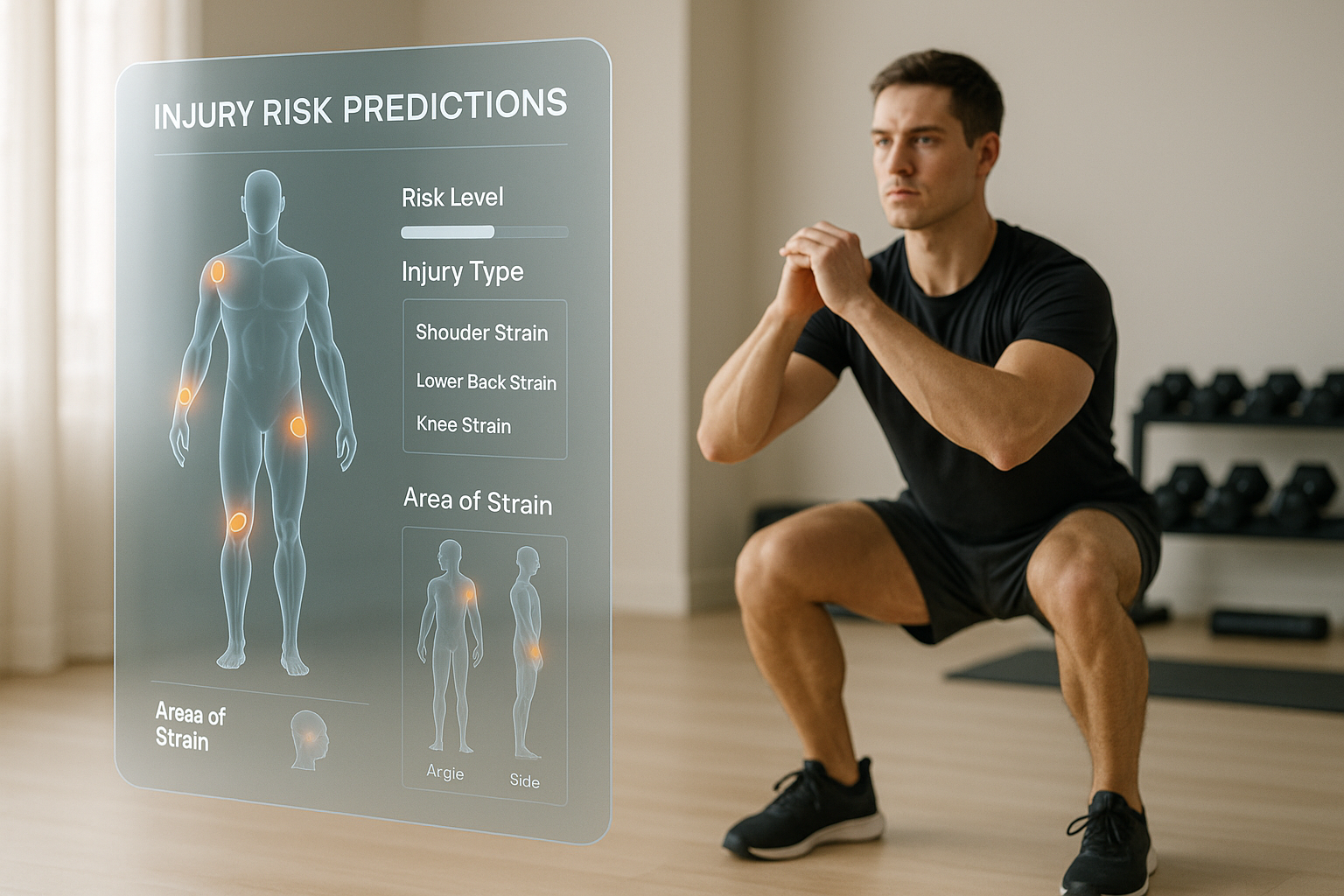
AI is transforming injury prevention in fitness and sports. By analyzing data from wearables, biomechanics, and training patterns, AI predicts injury risks with up to 95% accuracy. This proactive approach helps athletes stay safe and improve performance.
Key Takeaways:
- AI's Role: AI predicts injuries by analyzing movement, training loads, and health data. Tree-based models like Random Forest and XGBoost are highly effective, with an average AUC score of 0.77.
- Recent Advances: Models now predict risks like musculoskeletal injuries after concussions with 95% accuracy. Biomechanical analysis identifies movement issues to prevent injuries.
- Unified Systems: Platforms like BondMCP integrate fragmented health data for precise injury predictions, reducing bias and enhancing reliability.
- Impact: AI-powered tools lead to fewer injuries, smarter training, and personalized recovery plans.
AI is shifting fitness from reactive care to proactive injury prevention, benefiting athletes at all levels.
Recent AI Model Advances for Injury Prediction
Concussion-Related Injury Prediction
In April 2025, researchers at the University of Delaware achieved a major step forward by developing a model capable of predicting lower-extremity musculoskeletal injuries following a concussion with an impressive 95% accuracy [4]. This advancement is a significant development in sports medicine, addressing the increased risk faced by athletes who have experienced concussions - these individuals are twice as likely to sustain subsequent injuries [4]. The model evaluates over 100 variables, including an athlete's sports and medical history, the type of concussion sustained, and cognitive performance data, to detect subtle changes that traditional assessments often overlook [4].
"Even a minuscule difference in balance, reaction time, or cognitive processing of what's happening around you can make the difference between getting hurt and not", explains Thomas Buckley, professor of kinesiology and applied physiology at the College of Health Sciences [4].
"Tracking an athlete's performance over time, rather than relying on absolute values, helps identify disturbances, deviations, or deficits that, when compared to their baseline, may signal an increased risk of injury", adds Austin Brockmeier, assistant professor of electrical and computer engineering [4].
Interestingly, the model maintained high accuracy even when sport-specific data was excluded, suggesting that individual characteristics play a more significant role in risk assessment than the type of sport itself. The next step for these AI systems involves incorporating biomechanical analysis, further enhancing their ability to predict and prevent injuries by combining diverse data sources.
AI-Powered Biomechanical Analysis
Building on the success of concussion-related injury prediction, biomechanical analysis represents another key innovation in the field. A study published in the Journal of Biomechanics demonstrated that machine learning algorithms could effectively predict knee injury risk by analyzing jump-landing movements [5]. This method focuses on detecting subtle changes in movement that might indicate a higher likelihood of injury.
AI-powered biomechanical analysis uses data collected from wearable sensors and motion-tracking devices to identify problematic movement patterns. These systems monitor factors like speed, acceleration, joint angles, and force production, offering early warnings about potential injury risks. The insights generated can then be used to design personalized training programs aimed at mitigating these risks [6].
What makes this approach particularly transformative is its application in rehabilitation. AI tools provide real-time feedback to help athletes adjust their movement patterns, reducing the likelihood of re-injury. Current advancements in this area include the use of deep learning algorithms to analyze increasingly complex biomechanical data and the development of advanced wearable devices capable of detailed tracking during both training and competition [5].
Key Factors and Methods in AI Injury Prediction
Common Risk Indicators Analyzed by AI
AI systems analyze a variety of physical and performance-related factors to predict injury risks for athletes and fitness enthusiasts. By combining multiple data points, these models create detailed risk profiles.
Physical attributes often serve as the foundation for these predictions. For instance, in Australian Football, factors like age, height, body mass, and playing position were used to predict hamstring strains with an accuracy of 85% [7].
Strength and flexibility metrics also play an important role. A study involving NCAA athletes found that combining hip strength measurements with demographic details and balance data could reliably predict future injuries [7]. AI can identify imbalances or weaknesses that might otherwise go unnoticed.
Training load and recovery factors are critical as well. Research on elite male volleyball players highlighted predictors such as fatigue, overuse patterns, sleep quality, muscle soreness, and overall training intensity [7].
Performance characteristics in elite youth football further demonstrate the power of AI. By integrating physical data like height and weight with attributes such as strength, flexibility, speed, agility, and endurance, an AI model using XGBoost achieved an impressive 85% precision in injury risk assessment [7].
Machine Learning Techniques in Injury Prevention
To turn these risk indicators into actionable predictions, machine learning algorithms are employed. Among these, tree-based models are particularly effective.
Random Forest is the most frequently studied method for injury prediction, appearing in 54% of reviewed studies [2]. Its strength lies in its ability to handle complex datasets and deliver reliable results. Variants like conditional, calibrated, and survival Random Forests have been successfully applied across various sports and injury types.
Extreme Gradient Boosting (XGBoost) has also shown outstanding performance. In every study where it was tested, XGBoost delivered the best statistical outcomes [2]. This consistency has made it a go-to algorithm for developing advanced injury prediction systems.
Tree-based models stand out in their predictive capabilities. In 60% of studies, these algorithms outperformed others, achieving an average AUC score of 0.77 - 12% higher than the 0.69 average reported by other methods. Notably, a Random Forest model achieved the highest AUC score of 0.95 [2].
Other methods, like Support Vector Machines (SVM) and Artificial Neural Networks (ANN), also contribute to injury prediction, especially when combined with additional data sources. For example, in a study focused on elite soccer players, SVM achieved an AUC score of 0.9725 when predicting reinjury risk using cardiopulmonary exercise test data [8].
AI Model Development Process
Creating effective injury prediction models involves a systematic process, starting with the integration of data from various sources [1].
Data preprocessing is a crucial first step. This involves standardizing inputs from different devices and platforms, as well as addressing missing or noisy data to ensure the dataset's integrity [1]. Feature selection then narrows down the most relevant predictors of injury.
During the model training phase, machine learning algorithms identify patterns and relationships between risk factors and injury outcomes. Striking a balance between model complexity and interpretability is essential, as the ultimate goal is to provide actionable insights for coaches and medical staff.
Validation is the final and perhaps most critical step. It ensures that the system is both reliable and accurate before being deployed. Despite advancements, a systematic review found that 98% of AI-based analyses for predicting sports injuries had a high or unclear risk of bias [1]. This highlights the importance of rigorous validation protocols and stricter standards in model development.
Additionally, ethical considerations around data privacy and transparency must be prioritized, given the sensitive nature of health and performance data these systems handle [1].
Forum Numerica - Estelle Delouche - Integrating AI and Biomechanics for Sports Injury Prevention
Integrating AI with Unified Health Systems
Fragmented health data is a major hurdle for AI in healthcare. Picture this: athletes and fitness enthusiasts often juggle multiple devices and platforms - wearables for heart rate tracking, apps for logging workouts, electronic medical records, and performance evaluations from coaches. This scattershot approach creates silos of information, limiting how effectively AI models can analyze and predict. AI thrives when it has access to a seamless flow of comprehensive data, and that's where unified systems like BondMCP come into play, revolutionizing injury prediction by integrating these isolated data sources.
BondMCP's Role in Injury Risk Prediction

BondMCP tackles the challenge of disconnected health data by creating a smart layer that bridges the gap between various systems. For athletes, this means a unified ecosystem where sleep patterns, workout routines, and medical records all work together seamlessly. This integration has already shown its value in diverse sports environments.
What makes BondMCP stand out is its structured protocol and SDK, which empower developers to create health-aware, contextually intelligent agents right from the start. This eliminates the need to repeatedly build memory systems, agent routing, or toolchains for every new application. For clinics and health platforms, BondMCP offers scalable solutions that connect previously siloed data sources, enabling proactive care. Instead of relying on static dashboards that capture isolated health snapshots, it facilitates a dynamic, interconnected approach to precision health.
Benefits of Context-Aware AI
With unified data integration, context-aware AI systems unlock new levels of effectiveness in injury prevention. When AI has access to a comprehensive dataset covering biomechanics, training loads, physiological metrics, and historical records, its ability to recognize patterns becomes far more advanced [3].
"AI models improve the accuracy and reliability of injury risk assessments by tailoring prevention strategies to individual athlete profiles and processing real-time data." – Carmina Liana Musat, Faculty of Medicine and Pharmacy, 'Dunarea de Jos' University of Galati [10]
Real-time responsiveness is another game-changer. When health systems communicate seamlessly through a unified protocol, AI can issue immediate alerts for anomalies. This capability is critical, especially when you consider that U.S. emergency departments handle about 4.3 million nonfatal sports and recreation-related injuries annually [9].
Comprehensive data integration also addresses a key issue: bias in predictive models. A 2022 study in Sports Medicine revealed that 98% of sports injury prediction models carried a high risk of bias [3]. By capturing a full spectrum of data, systems like BondMCP reduce these gaps, leading to more accurate predictions.
Additionally, unified platforms significantly enhance operational efficiency. By 2025, healthcare is expected to generate around 10,800 exabytes of data, with 80% being unstructured [11]. Unified systems organize and contextualize this massive volume of information, transforming it into actionable insights for injury prevention rather than leaving it scattered across isolated silos.
Finally, a health-specific ontology ensures that different systems interpret data consistently. This standardization is essential for maintaining high data quality and enabling accurate communication between systems, which directly supports more reliable injury risk assessments.
sbb-itb-f5765c6
Future Prospects for AI in Injury Prevention
The role of AI in injury prevention is evolving quickly, moving athlete care from reactive treatments to a more predictive and preventative approach.
Enhanced Precision with Data Integration
Recent advancements in data integration are significantly improving the precision of AI systems - some now boast accuracy rates exceeding 92% [undefined][10]. By combining information from wearable devices, biomechanical evaluations, performance data, and even psychological factors, AI creates detailed, individualized athlete profiles. This integration addresses a major limitation of earlier models by breaking down data silos and enabling a more comprehensive understanding of injury risks.
The effectiveness of this approach is already evident. For example, AI-powered wearables can now predict injuries with an impressive 94% accuracy [15]. These advancements are setting the stage for broader adoption, benefiting both individual athletes and entire teams.
Expanding AI for Teams and Individuals
The sports AI market is projected to hit $19.2 billion by 2030 [15]. Professional leagues adopting AI have already seen tangible benefits, such as reducing injury-related costs by nearly $690,000 per season. Meanwhile, apps tailored for individual users are achieving triple the engagement rates of traditional tools [15][17].
During trial phases, predictive AI models have shown a 20% drop in soft tissue injuries, with 85% of athletes modifying their routines based on AI-generated feedback [15]. Real-time coaching tools for runners now analyze form on the fly, while strength training apps adjust workouts based on fatigue levels [12]. Despite these advancements, professional athletes still face an average of 62.49 injuries per 100 players each season [16]. This underscores the importance of building robust systems. Collaborative data-sharing initiatives, where organizations pool resources to create larger datasets, could unlock even more refined machine learning models. These models would allow for highly personalized risk assessments and better injury prevention strategies [2].
Shifting to Proactive Health Management
The next big leap in injury prevention is proactive health management, made possible by AI's ability to continuously monitor and intervene in real-time. This shift moves injury care from being reactive to proactive.
"AI's integration into sports & exercise medicine is driving precision, personalization, and proactive care, ultimately improving outcomes for athletes and patients alike." – Prof Patrick Shu-hang YUNG, Chairman of Department of Orthopaedic and Traumatology; Associate Dean of Mainland Affairs, Faculty of Medicine, The Chinese University Of Hong Kong [13]
AI systems now process data from wearables, cameras, and sensors to assess biomechanics and identify potential injury risks [13]. By analyzing both historical and live data - like training loads, sleep patterns, and biomarkers - these systems can flag overuse injuries before they even begin to show symptoms [13].
This proactive approach is also transforming recovery and rehabilitation. AI creates customized recovery plans based on the type of injury, progress made, and biometric feedback [13]. Wearables and smartphone apps play a crucial role here, ensuring exercises are performed correctly and minimizing the chance of re-injury.
AI is also making strides in concussion detection. By evaluating balance, cognitive performance, and speech patterns, these systems can identify concussions and monitor recovery, helping teams make informed return-to-play decisions. The integration of AI with technologies like biometric sensors, augmented reality, and 5G connectivity is enabling even more advanced real-time monitoring and feedback systems [14].
Perhaps most groundbreaking is AI's ability to detect early signs of health deterioration and optimize treatment plans based on individual needs [12]. This turns injury prevention into a more predictive science, where issues are addressed before they escalate. Looking ahead, AI-powered platforms are expected to deliver increasingly accurate risk predictions and automated safety measures [14]. As global safety standards continue to evolve, these systems will likely become a cornerstone of sports and fitness at all levels.
Conclusion: The Path Forward for AI in Fitness
AI is taking injury prediction from educated guesses to precise science. With models now reaching 95% accuracy in predicting lower-extremity musculoskeletal injuries following concussions, we're seeing a major shift in how athletes and fitness enthusiasts tackle injury prevention [4].
Dan Watson, Deputy Athletic Director of Competitive Excellence and Campus Recreation, summed it up perfectly:
"We can't prevent injuries, but we can reduce and mitigate the risks, and that's what this model does for athletics." [4]
The real breakthrough lies in data integration. By pulling together information from wearables, biomechanics, and recovery metrics, AI systems can create risk profiles that simply weren't possible before. Platforms like BondMCP play a key role here, bridging the gap between fragmented health data and giving AI models a full picture rather than piecemeal insights.
Austin Brockmeier, Assistant Professor of Electrical and Computer Engineering, emphasized the value of personalized tracking:
"Tracking an athlete's performance over time, rather than relying on absolute values, helps identify disturbances, deviations, or deficits that, when compared to their baseline, may signal an increased risk of injury." [4]
The challenge now isn’t whether AI will change injury prevention - it’s how quickly we can scale these solutions in a responsible way. As discussed earlier, scaling requires large, diverse datasets and thorough validation. A 2022 study revealed that 98% of sports injury prediction models face a high risk of bias, often due to limited sample sizes [3]. Building robust, inclusive datasets while safeguarding privacy will be critical to success.
AI-driven injury prediction is no longer just for elite athletes - it’s becoming accessible to professionals, weekend warriors, and everyone in between. The future of fitness lies in smarter, connected systems that shift injury prevention from reactive care to proactive science.
FAQs
How do AI models like Random Forest and XGBoost accurately predict injury risks in athletes?
AI models like Random Forest and XGBoost have proven to be powerful tools for predicting injury risks in athletes. What sets them apart is their ability to analyze intricate, non-linear patterns in data that traditional methods often overlook. By processing a wide range of inputs - such as athlete profiles, training intensity, and past injury records - these models can identify connections that might otherwise go unnoticed.
One of their standout features is how well they handle large datasets with multiple variables at once. Studies repeatedly highlight their impressive predictive accuracy, often achieving AUC scores above 0.9, which reflects top-tier performance. This makes them incredibly useful for assessing injury risks in a variety of sports and fitness settings.
How does biomechanical analysis improve AI's ability to predict and prevent injuries in fitness and sports?
How Biomechanical Analysis Boosts AI in Injury Prevention
Biomechanical analysis plays a crucial role in improving AI's ability to predict and prevent injuries. By studying how people move and perform, AI can use tools like wearable sensors and motion analysis to gather detailed data on movement patterns. This information helps pinpoint inefficiencies or potential risks that might lead to injuries.
With this data, AI systems can develop personalized strategies for injury prevention. They can also monitor physiological changes in real time, addressing potential problems before they become serious. This blend of biomechanics and AI not only helps athletes and fitness enthusiasts train more safely but also enhances their overall performance.
How does combining fragmented health data with platforms like BondMCP improve AI predictions for injury risks in fitness?
Integrating scattered health data through platforms like BondMCP helps create a unified dataset, boosting the precision and dependability of AI injury risk predictions. By blending data from wearables, medical records, fitness habits, and real-time health metrics, AI models can uncover individual risk factors and patterns that might otherwise be overlooked.
This integrated approach allows AI to deliver more tailored and accurate injury risk assessments. For instance, combining real-time data with historical trends enables AI to spot subtle red flags and suggest timely actions, potentially preventing injuries. Advanced machine learning techniques, such as neural networks, take this a step further by analyzing intricate relationships between variables, leading to safer and more effective fitness strategies.