
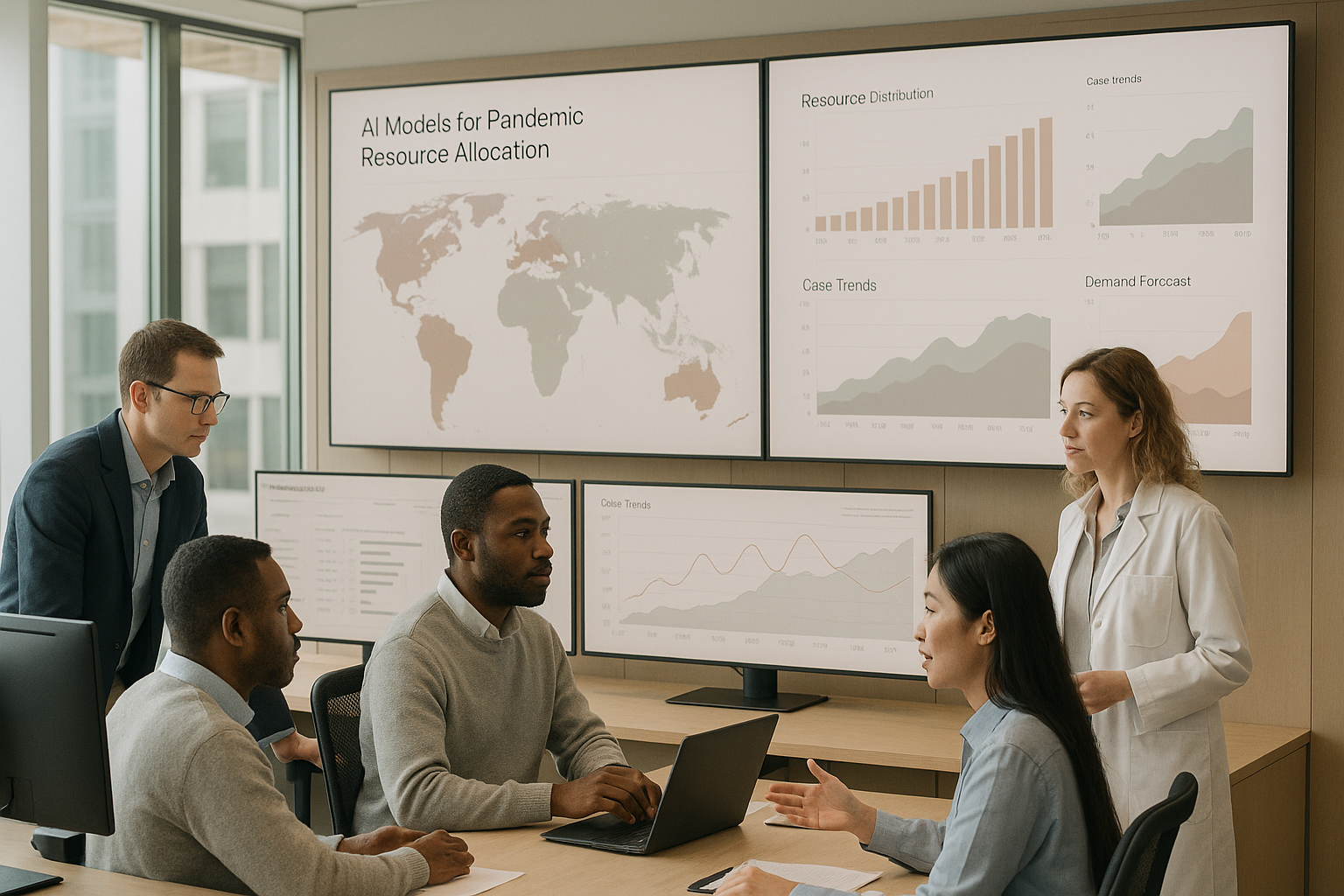
AI is transforming how we manage pandemics, helping healthcare systems save lives and resources. From predicting disease outbreaks to optimizing medical supply distribution, AI tools are reshaping pandemic responses. Here’s how:
- Efficient Resource Allocation: AI ensures critical supplies like ventilators and PPE are distributed where they’re needed most, reducing shortages.
- Predictive Modeling: Advanced AI models forecast disease spread and patient outcomes, enabling early interventions.
- Faster Vaccine Development: AI accelerates vaccine research, cutting development time and improving precision.
- Real-Time Decision-Making: AI processes massive data sets quickly, helping hospitals manage staff, beds, and supplies through custom dashboards for real-time health insights during surges.
- Wearable Tech Integration: Devices powered by AI detect early signs of illness, providing critical data for outbreak monitoring.
AI’s ability to analyze data and predict trends is helping healthcare systems prepare for and respond to pandemics more effectively. While challenges like data privacy and accuracy remain, the potential for AI to revolutionize public health is undeniable.
Dynamic Resource Management in Response to Pandemics
AI Predictive Models for Managing Disease Outbreaks
Predicting how diseases spread during pandemics is no easy task. Traditional epidemiological models often fall short when it comes to accounting for ever-changing factors like human behavior and government policies. This is where AI-powered predictive models shine - they can process massive amounts of real-time data to forecast outbreak trends and healthcare resource needs with greater precision [10]. These advancements highlight AI's growing role in helping manage resources during pandemics.
How AI Enhances Disease Spread Predictions
AI models bring a new level of sophistication to analyzing pandemic data, uncovering patterns that traditional methods might overlook [4]. Unlike older approaches, these models combine a wide range of factors - like epidemiological data, environmental conditions, real-time biomarker monitoring, mobility trends, and vaccination rates - to create a more complete picture of disease dynamics [5].
Using advanced architectures such as CNN-LSTM and transformer models with self-attention, AI can quickly adapt to policy changes, like the introduction or easing of lockdowns, to deliver real-time, accurate forecasts [4]. This flexibility is crucial when conditions are changing rapidly.
The results speak for themselves. For instance, an improved LSTM deep learning model achieved an average prediction error of just 1.43% for confirmed COVID-19 cases in Russia over a three-day period in July 2020 [6]. In another study, an AI model outperformed both LSTM (R² = 0.89) and CNN (R² = 0.90) with a higher R² of 0.92, showcasing its superior forecasting accuracy [5].
AI doesn't just predict disease spread - it also excels at forecasting patient outcomes. For example, a Decision Tree model successfully predicted hospitalization durations with a determination coefficient of 49.8% and achieved a 96% accuracy rate in assessing mortality risks. These insights have helped healthcare systems better prepare for surges in patient demand [6].
Real-World Applications of AI During COVID-19
The practical use of these models during the COVID-19 pandemic demonstrates their potential. For example, Alibaba's AI system could diagnose COVID-19 from CT scans with 96% accuracy in just 20 seconds [2]. In Guangdong, China, AI algorithms analyzed large datasets to trace and predict transmission paths, significantly reducing local transmission rates within the first month [2]. Meanwhile, Baidu's AI-powered assistant, Melody, provided remote consultations, streamlining diagnostics and patient care during the crisis [2].
In Shanghai, the "COVID-19 Intelligent Evaluation System" at the Public Health Clinical Center processed patient data and imaging results to identify high-risk cases, enabling early intervention and prevention measures [2]. Baidu also developed a surveillance platform that tracked the virus's spread across China, identifying numerous potential cases in its early stages. This early detection likely played a role in lowering transmission rates in affected areas [2].
Another example is the "COVID-19 Analysis and Control Platform" from the Nanjing Edge Intelligence Research Institute. This platform aggregated real-time geographic and temporal data to support regional prevention and control measures [2]. Google AI also contributed by creating a model capable of predicting COVID-19 case numbers up to two weeks in advance, helping healthcare systems plan resources and staffing more effectively [7].
However, these successes came with challenges. AI forecasts weren't always accurate, often due to issues like limited data, noisy inputs, and the tension between maintaining data privacy and addressing public health needs [8]. As G. Petropoulos pointed out:
"AI systems are still at a preliminary stage, and it will take time before the results of such AI measures are visible."
- G. Petropoulos [8]
While AI predictive models aren't flawless, they represent a major step forward compared to traditional methods. Their ability to provide actionable insights has proven invaluable in helping healthcare systems prepare for and respond to crises more effectively.
Using AI to Distribute Healthcare Resources
AI has transformed how critical healthcare resources are distributed during crises, offering a lifeline in situations where traditional methods often falter. In times of pandemics or natural disasters, ensuring medical supplies reach the right places quickly can save lives. By leveraging vast data sets, AI systems are reshaping supply chains to meet these urgent demands more effectively.
AI-Based Medical Supply Distribution
One of AI's standout capabilities is predicting where medical supplies will be needed before shortages arise. By analyzing a variety of data sources - hospital inventories, patient admission rates, social media activity, and even online search trends - AI systems can forecast demand with impressive accuracy.
But AI doesn't stop at forecasting. It actively optimizes the distribution of limited resources like medicines and personal protective equipment (PPE). For example, during the COVID-19 pandemic, AI played a crucial role in addressing shortages of ventilators, masks, and other essential equipment by adjusting distribution patterns in real time based on shifting needs [1].
AI also enhances logistics by optimizing delivery routes. Using real-time insights into traffic conditions, weather, and delivery priorities, these systems ensure that medical supplies reach their destinations as quickly as possible. This dynamic routing capability proved invaluable during crises when transportation networks were under strain [11].
The technology has also shown its value in disaster response. For instance, researchers like Zahedi and colleagues developed a decision-making model to coordinate goods distribution and vehicle routing during emergencies. Their work, tested with data from the 2017 Kermanshah earthquake in Iran, demonstrated how AI can streamline complex logistics when every minute matters [1].
Generative AI further supports crisis management by producing on-demand risk assessments, scenario simulations, and mitigation strategies. This allows healthcare administrators to evaluate multiple distribution plans and choose the most effective one before taking action [11].
AI for Healthcare Staff and Hospital Management
AI's influence extends beyond supplies, improving staffing and operational decisions during patient surges. Managing healthcare personnel during a crisis is a delicate balancing act - hospitals must ensure adequate staffing levels while protecting workers from exhaustion and exposure. AI systems simplify this process by analyzing real-time data on patient flow, staff availability, and facility capacity.
These systems can proactively alert administrators to potential staffing shortages, enabling them to reallocate personnel or bring in additional support before the situation becomes critical [11]. This proactive approach builds resilience, ensuring that hospitals remain functional even under extreme pressure.
Capacity management is another area where AI shines. Algorithms process data on admission rates, discharge patterns, and treatment durations to predict when a hospital might hit its capacity limits. During the COVID-19 pandemic, this capability helped administrators prepare for patient surges, preventing facilities from becoming overwhelmed.
AI also supports decision-making for sourcing strategies. It can recommend whether hospitals should hire temporary staff, redistribute existing teams, or collaborate with other facilities to share resources [11].
The broader impact of AI on healthcare logistics is notable. Machine learning has reduced demand forecasting errors by 10–20% and improved reaction times to disruptions by 20–30%. Delivery reliability has also improved by 10–20%, as AI predicts delays and suggests alternate routes [12].
sbb-itb-f5765c6
AI in Disease Monitoring and Vaccine Development
AI is reshaping how we monitor diseases and develop vaccines, offering tools for early outbreak detection and significantly speeding up vaccine creation.
AI-Powered Pathogen Tracking
AI systems are proving to be game-changers in identifying disease outbreaks before they escalate into global threats. By analyzing a wide range of data - like social media trends, online search queries, and medical records - AI can spot warning signs much earlier than traditional methods.
Take EPIWATCH, for example, which flagged a spike in pneumonia cases in China weeks before the World Health Organization (WHO) officially identified clusters in pediatric hospitals [19]. Similarly, HealthMap raised an alert on December 30, 2019, about "a cluster of cases of pneumonia of unknown cause" in Wuhan, shortly after the first COVID-19 case emerged [18]. A study in Weifang, China, further highlighted AI's precision, showing machine learning methods achieving 100% sensitivity in detecting warning signals, compared to 71% for older adaptive threshold methods [20].
AI's benefits extend to border security and travel screening. In the summer of 2020, Greece implemented a reinforcement learning system named Eva, which identified 1.85 times more asymptomatic COVID-19 carriers than random testing [18].
Hospitals have also embraced AI for pathogen tracking. The Enhanced Detection System for Healthcare-Associated Transmission (EDS-HAT) combined whole-genome sequencing with machine learning to analyze patient electronic health records. Deployed across nine University of Pittsburgh hospital sites from November 2016 to November 2018, this system helped prevent up to 40% of hospital-acquired infections by identifying otherwise undetected transmission routes [18].
These early detection capabilities naturally lead to advancements in vaccine development, where AI is pushing boundaries to respond to emerging threats faster than ever.
Accelerated Vaccine Development with AI
Building on its strength in outbreak detection, AI has revolutionized vaccine development by drastically reducing the time it takes to design effective vaccines. Traditional vaccine development can take years, but AI accelerates this process and introduces new ways to predict viral evolution and optimize molecular structures, similar to how AI tools for patient-centered treatment plans personalize medical care.
In May 2025, scientists at Harvard Medical School introduced a predictive AI model called EVE-Vax. This system uses evolutionary, biological, and structural data to forecast and design surface proteins likely to emerge as viruses mutate. When applied to SARS-CoV-2, EVE-Vax generated 83 optimized spike protein variants with up to ten mutations. Lab tests confirmed these proteins triggered immune responses similar to those observed during the COVID-19 pandemic [17].
"We show that if you can see where a virus is evolving ahead of time, you can begin to make future-proof vaccines", said Noor Youssef, Scientific Lead for the Predictive Modeling for Vaccine Design group at Harvard Medical School [17].
At Los Alamos National Laboratory, researchers under the GUIDE program evaluated 10^17 antibody sequences using 168,000 binding simulations. From this massive dataset, they identified 376 high-confidence designs, alongside 359 lower-confidence ones. One "long-shot winner" even outperformed the top candidate among the high-confidence sequences, showcasing AI's ability to uncover unexpected breakthroughs [13].
AI also excels at analyzing vast amounts of viral genomic data to pinpoint vaccine targets faster than human researchers. By integrating multi-omic datasets - spanning genomics, transcriptomics, proteomics, and immunopeptidomics - AI identifies potential antigens with remarkable speed. Transformer-based models further enhance accuracy in designing vaccine antigens, while improved epitope prediction ensures vaccines target the precise molecules needed to trigger strong immune responses [14].
"Traditional vaccine design uses all sorts of different methods, but nobody's used this approach before. EVE-Vax opens a new field of potential application and design for vaccines", explained Debora Marks, Professor of Systems Biology at Harvard Medical School [17].
The impact of vaccines in the U.S. alone is staggering: over the past 20 years, pediatric vaccines have prevented more than 300 million illnesses, 32 million hospitalizations, and nearly 750,000 deaths [16]. With AI advancing vaccine development, these life-saving benefits could grow exponentially, especially during future pandemics.
"AI's ability to integrate computational speed with biological complexity redefined the boundaries of what is possible in global health responses, signaling a new era of AI-driven therapeutic development for future crises", noted researchers at Islamic Azad University, Iran [15].
Future Applications of AI in Pandemic Preparedness
The future of pandemic preparedness is being reshaped by advancements in AI, which are enabling better resource management and more effective health monitoring. These technologies are paving the way for predicting and preventing disease outbreaks before they spiral out of control.
AI and Wearable Devices for Early Outbreak Detection
Wearable devices are emerging as key tools in identifying potential pandemic threats early on. In 2020, about 30% of adults in the U.S. were using wearables, with adoption expected to grow at an annual rate of 24.7% through 2026 [22]. This expanding use offers a unique opportunity for monitoring health trends across populations.
These devices, powered by AI, track vital physiological data and use machine learning to identify early, pre-symptomatic changes [23]. For example, AI-enabled devices like Garmin and Oura were able to predict COVID-19 infections up to six days before testing, achieving an impressive area under the curve (AUC) of 0.82 [23]. In 2024, researchers introduced an AI-powered wristband that could detect COVID-19 by analyzing vital signs and cough sounds, boasting an accuracy rate of over 90% [23].
While these advancements are promising, challenges remain. Issues like inconsistent data quality, variability in sensor performance, and potential biases need to be addressed with rigorous standards [21][22]. Ethical concerns around privacy, data security, and equitable access also require careful consideration [21][24]. To fully leverage wearable technology, health systems should focus on setting local data quality standards, ensuring device interoperability, and promoting equitable access to both the technology and its insights [21]. Additionally, maintaining reliable signal quality across a wide range of user activities is crucial [24].
In conjunction with wearables, unified health platforms are proving essential for streamlining pandemic responses.
Unified Health Platforms for Better Pandemic Response
The COVID-19 pandemic exposed significant flaws in how health data is integrated, with healthcare systems struggling to manage fragmented information while operating under immense pressure [9]. Moving forward, unified platforms that consolidate diverse health data into actionable insights will be critical for effective pandemic preparedness.
These platforms bring together data from electronic health records (EHRs), public health databases, and patient-generated inputs, enabling AI to identify emerging outbreaks, support patient care, and optimize resource allocation in real time [9]. For instance, BondMCP - Health Model Context Protocol exemplifies how such integration can work. By creating a seamless intelligence layer, BondMCP connects data from wearables, lab results, fitness trackers, and sleep monitors. This allows insights like sleep disruptions detected by wearables to inform hospital capacity planning, while laboratory trends can automatically update public health systems. The result? Faster resource deployment and more precise interventions, all without the need for manual data correlation.
Federated learning systems are also playing a pivotal role in these platforms. These systems enable healthcare organizations to develop machine learning models collaboratively, without centralizing sensitive data. This privacy-preserving approach proved invaluable during the COVID-19 pandemic, when traditional data-sharing methods were restricted [9].
"While AI has remarkable transformative potential for pandemic mitigation, it is dependent upon extensive worldwide collaboration and from comprehensive, continuous surveillance data inputs."
– Professor Eric Topol, MD, Founder and Director of the Scripps Research Translational Institute [3]
To ensure these systems deliver on their potential, it will be essential to establish standardized data collection protocols, agile regulatory processes for rapid approvals, and clear guidelines for data governance and interoperability [9]. These measures can shift the focus from reacting to outbreaks to preventing them, reducing the overall impact of future health crises.
Conclusion: The Future of AI in Pandemic Management
AI has become a cornerstone in managing resources during pandemics. Research highlights that 86% of medical organizations now use AI, with 60% acknowledging its ability to identify health patterns that surpass human capabilities [26]. This marks a major shift in how healthcare systems prepare for and respond to global health crises.
During the COVID-19 pandemic, AI tools demonstrated their value by enabling faster diagnostics and cutting contact tracing times in half. These advancements played a key role in reducing transmission rates, saving lives, and optimizing critical resources [2].
"We know from COVID-19 that we need better tools so that we can inform more effective policies. There will be another pandemic, and these types of frameworks will be crucial for supporting public health response." - Lauren Gardner, Johns Hopkins [27]
Building on these successes, the next step involves integrating AI capabilities into unified health platforms to enhance pandemic preparedness. AI's future potential is immense. For instance, machine learning algorithms are already outperforming traditional methods in predicting outbreak patterns. However, achieving this potential hinges on addressing critical challenges. Data standardization is essential for creating effective learning healthcare systems, while explainable AI is vital for earning the trust of healthcare professionals and policymakers [9]. Additionally, 72% of organizations cite data privacy as a major concern, underscoring the need for robust frameworks that protect patient information while enabling collaborative AI development [26].
As Martin McKee, Research Director of the European Observatory on Health Systems and Policies, notes:
"AI will have profound consequences for public health... The one thing about which we can be certain is that health policymakers of the future will have to acquire an understanding of this complex area" [25].
To ensure AI's responsible use, policymakers must establish clear guidelines, mandate transparency in AI training methods, and prioritize the development of explainable AI systems. At the same time, healthcare systems should work to integrate AI into existing workflows with minimal disruption, leveraging diverse datasets to promote equitable access to care [25].
FAQs
How does AI improve predictions of disease outbreaks compared to traditional models?
AI has transformed how we predict disease outbreaks by diving into massive, complex datasets in real time - something traditional models, often tied to historical data and slower processes, struggle to achieve. By pulling information from diverse sources like social media trends, weather conditions, and health records, AI uncovers patterns and trends that might otherwise slip through the cracks.
Using machine learning, AI can spot subtle changes in how diseases spread or shifts in human behavior, giving us earlier warnings and a chance to act faster. This ability to adapt in real time becomes especially crucial during rapidly evolving health crises, helping public health strategies become sharper, quicker, and more effective.
How does AI help ensure medical supplies are distributed effectively during a pandemic?
AI has become a key player in managing the distribution of medical supplies during pandemics, helping streamline supply chains and support real-time decision-making. With advanced algorithms, AI can forecast demand, fine-tune inventory management, and ensure critical resources reach the areas that need them most.
Take, for instance, how AI models analyze disease patterns. These insights help allocate healthcare resources more precisely. Meanwhile, generative AI can simplify logistics and adjust to ever-changing situations. By combining these tools, healthcare systems can act faster and more effectively, ensuring better resource distribution during crises.
How do AI-powered wearable devices help detect and monitor disease outbreaks early?
AI-powered wearable devices are making a big difference in spotting and tracking disease outbreaks early. By constantly monitoring vital health signs like heart rate, body temperature, and respiratory rate, these devices can detect potential infections before symptoms become serious.
What sets these wearables apart is their ability to process this data using advanced AI algorithms. They don't just stop at individual metrics - they combine this information with other inputs, like environmental conditions and public health trends, to uncover patterns and predict outbreaks. This kind of early warning system allows for quicker action, smarter use of resources, and more effective ways to slow the spread of diseases, which can be lifesaving during health emergencies.