
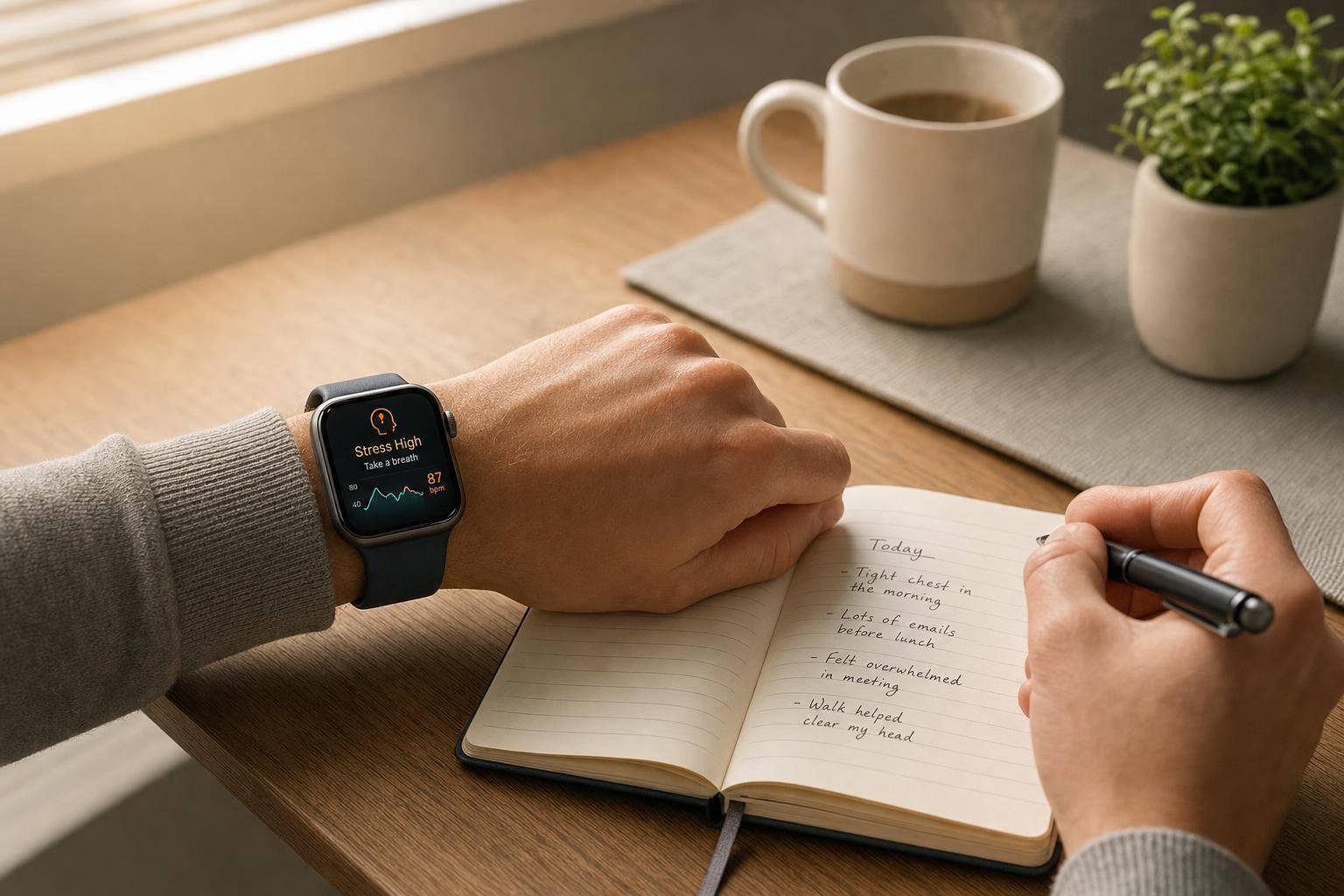
If I want to catch stress early, AI-based wearable tracking usually beats manual tracking. It watches body signals all day, while manual methods depend on me noticing stress, remembering it, and writing it down later.
Here’s the short version:
- Manual tracking uses journals, mood logs, and clinician check-ins.
- AI tracking uses wearables to read signals like heart rate, HRV, sleep, skin temperature, and EDA.
- Manual methods give me the reason behind stress.
- AI methods give me the timing, with alerts while stress is building.
- Neither is perfect: self-reports can miss details, and wearables can be thrown off by motion, fit, heat, or battery limits.
- Best use: AI for day-to-day monitoring, manual notes for trigger and context.
A few numbers stand out:
- One multimodal AI system reached 87% recall for moderate stress detection.
- Clinical-grade devices hit about 94.4% accuracy.
- Smartwatches average about 83.6%.
- Smart bands average about 69.5%.
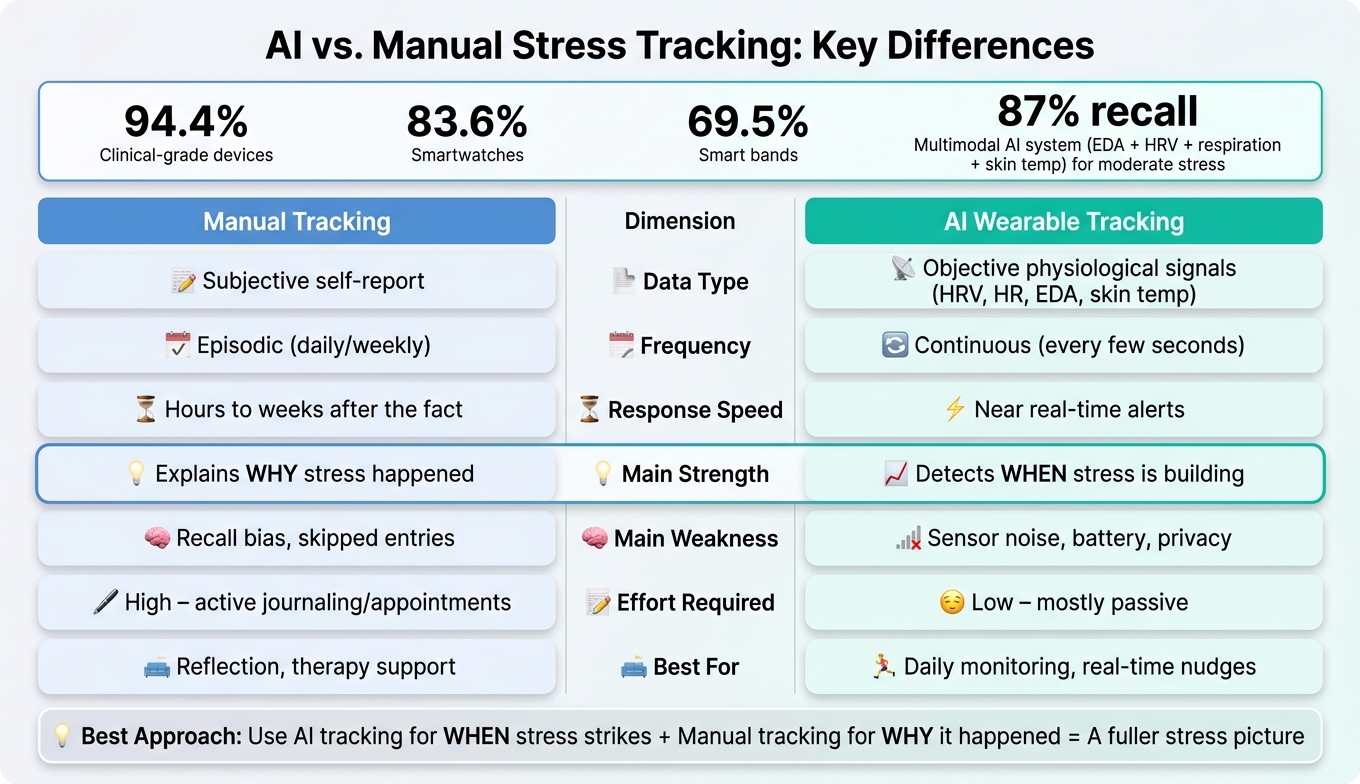
AI vs. Manual Stress Tracking: Accuracy, Speed & Key Differences
Quick Comparison
| Area | Manual Tracking | AI Wearable Tracking |
|---|---|---|
| What it uses | Self-reports, journals, questionnaires | Sensor data from wearables |
| Data type | Subjective | Objective body signals |
| Frequency | Occasional | Continuous |
| Main strength | Explains triggers and feelings | Spots patterns and stress changes early |
| Main weakness | Recall bias, skipped entries | Sensor noise, wear time, privacy issues |
| Response time | Later | Near real time |
| Best for | Reflection, therapy support | Daily monitoring and in-the-moment prompts |
My takeaway: manual tracking tells me why I felt stressed, while AI tells me when stress started to climb. If I use both, I get a clearer view without relying on memory alone.
sbb-itb-f5765c6
How Manual Stress Tracking Works
Manual stress tracking includes everything from clinical questionnaires to private notes in a journal. In day-to-day life, someone might score their stress on a basic 1–10 scale before bed, write down what made them tense after work, or keep a mood log in a notebook. In clinical care, providers often use validated tools such as the Perceived Stress Scale (PSS), a 10-item questionnaire that measures how often a person felt unable to control important things or handle daily demands over the past month.[3][5][6][7]
Clinicians may also check blood pressure or resting heart rate, but those are only brief snapshots, much like the difference between AI health coaching vs traditional personal training methods. So while manual tracking can help with reflection, it usually does a poor job of spotting stress as it builds.
What Self-Reports and Clinical Reviews Do Well
Manual tracking gives context that a wearable can't provide on its own: why a stress spike happened. Journals and mood logs can record the trigger, timing, and setting - a traffic jam on the commute, a work deadline, an argument at home, or worry about family duties. Over time, those notes can show patterns that are hard to ignore, like stress tied to commuting, conflict with certain people, or repeated tension before deadlines.
Clinicians also use questionnaire scores along with conversation to look for deeper triggers - caregiving strain, money pressure, or recurring conflict - and to see whether things are getting better or worse from one visit to the next.[4][10][11] That mix of numbers and personal detail is something raw sensor data can't match by itself. Still, those insights depend on when the person reports them.
Where Occasional Tracking Falls Short
Questionnaires may only be done once in a while, and therapy sessions usually happen weekly or every other week. Journals also tend to get skipped on the busiest and most stressful days - which, of course, are often the days that matter most to record. The result is gaps where stress spikes pass by with no record at all.[8][9] This is particularly challenging for those trying to balance health and busy schedules where manual logging is often the first habit to drop.
Recall bias makes this harder. When someone fills out a stress scale about the past month, they often remember the latest event or the most dramatic one and blur much of the rest.[10][12][13] A long run of rough but ordinary workdays can fade into the background next to one intense argument. Manual tracking can explain stress well, but it misses a lot of when that stress shows up. That's the gap where wearable data and AI prediction start to matter.
How AI Stress Tracking Uses Wearables and Prediction Models
Where manual tracking leaves holes, wearable-based AI keeps the line going. Instead of waiting for you to log how you feel, AI reads body signals all day. But that only works if it starts with the right inputs.
The Data AI Reads in Real Time
AI stress models look at heart rate, HRV, sleep, skin temperature, respiration, movement, and skin conductance (EDA). Each one adds part of the story.
HRV is one of the main stress markers because it reflects autonomic nervous system balance and your ability to handle strain. Lower HRV often points to a heavier stress load. Movement data helps the model tell the difference between a heart rate spike from exercise and one that hits while you're sitting at your desk. That's the key idea here: one signal alone usually doesn't tell you much.
The next job is to turn that stream of data into a stress estimate.
How AI Moves from Tracking to Prediction
Gathering data is only the start. AI has to clean the signal, compare it against your baseline, and spot patterns that suggest stress is building. Studies show that combining several biosignals can beat one-metric methods. In one multimodal system, EDA, HRV, respiratory rate, and skin temperature were combined to detect moderate stress with an 87% recall rate.[1]
That matters because it can give you an earlier heads-up. Instead of realizing on Friday night that you're drained, a model may pick up lower HRV, a rising resting heart rate, and broken sleep before the stress snowballs.
Still, the output depends a lot on sensor quality, model design, and how well the system handles person-to-person differences. Wrist-based optical sensors are less precise than clinical ECG systems. Heat, humidity, and poor sensor contact can also throw off skin temperature and EDA readings. So AI stress tracking is best used as guidance, not diagnosis.
How Healify Fits This Approach
Healify uses wearable data, biometrics, bloodwork, and lifestyle inputs to turn noisy signals into clear next steps. That matters even more when you put AI tracking next to manual tracking and look at the gap side by side.
AI vs. Manual Stress Tracking: Key Differences
Manual tracking is occasional. AI tracking is continuous. That’s the big split.
But the difference goes deeper than what each method records. It also comes down to how fast each one can spot stress as it starts to climb. The sharpest contrasts show up in accuracy, timing, and personalization.
Accuracy, Objectivity, and Pattern Detection
Self-reports depend on memory, which means they often miss stress that builds between check-ins. Sensor-based AI gets around that by measuring all the time. Instead of asking how you feel, it looks at what your body is doing.
Of course, that doesn’t mean it’s perfect. Consumer wearables help, but they still don’t match clinical-grade devices. Research shows clinical-grade devices reach 94.4% accuracy in stress detection, while smartwatches average around 83.6% and smart bands drop to 69.5%.[2] Fit, motion, and device quality can still skew the numbers.
| Dimension | Manual Tracking | AI Wearable Tracking |
|---|---|---|
| Data type | Subjective self-report | Objective physiological signals (HRV, HR, EDA, skin temperature) |
| Measurement frequency | Episodic (daily, weekly) | Continuous (every few seconds to minutes) |
| Main source of error | Recall bias, social desirability, scale interpretation | Sensor noise, motion artifacts, wear time |
| Short-term fluctuation detection | Poor - misses within-day stress spikes | Strong - catches real-time changes |
| Pattern detection over weeks | Moderate, with consistent effort | High - learns personal baselines automatically |
Objective signals and subjective reports don’t always match.[15] Someone’s HRV may dip while they still say they feel fine. That’s not a contradiction so much as two different views of the same moment. One shows what the body is doing. The other shows what the person notices and remembers.
That’s why using both often works better than relying on just one.
Accuracy matters most when it helps you act sooner.
Real-Time Feedback and Faster Action
Earlier feedback gives you a chance to do something during the stress window, not long after it passes.
Manual methods such as journaling, self-report apps, and therapy sessions usually give you insight after the fact. You may notice that every Tuesday afternoon leaves you drained, but you often spot that pattern later, when you’re looking back on the week.
AI systems can catch stress while it’s building. If HRV drops and resting heart rate rises without physical exertion, the system can suggest a breathing exercise or a short walk right then, while the moment is still happening. Healify's AI coach Anna turns stress flags into immediate guidance.
| Dimension | Manual Tracking | AI Wearable Tracking |
|---|---|---|
| Response speed | Hours to weeks after the fact | Near real-time alerts and prompts |
| Type of feedback | Reflective insights, therapist guidance | Breathing cues, recovery suggestions, coaching nudges |
| Manual effort required | High - active journaling or appointments | Low - mostly passive, with occasional check-ins |
That speed changes the role of stress tracking. Instead of becoming a weekly review habit, it becomes something closer to a nudge in the moment - more like a tap on the shoulder than a postgame recap.
Personalization and Practical Tradeoffs
Manual personalization tends to build slowly. A therapist forms a picture of you over months of sessions. A journal can help you spot patterns too, but only if you stay consistent and honest with yourself.
AI personalization moves faster. It keeps recalibrating to your own baselines, learning what your normal HRV looks like and flagging changes that a one-size-fits-all threshold might miss. Research backs this up: personalized models show higher sensitivity and F1 scores for stress detection than generalized models.[14]
Still, AI tracking comes with tradeoffs. Battery life can get in the way, especially if you forget to charge your device before bed. Privacy is a real concern because physiological data is sensitive, and consumer apps may not have the same protections as clinical records. There’s also the risk of reading too much into normal ups and downs.
| Manual Tracking | AI Wearable Tracking | |
|---|---|---|
| Pros | Captures context, emotions, and triggers; no device needed; lower privacy risk | Continuous, objective, low daily effort; learns your baselines; real-time feedback |
| Cons | Recall bias; inconsistent; misses within-day stress; time-intensive | Sensor noise; battery and wear time demands; privacy concerns; can miss subjective context |
| Best-fit use case | Understanding emotional triggers; therapy support; reflective habit-building | Daily stress monitoring; catching patterns early; real-time micro-interventions |
In day-to-day life, that means the choice isn’t always either-or. Manual tracking gives you context. AI gives you timing. Put them together, and you get a fuller picture of what stress looks like for you.
Conclusion: Which Stress Tracking Approach Makes More Sense Today
The choice comes down to what you need most: context, continuity, or a mix of both. Manual tracking gives you meaning - it helps explain why a rough week felt rough. AI-powered wearable tracking gives you continuity - a steady read on what your body is doing, even when you’re not thinking about it. Put simply, manual tracking adds context, while AI adds continuity.
In day-to-day life, AI tracking is usually the more practical pick. Wearables collect signals passively, even on days when you skip a check-in. That matters because stress often creeps up quietly before it becomes obvious.
AI tracking is a screening tool, not a diagnosis. It can point out that something seems off, but it can’t always tell you why. That’s why a short self-check-in still matters. It’s not the main method, but it adds the explanation behind the signal.
Key Takeaways for Daily Stress Management
The goal is to act earlier and more consistently. Continuous data gets you closer to that than occasional logs, but only if that data turns into something you can use. Healify’s AI coach Anna takes wearable data, biometrics, and lifestyle inputs and turns them into clear guidance for stress, recovery, and sleep. That makes Healify useful for turning passive data into daily action.
FAQs
Can AI stress tracking work without a wearable?
Yes. AI can track stress without a wearable by reading behavior signals such as typing speed, mouse movement, and facial cues like blink rate, pupil size, and facial muscle tension.
It can also use remote photoplethysmography (rPPG), a contactless method that works with a standard RGB camera. It picks up tiny skin color changes tied to blood flow and can tell the difference between stress and relaxation with over 85% accuracy.
How accurate are smartwatch stress alerts?
Smartwatch stress alerts are getting more precise, but their accuracy still depends on the device, the sensors it uses, and what you’re doing at the time. A consumer smartwatch can track signals such as heart rate variability, electrodermal activity, and skin temperature.
That said, the numbers vary quite a bit. Consumer-grade devices often land at about 70% accuracy for stress and mood detection. More advanced multimodal systems can reach up to 98%. Results also tend to get better over time as the system learns your personal baseline.
In plain English: the more the watch gets to know your normal patterns, the better it can spot when something is off.
Should I use AI tracking and journaling together?
Yes. Using AI tracking with journaling can work very well.
AI-powered wearables give you objective, real-time data, such as heart rate variability, skin temperature, and sleep patterns. Journaling adds the personal context those biometrics can’t show on their own.
Put them together, and you get a fuller view of your well-being. AI might flag a stress spike, while your journal helps you spot the emotional or situational trigger behind it.