

Health technology has the potential to improve care access and outcomes, but it often fails to serve diverse communities due to systemic barriers. These challenges include limited internet access, unaffordable devices, language gaps, and mistrust in healthcare systems. Without addressing these issues, digital health tools risk widening disparities rather than closing them.
Key barriers include:
- Internet Access: Many rural and underserved areas lack reliable broadband, making telemedicine and digital tools inaccessible.
- Device Costs: Smartphones, wearables, and data plans are often too expensive for low-income families.
- Language and Representation: Health platforms rarely support multilingual users or reflect diverse cultural beliefs.
- Digital Literacy: Many people lack the skills or confidence to use digital tools effectively.
- Fragmented Systems: Disconnected health platforms create confusion, but improving data integration can reduce these inefficiencies and improve care.
Solutions require improving infrastructure, lowering costs, and involving communities in tool development. Policymakers and developers must prioritize equity by addressing these systemic issues through better design, training, and data-sharing protocols.
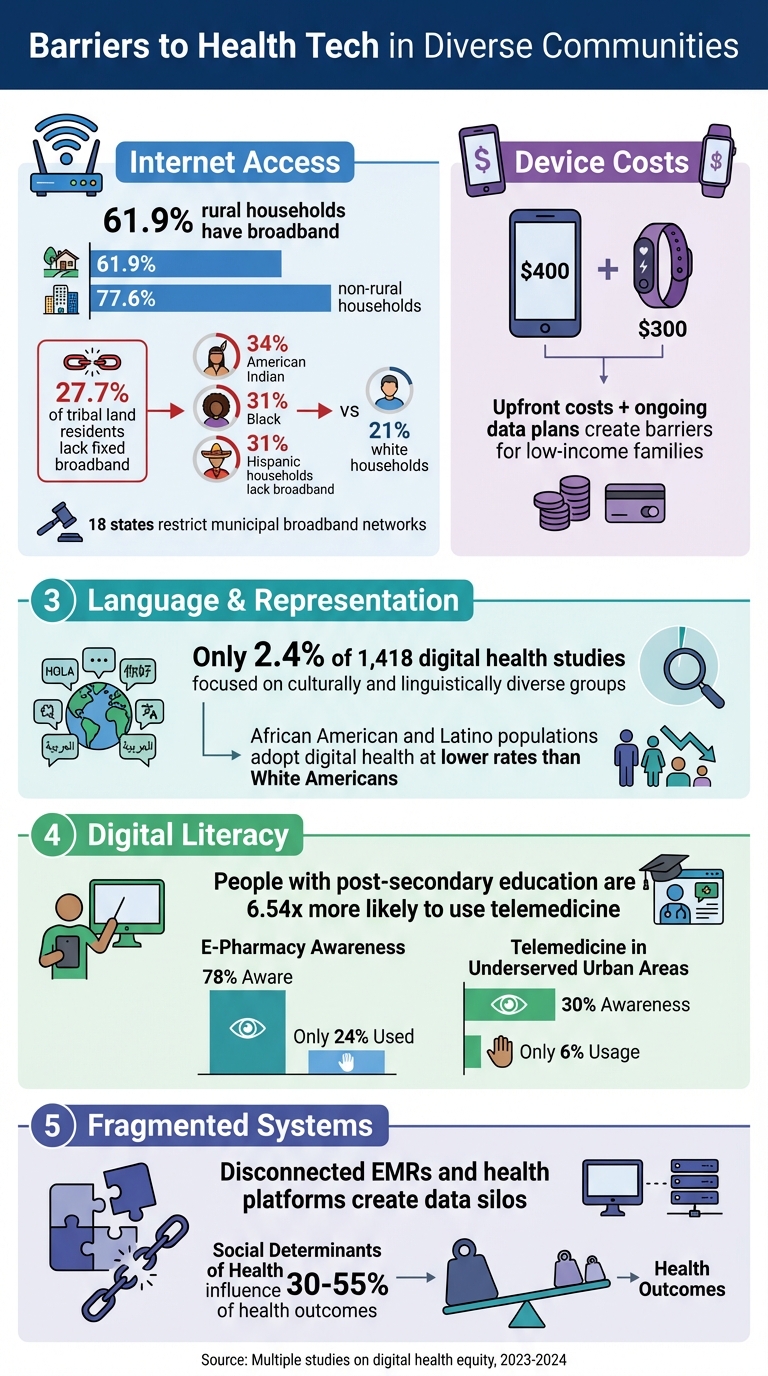
Key Barriers to Health Tech Adoption in Diverse Communities
Advancing Digital Healthcare Equity: Navigating Disparities in the Digital Age
sbb-itb-f5765c6
Access and Infrastructure Problems
Health technology depends heavily on two key factors: stable internet access and affordable devices. Unfortunately, many communities still lack these essentials, creating significant barriers to equitable access.
Internet Access and Connectivity Gaps
Edgar Camero from ChangeLab Solutions highlights the importance of broadband access, stating:
"Broadband connection is a super determinant of health because it influences whether individuals can access various SDoH that affect an individual's health outcomes" [4].
Despite its importance, internet connectivity remains unevenly distributed. In rural areas, only 61.9% of households have broadband, compared to 77.6% in non-rural areas [4]. The situation is even worse on tribal lands, where 27.7% of residents lack fixed broadband [8]. These gaps are particularly stark for BIPOC communities in rural areas: 34% of American Indian, 31% of Black, and 31% of Hispanic households lack broadband, compared to 21% of white households [4].
Infrastructure in rural areas often lags behind, relying on outdated copper wiring that can't support modern health technologies. Janessa M. Graves, an Associate Professor at Washington State University, explains:
"Inadequate broadband infrastructure is a critical barrier to provision of telehealth services and remote learning in rural areas, particularly for approaches that involve synchronous video communication between provider and recipient" [6].
The disparity is clear in rural Washington State, where only 67.5% of students have access to broadband suitable for video-based communication, compared to 84.2% in urban areas [6].
Legal restrictions further complicate the problem. In 18 states, laws hinder or outright ban municipal broadband networks, reducing competition and keeping prices high [4]. As a result, rural residents often rely on costly alternatives like mobile hotspots or LTE sticks, which come with data caps and overage fees that make continuous health monitoring financially unfeasible [5].
However, some communities are finding creative ways to bridge the gap. For instance, Wilson, North Carolina, operates Greenlight, a community-owned fiber network that offers affordable internet to public housing residents and delivers 100 Mbps speeds to community centers and libraries [4]. On a larger scale, the federal Tribal Broadband Connectivity Program has allocated $1.86 billion to 226 Tribal entities as of October 2024, connecting over 4,500 Tribal homes in areas with high unemployment [7]. Similarly, the Broadband Infrastructure Program has upgraded or built over 2,750 miles of fiber, bringing internet access to 40,000 previously unserved households and 130 community anchor institutions, with 80% of these projects in rural areas [7].
While improving internet access is critical, device affordability remains another major hurdle.
Device Costs and Economic Barriers
The cost of devices like smartphones, tablets, and wearable health monitors poses a significant challenge for low-income families. These technologies often require a substantial upfront investment, along with ongoing expenses for data plans and subscriptions [2]. For families already struggling to meet basic needs, spending $400 on a smartphone or $300 on a fitness tracker is simply not an option.
Dr. Katharine Lawrence from NYU Grossman School of Medicine points out:
"Digital health solutions may have unintended consequences for socially marginalized and disadvantaged populations, and may contribute to, exacerbate, or even create health disparities" [1].
This creates a troubling dynamic: the communities that stand to gain the most from health technology - those with significant health challenges and limited access to traditional care - are often the least able to afford it. Without addressing these financial and infrastructural barriers, health technology risks deepening existing inequalities rather than solving them.
Cultural and Language Barriers
Cultural and language barriers - rooted in trust, representation, and lived experience - create significant obstacles to the effective use of health technologies.
Language Gaps and Limited Multilingual Support
Many health apps and devices operate under the assumption that users are fluent in English, leaving millions of people excluded. Language and literacy skills are key digital determinants of health, directly influencing whether someone can successfully use a health app or virtual care platform [1]. The statistics highlight this gap: African American and Latino populations in the U.S. consistently adopt digital health technologies at lower rates compared to White Americans [3].
But the issue goes beyond simple translation. When health technologies lack robust multilingual support, they often become difficult to navigate and fail to resonate with users on a personal level [3]. Shongkour Roy, MS, from the University of Memphis, explains:
"Marginalized groups with limited tech skills, including non-English speakers, older adults, and disabled individuals, may be left behind" [2].
This is especially concerning given that social determinants of health - like language and literacy - can account for as much as 30% to 55% of health outcomes [1]. Without addressing these language barriers, health tech struggles to connect with diverse communities in meaningful ways.
Cultural Relevance and Representation
The effectiveness of digital health tools improves when they reflect users' cultural and socioeconomic realities [10]. However, many technologies fail to meet this standard, often presenting images, scenarios, and frameworks that don't align with how diverse communities perceive health, illness, and treatment.
Cultural adaptation operates on two levels. Surface adaptation involves visible elements, such as language, clothing, and settings, while deep structure adaptation addresses deeper factors, like cultural beliefs about illness shaped by religion, family dynamics, and social norms [10]. For instance, during the adaptation of the WHO's E-Mental Health Program for overseas Filipino workers, Filipino psychologists suggested removing images of doctors to avoid "pathologizing" mental health - an issue that carries significant stigma in Filipino culture [10].
Lara Whitehead, MA, from Monash University, underscores the importance of this approach:
"Cultural and linguistic perspectives should be considered in the design and delivery of DHTs, with this best served through the inclusion of the target communities at all stages of development" [3].
When communities don't see their identities or values reflected in these technologies, they often disengage. This lack of alignment not only alienates users but also deepens historical mistrust, further reducing adoption.
Historical Distrust in Healthcare Systems
Generations of systemic racism and structural violence have eroded trust in healthcare systems, particularly among African American, Native American, and Indigenous communities [1][3]. concerns about surveillance, data privacy, and algorithmic bias only exacerbate these fears [1]. These historical injustices, combined with infrastructural and economic barriers, create additional hurdles for tech adoption.
Dr. Katharine Lawrence from NYU Grossman School of Medicine explains:
"Health disparities are the result of social and structural factors that confer a social disadvantage on an individual or population, dis-favorably impacting their lived experience with healthcare" [1].
For Indigenous and First Nations populations, the digital divide is further widened by technologies that fail to account for cultural nuances, reinforcing disengagement. Given the history of harm inflicted by healthcare systems, rebuilding trust requires a fundamental shift in how patient-centered health tech is designed. This includes prioritizing data protection, inclusive representation, and meaningful collaboration with marginalized communities.
Low Digital Literacy and Awareness
Even when health technologies are within reach, many people struggle to use them effectively due to a lack of digital skills and confidence. Digital literacy isn’t just about knowing how to operate devices - it’s about having the self-assurance and ability to navigate digital platforms successfully [1]. Without these, even free and accessible technologies often go unused. This issue is particularly pronounced in underserved communities, where educational disparities make the problem even more challenging.
Digital Literacy Gaps in Underserved Communities
Certain groups, such as older adults, individuals with limited education, and those with lower English proficiency, face the greatest hurdles [2]. For example, people with post-secondary education are 6.54 times more likely to use telemedicine services, highlighting the connection between digital skills and confidence in adopting new technologies [9]. Even though the tools may be available, the ability to use them remains unevenly distributed.
As healthcare increasingly moves toward digital-first approaches, those lacking digital literacy risk being excluded [2]. The World Health Organization emphasizes:
"Digital health should be an integral part of health priorities and benefit people in a way that is ethical, safe, secure, reliable, equitable and sustainable" [1].
Beyond skill gaps, concerns about data privacy and security further discourage many from engaging with digital health tools , such as AI tools for biomarker monitoring,, especially in communities already hesitant to adopt new technologies [1][9].
Missing Education and Training Programs
A key barrier to improving digital literacy is the lack of accessible education and training programs. For instance, while 78% of people in one study were aware of e-pharmacy services, only 24% had ever used them for health needs [9]. In underserved urban areas, awareness of telemedicine can be as low as 30%, with usage rates plummeting to just 6% [9]. Simply knowing about these tools isn’t enough - people need the skills and confidence to use them effectively.
Community-based training programs are rare but essential for building digital skills and confidence [2]. A 2023 study published in the Journal of Medical Internet Research highlighted an intervention at a federally qualified health center in the U.S. The program involved student-led support sessions aimed at reducing the cognitive burden of telehealth video visits. This approach helped patients take greater control of their health and better understand medical information, particularly in marginalized groups [2][1].
Successful training programs must go beyond technical instructions. They should focus on building confidence and be delivered in trusted local spaces, like community health centers, rather than through impersonal tutorials [1][2]. Without such initiatives, the global digital health market - valued between $150 billion and $350 billion before COVID-19 [1] - will continue to expand in ways that exclude the very communities that could benefit most.
Solutions: Community-Centered Design
To tackle the barriers in health tech adoption, a fresh approach is needed - one that places community participation at its core. The best health technologies aren’t created in a vacuum; they’re co-developed with input from the very people they’re meant to serve. Instead of relying on assumptions from engineers and designers, developers should actively involve target communities from the outset. Methods like Human-Centered Design (HCD) and Agile software development encourage rapid prototyping and continuous feedback, ensuring that stakeholders and end-users directly influence the product's development. This process leads to solutions that are not only functional but also resonate with the people who need them most [1].
Co-Design with Target Communities
True co-design goes beyond a single focus group or survey - it’s about sustained collaboration. It involves bringing diverse voices into every phase of development, from brainstorming and planning to implementation and review [1]. Frameworks like Equity-Centered Design and the Digital Health Equity Framework (DHEF) provide structured ways to ensure health tech doesn’t unintentionally reinforce existing disparities. As Pooja Bachani Di Giovanna, Assistant Director at the Davenport Institute, puts it:
"Giving these groups a 'seat at the table' is a major step in overcoming historic marginalization, but genuinely listening to and considering their ideas is also necessary and even obligatory" [11].
If communities don’t see how their feedback is shaping the final product, trust erodes, and future collaboration becomes unlikely [11]. Inclusive practices also extend to creating interfaces that are sensitive to language and cultural differences, which is explored further below.
Multilingual and Culturally Appropriate Interfaces
Health tech interfaces must cater to diverse populations by offering multilingual support and culturally sensitive designs. This includes addressing varying levels of English proficiency and respecting cultural norms and beliefs [3]. Features like audio-visual aids and imagery that reflect community diversity can reduce cognitive barriers and make tools more accessible [1]. However, a 2023 systematic review of 1,418 digital health studies revealed that only 34 studies - just 2.4% - focused on the needs of culturally and linguistically diverse groups [3].
In addition, clear data practices and simplified privacy controls are critical for building trust, especially among communities with historical reasons to distrust healthcare systems or surveillance [1].
Community Hubs and Local Support
To address infrastructure gaps and digital literacy challenges, physical and digital community hubs are vital. These hubs provide access to broadband, digital devices, and hands-on training in areas often referred to as "digital deserts" [1]. They also rely on trusted local figures - such as community leaders, faith-based organizations, and neighborhood advocates - to foster relationships with historically excluded groups [11].
Di Giovanna highlights the importance of meeting people where they are:
"For assistance programs to be successful, local governments must meet the targeted groups where they are" [11].
Rather than expecting marginalized groups to travel for resources, successful programs bring health tech education directly into their routines. This could mean integrating training into weekly faith-based gatherings, neighborhood meetings, or other community events [11]. These hubs also serve as spaces for participatory design sessions, where developers can test prototypes and gather immediate feedback, ensuring the tools they create align with the community’s specific needs [1].
Using Unified Protocols for Connected Health Tech
Even when communities overcome hurdles like limited access and digital literacy, they often face a new challenge: disconnected health systems. Picture this: a patient uses a fitness tracker, checks lab results on one platform, tracks medications in another app, and talks to a doctor who doesn’t have access to any of this data. It’s a fragmented experience that hits underserved populations the hardest, especially non-English speakers and older adults [2].
The root of the problem lies in the lack of interoperability between many Electronic Medical Records (EMRs), even though Electronic Health Records (EHRs) are designed for data sharing [2]. This gap leads to what researchers call "data absenteeism", where marginalized groups are either missing from or misrepresented in health records [14]. For instance, Hispanic and Asian/Pacific Islander populations in the U.S. often have incomplete linkages between Social Security numbers and death certificates in national databases. This skews AI tools that rely on such data [14]. The solution? Unified communication protocols that make seamless data sharing possible.
Connecting Different Data Sources
Unified protocols bridge the gap by integrating data from wearables, health apps, lab results, and personal health records into one cohesive system [2][12]. Take BondMCP - Health Model Context Protocol as an example. It creates an intelligence layer where your sleep tracker informs your fitness coach, your lab results adjust your supplement plan, and your health goals shape real-time decisions. Instead of juggling conflicting advice from multiple apps, users get a streamlined, personalized experience.
This kind of integration is particularly helpful for multicultural users who navigate care across multiple providers and systems. With seamless data flow, a patient can move between a community clinic, a retail health center, and home-based monitoring devices without losing track of their health journey [13].
Personalized and Context-Aware Health Interventions
Unified protocols do more than just connect data - they enable context-aware AI agents that grasp cultural and linguistic nuances. Traditional AI systems often prioritize data quantity over quality and context [14]. For example, machine-learning models trained exclusively on standard English might overlook critical health information shared by users who speak African American Vernacular English or other dialects [14].
These systems also need to consider Digital Determinants of Health (DDOH) - factors like personal habits, digital literacy, and societal influences such as cultural beliefs or experiences with tech bias [1]. For instance, algorithms that use healthcare spending as a proxy for health needs often fail marginalized groups. Historically, institutions have spent less on Black patients, even when they’re sicker, causing these algorithms to misclassify them as healthier [14].
BondMCP tackles these challenges by offering a health-specific ontology and shared context layer. This allows AI agents to deliver personalized interventions that account for individual lifestyles and cultural contexts, effectively addressing the barriers we’ve discussed. Developers can use this framework to create health-literate, context-aware systems without building new solutions from scratch. By reducing fragmentation, these personalized interventions also improve continuity of care.
Reducing Fragmentation for Multicultural Users
The effects of fragmentation go beyond inconvenience - they directly contribute to health disparities. Social Determinants of Health (SDOH) influence 30% to 55% of health outcomes [1]. When health systems can’t share data across organizations, care coordination breaks down [12]. A review of U.S. digital health infrastructure found that the most common challenges for providers were poor integration with workflows and clunky information exchange systems [2].
Unified protocols promote what researchers call "data solidarity", focusing on equity and prioritizing the needs of those who might otherwise be disadvantaged by health technology [1]. By breaking down data silos and enabling efficient information sharing among care teams, these systems not only simplify data management but also help address long-standing inequities. For underserved communities already facing multiple barriers, this creates a smoother, more inclusive healthcare experience [12].
| Infrastructure Challenge | Impact on Diverse Communities | How Unified Protocols Help |
|---|---|---|
| Data Silos | Fragmented medical histories lead to incomplete care for mobile populations [13] | Connects wearables, labs, and routines into a unified health record |
| User-Unfriendly Interfaces | Language and literacy gaps limit engagement [2][3] | Provides culturally and linguistically tailored AI interfaces |
| Lack of Interoperability | Prevents seamless data sharing between EHR systems [2] | Standardizes data collection for smooth integration [13] |
For clinics, platforms, and developers working with diverse populations, unified protocols offer a scalable way to deliver personalized care. By tying together fragmented data, enabling proactive interventions, and moving beyond static dashboards, these systems reflect the full complexity of patients’ lives while reducing disparities in access and outcomes.
Policy and Implementation Strategies
To tackle health disparities, policy efforts need to address the underlying causes. Federal and state governments should focus on expanding high-speed internet access in "digital deserts" and subsidizing devices for families with low incomes [14][2]. These infrastructure improvements must go hand-in-hand with addressing biases embedded in digital health algorithms.
Bias-Reduced AI and Diverse Data Training
The flawed eGFRcr calculator, which inaccurately assessed kidney health in Black patients due to biased racial assumptions, highlights the need for regular bias audits and diverse data training in AI systems [15][14][2]. Automating the collection of race, ethnicity, and language (REAL) data can help identify disparities and guide improvement efforts [15]. As United Nations Secretary-General António Guterres stated:
"The digital divide is now a matter of life and death for people who are unable to access essential health-care information. It is threatening to become the new face of inequality" [15].
Unified protocols, like BondMCP, can support these initiatives by providing health-specific ontologies. These tools enable systems to deliver equitable, personalized care while avoiding the reinforcement of historical biases.
Cultural Competency and Provider Training
Healthcare providers must develop cultural competency to interpret patient data effectively. A 2023 review of 34 studies found that cultural factors influenced every stage of digital health adoption among diverse populations [3]. However, many providers lack the training needed to navigate these factors, especially when using digital health tools [2].
Training programs should incorporate the National CLAS Standards (Culturally and Linguistically Appropriate Services) to help healthcare organizations provide care that aligns with diverse cultural beliefs and languages [1]. Developers of tools like BondMCP must also ensure their AI systems are culturally aware, adapting to individual contexts and language preferences. These gaps in cultural competency highlight the need for well-defined policy frameworks to drive equitable adoption of health technologies.
Policy Frameworks for Equal Access
With gaps in access and literacy identified, policies must now aim to ensure all communities can benefit from digital health advancements. The HITECH Act, which incentivized the use of Electronic Health Records, serves as a model for encouraging the collection of demographic data to address disparities [14]. Programs like Medicare's Value-Based Purchasing and the NQF Disparities-Sensitive Measure Assessment can be used to evaluate how organizations perform on equity metrics [1].
| Framework/Policy | Focus Area | Key Objective |
|---|---|---|
| NIMHD Research Framework | Digital Health Equity | Tackles equity at individual, interpersonal, community, and societal levels [2] |
| National CLAS Standards | Cultural Competency | Ensures services align with diverse cultural health beliefs and languages [1] |
| WHO Global Strategy (2020-2025) | Digital Health | Advocates for equitable, sustainable digital health globally [1] |
Policies should also embrace "data solidarity", which emphasizes data justice and prioritizes those at risk of being left behind by health technology [1]. This approach moves beyond merely providing access to hardware, focusing instead on building "information capability" - the skills and knowledge needed to effectively use and benefit from digital health tools [14]. By integrating investments in infrastructure, bias reduction, and cultural competency training, policymakers can create a healthcare system where technology serves everyone fairly and effectively.
Conclusion
Our exploration highlights several pressing challenges, from disparities in digital access to mismatches between technology and community needs. While health technology has the potential to improve lives, its success depends on overcoming barriers like limited global digital access, gaps in digital literacy, and mismatched designs that fail to resonate with the communities they aim to serve.
Addressing these issues calls for a multi-layered approach. Designing with communities in mind ensures that tools are shaped by the real experiences of users, not just the assumptions of developers. Policy changes are also critical - expanding broadband access, subsidizing devices for low-income households, and requiring audits to address bias in AI systems. As the World Health Organization aptly states:
"Digital health should be an integral part of health priorities and benefit people in a way that is ethical, safe, secure, reliable, equitable and sustainable" [1].
Another key step is creating unified systems that allow seamless data sharing across platforms. When wearables, lab results, and health apps fail to communicate, patients are left managing fragmented systems. A shared intelligence layer can deliver personalized care, especially for those facing challenges like language barriers, limited tech skills, or financial constraints.
It's worth noting that social determinants of health influence 30% to 55% of health outcomes [1]. This stark statistic underscores the urgency of creating health technology that aligns with the realities of diverse communities. Digital exclusion only widens existing inequities, making it essential to develop systems that serve everyone. Ensuring these technologies are inclusive and effective isn't just a goal - it’s a necessity for achieving fair health outcomes.
FAQs
What can be done to improve internet access in underserved communities for better health tech adoption?
Improving internet access in underserved communities is key to unlocking the potential of health technologies in modern healthcare. A major step in this direction is addressing infrastructure gaps by expanding reliable, high-speed broadband access. Policies that promote affordable internet services and invest in digital infrastructure can go a long way in ensuring more equitable access to these vital resources.
Equally important is involving local communities in shaping and rolling out digital health programs. By incorporating culturally relevant solutions and enlisting community-based technology navigators, these tools become more approachable and easier to use. Together, these strategies can help close the digital divide and encourage the adoption of health technologies in underserved areas.
Why is cultural representation important in health technology for diverse communities?
Cultural representation plays a key role in health technology by ensuring that tools and services are designed to be relevant, accessible, and effective for people from all backgrounds. When digital health solutions take into account factors like cultural beliefs, languages, and specific community needs, they are better positioned to build trust, foster engagement, and deliver improved health outcomes.
On the flip side, ignoring cultural representation can have serious consequences. Marginalized groups may feel excluded, leading to mistrust and lower adoption of these technologies. To address this, practices like involving community members in the design process, adopting culturally sensitive methods, and offering multilingual support can help close these gaps. Such inclusive approaches promote fairness and improve access to healthcare for everyone, particularly for communities that have historically been overlooked or underserved.
How can health tech developers design solutions that better serve diverse communities?
To create health technologies that genuinely meet the needs of diverse communities, developers must include these groups at every stage of the design process. This means working directly with community members to make sure the tools are relevant, easy to use, and address challenges like language differences and trust concerns.
Partnering with respected community leaders or navigators can also help close communication gaps, build trust, and encourage broader adoption of the technology. Regularly gathering feedback from users during development ensures the tools reflect real-world needs and gives communities a sense of involvement and ownership. By focusing on inclusivity and understanding, developers can create solutions that serve everyone more effectively.