

AI is reshaping healthcare by enabling real-time treatment adjustments tailored to individual patient needs. Unlike fixed treatment plans that rely on periodic evaluations, AI-driven systems analyze continuous data from wearables, lab results, and patient records to make immediate, precise changes to treatments. This approach improves outcomes for conditions like diabetes, cancer, and mental health disorders by addressing variability in patient responses.
Key points:
- AI systems like RL-DITR and TxAgent optimize treatments using reinforcement learning and large language models.
- AI-driven tools have improved survival rates in oncology by 20% and reduced unscheduled visits in dental care by 28%.
- Digital twins and online learning systems allow for safer, more dynamic decision-making.
- Platforms like BondMCP integrate fragmented health data, enabling seamless AI-powered care delivery.
AI's ability to process diverse inputs and adjust treatments in real time is transforming chronic disease management and personalized medicine.
How AI-Powered Digital Therapeutics (DTx) Innovations Are Transforming Healthcare
sbb-itb-f5765c6
How AI Enables Real-Time Treatment Adjustments
AI has transformed static treatment plans into dynamic, ever-evolving systems by continuously analyzing patient data and adjusting treatments accordingly. This adaptability is powered by algorithms that learn from patterns, predict outcomes, and refine their recommendations as new information becomes available.
Core AI Techniques for Dynamic Adjustments
To ensure treatments can adapt in real time, AI relies on several key techniques that allow for immediate refinements.
Reinforcement Learning (RL) plays a central role in these dynamic systems. By treating healthcare decisions as a sequence of choices aimed at improving long-term patient outcomes, RL models move beyond rigid protocols. They adjust treatments - whether it’s dosage, timing, or type - based on how a patient’s condition evolves over time [5][8].
One specific RL technique, Q-Learning, evaluates the "value" of different treatment paths by combining historical data with a patient’s current condition. For instance, in August 2025, researchers Zhiyao Luo and Tingting Zhu tested the Qwen2.5-7B large language model as a dynamic insulin dosing agent using a Type 1 diabetes simulator. Their study revealed that with carefully designed prompts, the model matched the performance of specialized RL systems for stable patients. However, it faced challenges in handling complex physiological changes requiring precise arithmetic [3][5][8].
Large Language Models (LLMs) are also stepping into the role of treatment planners by analyzing patient data. In March 2025, a research team led by Shanghua Gao and Marinka Zitnik introduced TxAgent, an AI system equipped with 211 tools covering all FDA-approved drugs since 1939. When tested on 3,168 drug reasoning tasks, TxAgent achieved 92.1% accuracy, outperforming GPT-4o in drug interaction scenarios by integrating multi-step reasoning with real-time medical database insights [9].
Digital Twins, or virtual patient replicas, provide a safe environment to test treatment adjustments. These models use ensemble Q-networks to evaluate uncertainty levels. If the AI’s confidence in its recommendations drops below a certain threshold, it flags the case for human review instead of proceeding automatically [4].
"Dynamic treatment regimes generalize personalized medicine to time-varying treatment settings in which treatment is repeatedly tailored to a patient's time-varying – or dynamic – state." - Bibhas Chakraborty and Susan A. Murphy [8]
These advanced techniques enable AI to process diverse data sources, offering real-time insights that enhance treatment precision.
Combining Multiple Data Sources
AI systems gain their predictive edge by integrating information through the Model Context Protocol from wearables, lab results, electronic health records, and clinical notes. Different types of neural networks specialize in processing these inputs: Convolutional Neural Networks (CNNs) analyze medical imaging like X-rays and MRIs, while Long Short-Term Memory (LSTM) networks handle time-series data from devices such as heart rate monitors, glucose sensors, and sleep trackers [10][11].
A notable example comes from 2024, when researchers at the Shanghai Mental Health Centre combined text-based doctor’s notes (processed by BERT) with structured diagnostic data (analyzed by TabNet). This system monitored 6,727 patients with serious mental illnesses, achieving 94.3% accuracy in predicting medication adherence and 90.2% accuracy in identifying dangerous behaviors. This highlights how integrating diverse data sources creates a more holistic view of patient health [10].
Transformers, the architecture behind modern LLMs, are particularly adept at extracting context from unstructured data like clinical notes and patient histories to guide treatment decisions [1][11]. Additionally, Marginal Structural Models help AI systems account for time-dependent confounding factors, where changes in a patient’s condition influence both their treatment and outcomes [8].
The rise of online learning systems marks a significant shift. Unlike traditional "frozen" models, these systems continue to learn and improve after deployment, creating a feedback loop where real-world performance enhances future recommendations [7]. This evolution underscores AI’s growing role in mainstream medical practice.
Real-World Applications of AI in Dynamic Treatment
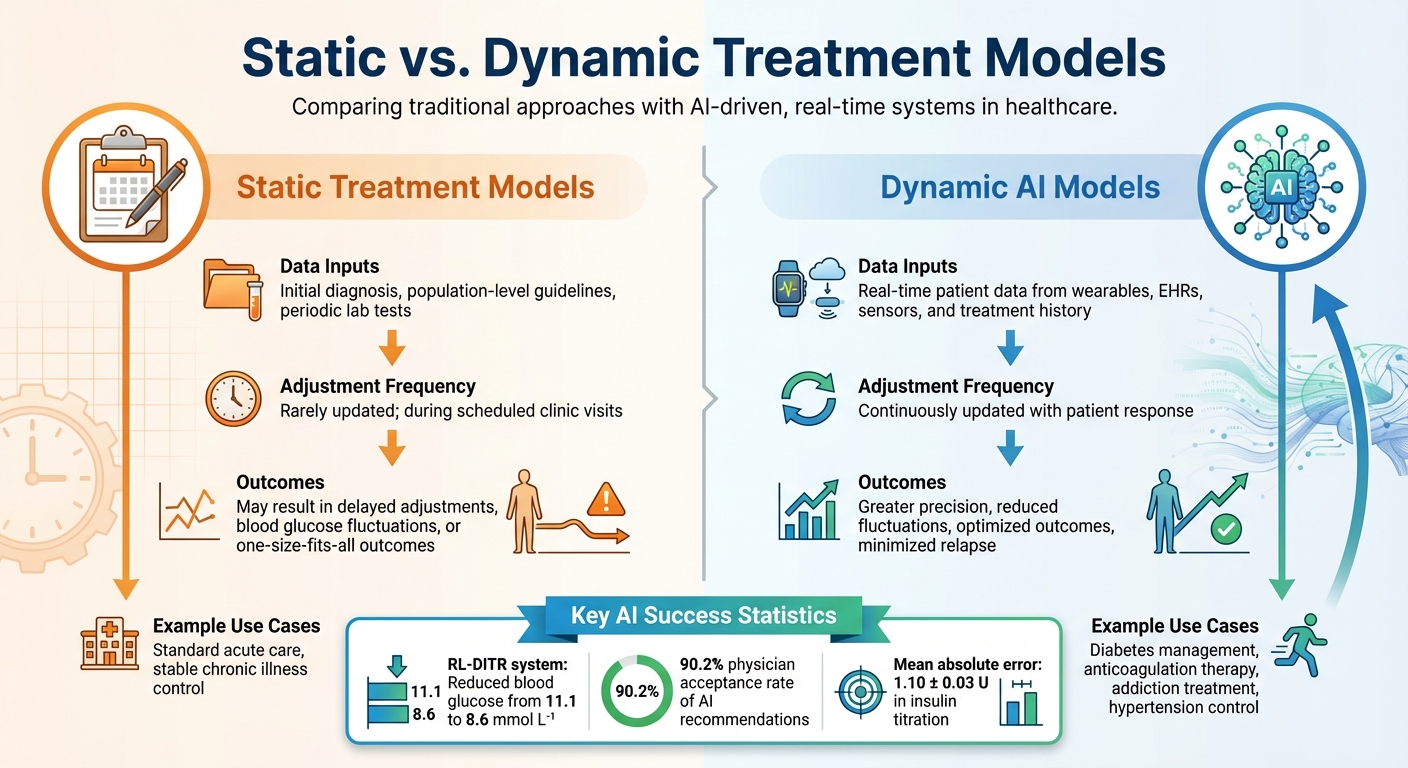
Static vs Dynamic AI Treatment Models: Key Differences in Healthcare
AI-powered dynamic treatment systems are changing the way clinicians handle complex chronic conditions. These systems move beyond rigid protocols, continuously adapting to individual patient responses, which leads to noticeable improvements in managing health outcomes.
AI-Driven Adjustments in Chronic Disease Management
One of the standout examples of AI's impact is in managing Type 2 Diabetes. In 2023, researchers published findings in Nature Medicine on the RL-DITR system, a reinforcement learning framework designed to fine-tune insulin regimens for hospitalized patients. The system analyzed glycemic state rewards and adjusted insulin doses in real time, tailoring treatment to each patient's metabolic needs.
In a feasibility trial involving 16 patients, the system lowered the average daily capillary blood glucose from 11.1 (±3.6) to 8.6 (±2.4) mmol L⁻¹ (P < 0.01). It also achieved a mean absolute error of 1.10 ± 0.03 U in insulin titration, outperforming junior and intermediate-level physicians. Impressively, physicians accepted 90.2% of the AI's recommendations, reflecting a high level of trust in its capabilities [12].
"Personalized and dynamic titration of insulin is of great clinical importance to reduce blood glucose fluctuations and prevent associated comorbidities and mortality in patients with T2D." - Nature Medicine [12]
Beyond diabetes, dynamic AI models are proving their value in other critical therapies. Anticoagulation therapy, for example, requires precise warfarin dosing to balance the risks of thrombosis (clotting) and hemorrhage (bleeding). A dynamic AI system for warfarin dosing uses patient-specific International Normalized Ratio (INR) data to recommend real-time dose adjustments. This approach reduces risks more effectively than static dosing schedules by accounting for each patient's unique coagulation profile [8].
Another area benefiting from AI-driven treatment adjustments is Opioid Use Disorder (OUD) management. A study in the American Journal of Epidemiology applied a dynamic AI model to optimize buprenorphine-naloxone dosing. By adapting dosages as patient conditions changed, the AI strategy outperformed standard clinical protocols in reducing the likelihood of relapse into regular opioid use [6].
Fixed vs. Dynamic Treatment Models
The differences between traditional and AI-driven approaches highlight the advantages of dynamic systems:
| Approach | Data Inputs | Adjustment Frequency | Outcomes | Example Use Cases |
|---|---|---|---|---|
| Static Treatment | Initial diagnosis, population-level guidelines, periodic lab tests | Rarely updated; during scheduled clinic visits | May result in delayed adjustments, blood glucose fluctuations, or one-size-fits-all outcomes | Standard acute care, stable chronic illness control |
| Dynamic AI Model | Real-time patient data from wearables, EHRs, sensors, and treatment history | Continuously updated with patient response | Greater precision, reduced fluctuations, optimized outcomes, minimized relapse | Diabetes management, anticoagulation therapy, addiction treatment, hypertension control |
Dynamic AI models shine in managing chronic conditions, especially when patient responses vary widely and treatments need to evolve over time. They also address "delayed effects", where an early intervention impacts the success of future treatments - something static protocols often overlook [13].
"Dynamic treatment regimes offer an effective vehicle for personalized management of chronic conditions... where a patient typically has to be treated at multiple stages, adapting the treatment (type, dosage, timing) at each stage to the evolving treatment and covariate history." - Bibhas Chakraborty, Department of Biostatistics, Columbia University [8]
These real-world examples show that AI-driven dynamic treatment systems are no longer theoretical. They are delivering measurable clinical benefits across various conditions, highlighting their potential to transform healthcare. With tools like BondMCP, the integration of these systems into unified health data platforms is becoming a reality.
How BondMCP Supports AI-Powered Healthcare
BondMCP provides the essential infrastructure needed to bring AI-driven healthcare into practical use by addressing one of the biggest challenges: fragmented health data. Today, data from wearables, lab tests, fitness apps, supplement logs, and clinical records often exist in silos, making real-time decision-making difficult. BondMCP bridges this gap by integrating these diverse data streams into a single, cohesive system, ensuring that AI models can work seamlessly with healthcare delivery.
Unified Context Layer for Health Data
BondMCP goes beyond basic data aggregation. It consolidates health data from a variety of sources - like wearables, electronic health records, intraoral scans, lab results, and fitness devices - into a unified platform tailored specifically for AI-powered medicine. This approach mirrors how advanced AI systems integrate diverse inputs, such as CBCT imaging, 3D facial scans, and clinical notes, to improve diagnostic accuracy and reduce variability [2].
Imagine a scenario where your sleep tracker, blood glucose monitor, and fitness app all feed data into the same system. With this unified context, AI can spot subtle patterns - like a spike in resting heart rate that could signal poor recovery - and trigger timely adjustments. BondMCP automates this data integration, eliminating the need for manual monitoring across multiple dashboards.
Real-Time Decision Support for Personalization
The unified data layer in BondMCP ensures that all parties - patients, clinicians, and AI agents - have access to continuously updated, interpreted data. This real-time flow of information is vital for managing conditions that require frequent adjustments due to biological variability or compliance challenges [14].
For example, AI models using BondMCP’s framework have demonstrated 85% accuracy in predicting mandibular growth trends, far surpassing the 54.2% accuracy achieved by junior clinicians [2]. In practice, this means more precise and personalized treatment plans can be delivered in real time, without adding extra work for healthcare providers.
Scalability and Automation in Healthcare
Beyond integration and real-time support, BondMCP is designed to scale precision healthcare solutions. Deploying AI-driven treatments on a large scale requires more than just powerful algorithms - it needs a system that can manage multiple AI agents working together under supervisory models to handle complex tasks [7]. BondMCP’s plug-and-play architecture enables this, allowing AI agents to remain dynamic and adaptive rather than becoming static after initial training.
The platform also supports continuous updates to AI models using new patient data [7]. This is a significant shift from traditional AI deployments, where models are validated once and remain unchanged. As of 2024, only 86 randomized trials of machine learning interventions have been conducted globally, and over 40% of FDA-approved medical AI devices lack clinical validation data [7]. BondMCP addresses this gap by embedding real-time monitoring and continuous validation into its operations, paving the way for large-scale precision health delivery.
"The linear model of AI deployment is a poor fit for modern LLM systems... AI systems have an important difference from other technologies in medicine: they are adaptive." - Nature [7]
Benefits and Future Directions of Dynamic AI Models
Clinical Advantages Already Achieved
Dynamic AI models have shown clear benefits compared to traditional fixed treatment plans. For example, they excel in managing conditions like opioid use disorder and chronic diseases by tailoring treatment type, dosage, and timing to individual needs [6][8]. These models also help minimize risks tied to fixed dosing strategies. Take warfarin administration as an example - dynamic models can reduce complications like clotting or excessive bleeding by continuously adjusting doses [8]. Plus, because they learn from real-world data, they bridge the gap between research findings and actual patient outcomes [7].
The Role of Emerging Technologies
The success of dynamic AI models is paving the way for even more groundbreaking applications through emerging technologies. One exciting development is the use of digital twins - virtual patient models that predict health outcomes and simulate personalized responses to treatments before they’re implemented [15]. For instance, in January 2025, researchers introduced the Digital Twin - Generative Pretrained Transformer (DT-GPT) and tested it on over 16,000 non-small cell lung cancer patients and more than 35,000 ICU patients. This model improved forecasting of clinical variables, reducing scaled mean absolute error by 3.4% for lung cancer patients and 1.8% for those with Alzheimer’s disease compared to earlier approaches [15].
Additionally, these systems are becoming increasingly adaptive, thanks to real-time biomedical data and feedback loops that allow them to update continuously [7].
A Smarter Path Forward in Healthcare
The transition from fixed to dynamic treatment plans represents a major evolution in healthcare. Traditional static protocols, designed mainly for acute care, often fall short when addressing the ongoing complexities of chronic conditions. Dynamic AI models bring the flexibility needed to personalize care on a large scale, aligning treatments with each patient’s unique biological and situational factors.
Platforms like BondMCP are at the forefront of this shift, unifying fragmented data and supporting these advanced models. By enabling seamless integration of research findings into practical applications, tools like BondMCP are helping to make adaptive, personalized care a reality.
FAQs
How do AI models like RL-DITR and TxAgent enhance treatment outcomes?
AI models like RL-DITR and TxAgent are changing the game in treatment by making real-time, personalized adjustments based on patient data. Here's how they work:
RL-DITR uses reinforcement learning to fine-tune treatment plans on the fly. It treats every clinical decision as an action, constantly updating its recommendations as fresh data - like lab results, vital signs, or wearable device metrics - comes in. This approach ensures that treatments stay aligned with the patient’s current condition, aiming to improve outcomes while minimizing potential side effects.
On the other hand, TxAgent functions as a smart assistant for clinicians. It dives into complex patient data and selects the most relevant tools, such as decision-support models or digital-twin simulators, to deliver context-specific recommendations. By pulling from a variety of data sources and offering evidence-backed insights, TxAgent helps healthcare providers create precise and flexible care plans.
Together, these models empower clinicians to make smarter, quicker decisions that adapt to each patient’s unique and changing needs.
How do digital twins enhance AI-driven healthcare?
Digital twins are virtual representations of an individual's health, built using real-time data from wearables, lab results, and medical records. These models simulate how a person might react to different treatments or lifestyle adjustments. As new data comes in, the twin evolves, enabling AI systems to predict outcomes, experiment with interventions, and refine treatment plans as the patient’s condition changes.
In real-world applications, digital twins support personalized care by modeling the potential impact of medications, surgeries, or lifestyle changes. This helps healthcare providers make informed decisions and reduce risks. For example, platforms like BondMCP integrate data from wearables, fitness activities, supplements, and lab tests. With this information, AI delivers accurate, real-time health insights, creating a dynamic and tailored healthcare experience for each person.
How does BondMCP unify fragmented health data for AI-driven care?
BondMCP tackles the issue of fragmented health data by building a centralized, health-focused context layer. This layer brings together information from various sources like wearables, lab results, fitness trackers, supplement logs, and sleep monitors. By standardizing all this data into a common format, BondMCP ensures that different systems can "communicate" effectively, making the data both interoperable and machine-readable.
Once the data is standardized, BondMCP's orchestration engine directs it to the right AI models - whether that's for diagnostics, risk prediction, or treatment planning. This process gives AI systems access to a real-time, detailed view of a patient’s health, paving the way for personalized, dynamic care. Developers don't need to create custom pipelines, as BondMCP simplifies the process. It also manages data privacy and tracking, making it easier to deploy adaptive, AI-powered health solutions.