
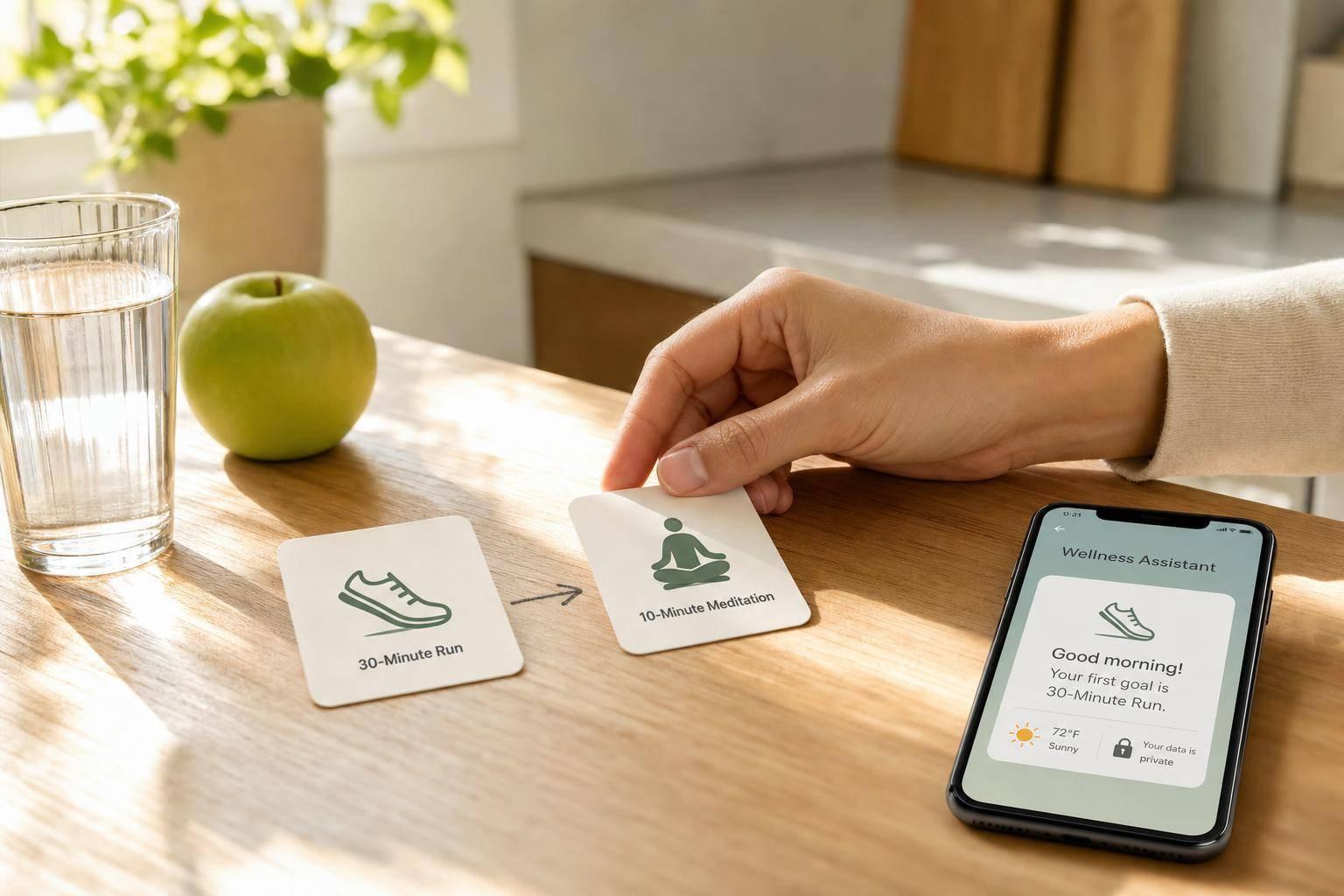
Trying to build several habits at once can work - but only if you don’t treat every habit as equal every day. Research suggests that people often do better when they focus on one or two priority habits, add others in steps, and let sleep, stress, food, and exercise shift in priority as life changes.
Here’s the short version:
- Multiple behavior plans can beat single-behavior plans
- Habits often take about 2 to 5 months to settle, with common averages around 66 to 77 days
- Some habits compete because they draw from the same time, energy, and attention
- Sequencing usually works better than piling on everything at once
- AI coaching helps most when it picks the next best action for today, not when it sends the same reminder every day
- Privacy matters because health apps may share data outside what many users expect
In other words: if you want to build more than one health habit, I’d keep it simple. Start with a small set of actions, let one habit get steady, and use data and context - like poor sleep, stress, or a packed schedule - to decide what should come next.
The Science of Making & Breaking Habits
sbb-itb-f5765c6
Quick comparison
| Topic | Main takeaway |
|---|---|
| Doing many habits at once | Can work, but overload is a risk |
| Best pace | Build in steps instead of all at once |
| Habit timeline | Often 66–77 days, sometimes 2–5 months |
| Best-studied habit groups | Sleep, activity, nutrition, and stress |
| Static reminders | Often too rigid |
| AI-based coaching | Better when it changes with context |
| Privacy | Check sharing, controls, and deletion options |
What follows boils the article down into the few ideas that matter most for day-to-day habit building.
What Recent Research Says About Forming Multiple Habits
How Habit Strength Builds and Breaks Across Behaviors
Habit strength grows through repetition in a stable setting. Do the same action in the same context often enough, and your brain starts tying the cues around it - time of day, place, and whatever happened right before - to the action itself. After a while, those cues start the routine on their own instead of forcing you to think it through every time.
A 2024 systematic review and meta-analysis covering 20 studies and 2,601 participants found that health habits usually take about 2 to 5 months to reach steady habit strength, though the full range ran from 4 to 335 days.[4] So the old "21-day rule" doesn't hold up. Median habit-formation timelines are closer to 66 to 77 days.[4]
Habits can also fade when routines get thrown off. A move, a job change, new work hours, or a switch from office work to remote work can weaken the cue-behavior link. And when one routine slips, other habits tied to that same schedule or trigger can slip with it. Those cue patterns are also what coaching systems watch when deciding when to suggest the next habit.
Why Goals Compete and Why Sequencing Helps
This research points to a simple rule: get one habit steady before piling on another. Trying to change too much at once can drain attention and self-control, which is why sequencing often beats doing everything all at once. Starting with one or two anchor habits can cut down on interference.[2][3] Once a behavior runs more on autopilot, it takes less mental effort, which leaves more room for the next one.
That's the logic AI health coaching can use when picking the next habit to work on, not just when tracking the one already in progress.
Which Health Behaviors Are Most Often Studied Together
Research on multi-goal interventions tends to group around four behavior areas: physical activity, nutrition, sleep, and stress management.[1][5] These areas affect each other in measurable ways. For instance, diet and physical activity programs have been shown to improve sleep quality and lower stress markers even when sleep or stress weren't direct targets.[1]
| Behavior Pair | Why Researchers Study Them Together |
|---|---|
| Physical activity + nutrition | Both are closely tied to chronic disease risk and general well-being, and changes in one often affect the other |
| Sleep + physical activity | Poor sleep can drain energy and weaken self-control; regular movement can help support better sleep |
| Stress management + nutrition | Higher stress can drive cravings for calorie-dense foods and make eating choices harder to manage |
| Sleep + stress management | Chronic stress can disrupt sleep timing and sleep quality; relaxation practices can help support steadier sleep |
Common targets in multi-goal studies include:
- Daily step goals
- Sleep schedules aimed at 7 to 9 hours per night
- Nutrition goals such as cutting added sugar or eating more whole grains
- Short daily stress-reduction habits like breathing exercises or brief mindfulness sessions[1][5]
These pairings give AI coaches a practical map for timing prompts and layering habits in a way that helps limit overload.
How AI Algorithms Support Multi-Goal Habit Formation
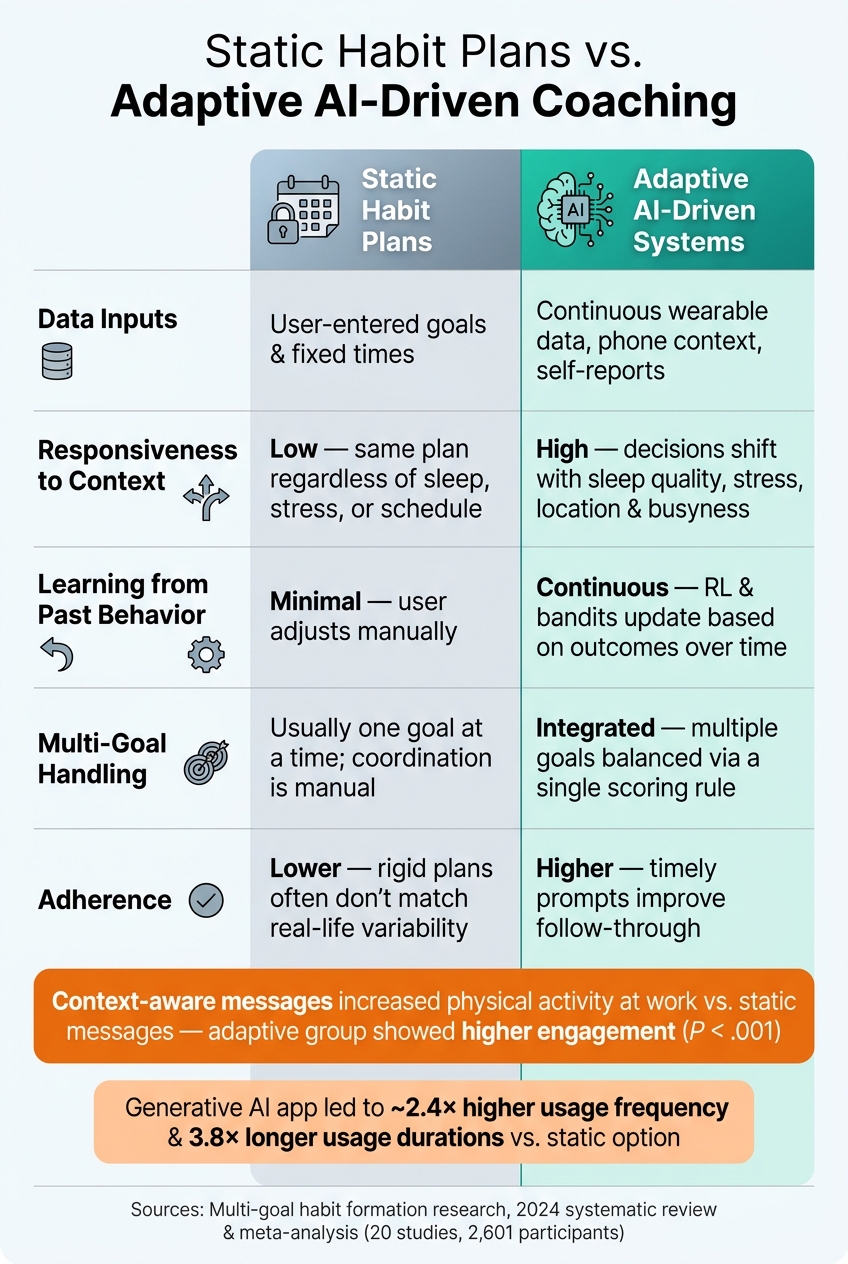
Static Habit Plans vs. Adaptive AI Coaching: Key Differences
Reinforcement Learning and Context-Aware Decisions
When habits start to compete, the hard part isn't setting goals. It's deciding which goal matters most right now. That's where AI systems step in.
Using reinforcement learning (RL) and contextual bandits, these systems choose which habit to prompt, what kind of prompt to send, and when to send it.[15][16] The decision comes from context: time of day, location, recent activity, heart rate, calendar busyness, recent sleep, and self-reported stress.[15][16] From there, the system picks the action most likely to lead to the best short-term result.[15][16]
This matters a lot in multi-goal situations, where the system is managing priorities across several behaviors at once. Say someone slept badly. Instead of pushing the same step target, the system may shift to an easier goal or send a stress-reduction prompt.[13][14] Then it learns from that choice and adjusts future prompts based on what worked in similar situations before.[6][13]
Wearables, Self-Monitoring, and Real-Time Adjustments
A just-in-time adaptive intervention (JITAI) gives support at the moment a person is most likely to benefit.[18] JITAIs have been used for physical activity, stress, sleep, and substance use, so they fit naturally into multi-habit coaching.[12]
In day-to-day use, a JITAI-based system pulls from steady streams of data, including step count, heart rate variability, sleep duration, GPS location, and self-reported stress or mood.[8][12][14] It uses those signals to decide which habit should come first when sleep, stress, and movement are pulling in different directions.[8][12][14]
For example:
- Low step counts plus high stress may trigger a walking prompt framed as stress relief.[8][9][15]
- Late-evening stress may shift the prompt away from movement and toward sleep hygiene.[8][9][15]
That kind of shift is the whole point. The system doesn't treat every day the same, because real life doesn't work that way.
Static Rules vs. Adaptive Multi-Goal Algorithms: A Side-by-Side Look
The difference stands out fast when you compare fixed habit plans with adaptive systems.
| Aspect | Static Habit Plans | Adaptive AI-Driven Systems |
|---|---|---|
| Data inputs | User-entered goals and fixed times | Continuous wearable data, phone context, self-reports [8][15] |
| Responsiveness to context | Low; same plan regardless of sleep, stress, or schedule | High; decisions shift with sleep quality, stress, location, and busyness [8][13][15] |
| Learning from past behavior | Minimal; user adjusts manually | Continuous; RL and bandits update based on outcomes over time [7][11][13] |
| Multi-goal handling | Usually one goal at a time; coordination is manual | Integrated; multiple goals balanced via a single scoring rule that balances goals [10][11][15] |
| Adherence | Lower; rigid plans often don't match real-life variability | Higher; timely prompts improve follow-through [12][14][15] |
Research on context-aware motivational messages backs this up. One experimental study found that context-aware messages increased physical activity at work compared with static messages, and the adaptive group showed higher engagement (P < .001).[17] Put simply, adaptive prompts can drive more engagement and more activity than static reminders.
What This Means for AI-Powered Health Coaching
What Good Multi-Goal Coaching Looks Like in Practice
The main takeaway is simple: good coaching should shift priorities, not pile on more demands.
When someone is working toward more than one health goal, the coach shouldn't push everything at once. It should coordinate habits and change emphasis as life changes. That means putting one goal in the lead while keeping lower-priority habits in maintenance mode.
A good place to start is the user's baseline. From there, the coach can keep some habits steady while giving one goal the main push. A 2019 study found that prompts sent after three straight days of missed self-monitoring did a better job of re-engaging users than fixed daily reminders.[20] In plain English: AI feedback loops work better when they respond to behavior, not just the time on the clock.
Good coaching also needs to account for real life. Schedule changes, sleep debt, and stress can throw off even the best plan. So the coaching should adjust when those things show up. That's what makes multi-goal coaching usable day to day.
That same idea is what an AI coach should turn into daily guidance.
How Healify Fits This Research-Backed Model
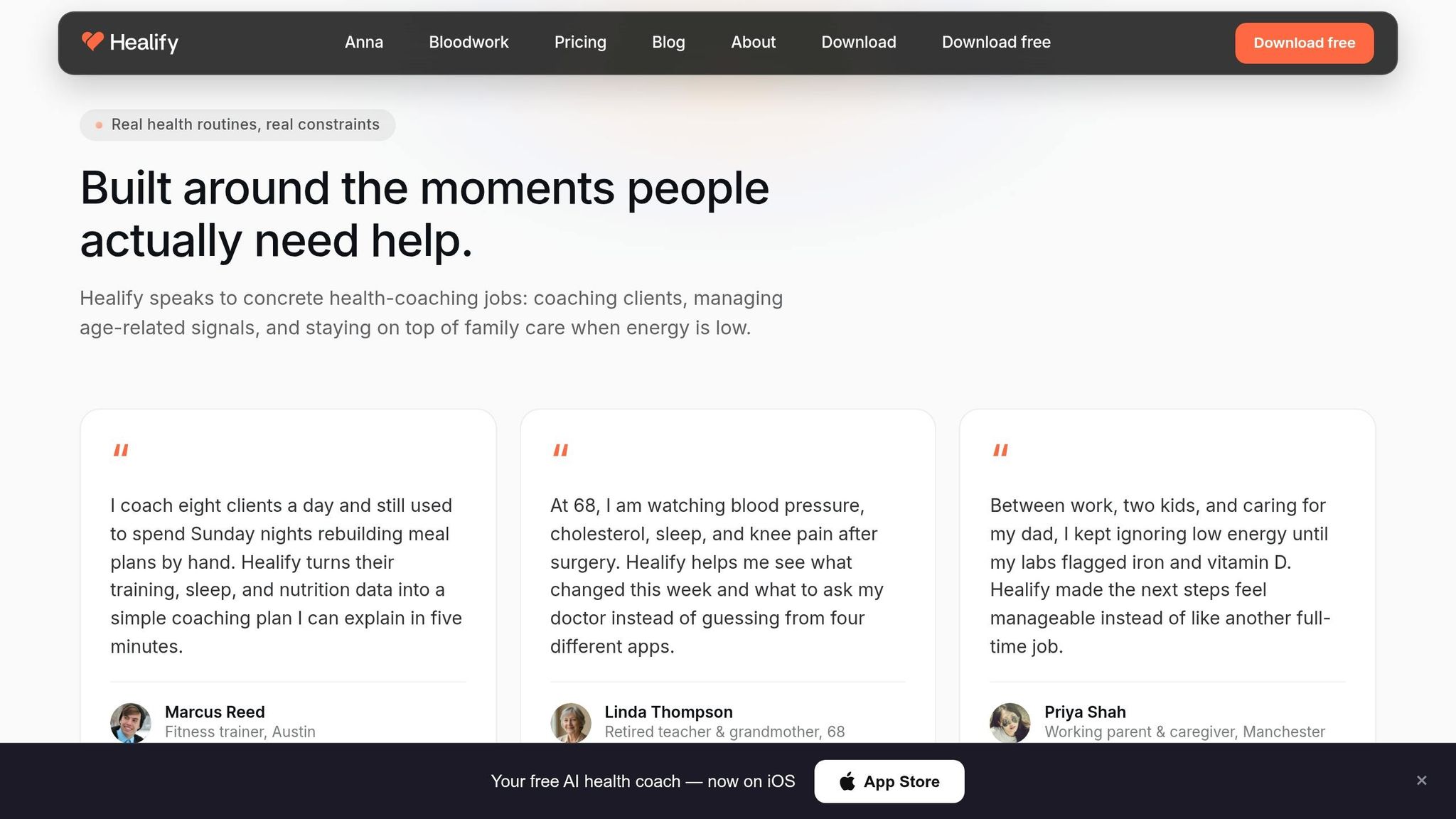
Healify brings together wearable, biometric, bloodwork, and lifestyle data into one prioritized action plan. Instead of throwing a long list of prompts at users, it cuts mental overload by surfacing one or two priority actions per day.
Its real-time health monitoring can also spot when stress or fatigue signals are climbing and adjust guidance on the fly. That might mean lighter activity, an earlier bedtime, or a wind-down routine instead of pushing the same plan no matter how the person feels.
AI coach Anna adds a conversational layer on top of that. She helps users sort through tradeoffs between goals, re-prioritize when schedules change, and make data like heart rate variability trends or bloodwork markers easier to understand and act on. A 12-month trial found an AI-led lifestyle intervention non-inferior on a composite outcome.[19] That backs the idea that AI coaching can work when it responds to the person and adjusts to their situation.
Stress and sleep support aren't side features in Healify. They're built into the core setup. That lines up with research showing that multi-behavior interventions that include sleep, stress, and psychological components can improve mental health outcomes, and that both stress/sleep-focused and diet/activity-focused approaches can reduce stress.[21][22]
Research-Backed Habit Mechanisms and Matching AI Coaching Features
These habit mechanisms line up well with specific AI coaching functions.
| Habit Mechanism | AI Coaching Feature | How It Works in Practice |
|---|---|---|
| Self-Monitoring | Real-time dashboards & Health Score | Tracks sleep, activity, and stress in one view so progress across goals is easy to see |
| Prompts & Cues | Context-aware alerts & notifications | Sends timely nudges based on inactivity, stress signals, or approaching bedtime - not fixed schedules |
| Reinforcement | Personalized feedback & streak tracking | Acknowledges when targets are met or maintained, helping lock in behaviors before they run on autopilot |
| Sequencing | Adaptive coaching plans | Adds new habits step by step, linking behaviors such as a post-dinner walk and a wind-down routine to build chains |
| Habit stabilization | 24/7 progress monitoring | Moves habits from active prompting to maintenance level once they happen steadily without reminders |
Engagement matters because adaptive coaching gets better only when the system keeps learning from use. A 2024–2025 trial found that a generative AI-enabled app led to about 2.4× higher usage frequency and 3.8× longer usage durations than a static option, with more personalization linked to larger drops in anxiety symptoms.[23] More engagement gives the system more data, which helps it keep adjusting the coaching.
Limits, Privacy, and Key Takeaways
Why the Evidence Is Promising but Still Incomplete
Even with coaching that adjusts over time, the evidence still has gaps. Many digital health studies run for only 8 to 12 weeks, which is shorter than the 2 to 5 months many habits need before they start to stick. That gap matters. Multi-goal coaching needs enough follow-up to show whether new routines last or fade once the first burst of motivation wears off.
Studies that track more than one goal are also harder to judge. Researchers have to watch several outcomes at the same time, sort out how one behavior affects another, and define what “success” means when someone improves in one area but stalls in another. On top of that, study samples often lean toward motivated volunteers or wellness-focused groups. So the results may not map neatly to the broader U.S. public.
AI can help with timing and sequencing. It can suggest the right nudge at the right moment. But it can't do the push-ups, cook the meal, or get you to bed on time. Progress across sleep, activity, nutrition, and stress won't move in a straight line.
Data Privacy and User Control in Health Habit Apps
Data limits are only part of the story. Apps that pull from wearables, biometrics, and lifestyle logs can build a detailed picture of daily life. That makes clear data practices a must. Many consumer health apps sit outside HIPAA, which means protections often depend on consumer privacy law and the app's own policy. And if people don't trust the app, they stop sharing the data the system relies on.
The FTC's Health Breach Notification Rule now applies to many health apps and connected devices, and it requires breach notice within 60 days.[24][26][27] Even with that rule, users still need plain explanations of how data is collected, shared, and stored.
FTC analysis has found health data moving from apps and devices to dozens of third parties, sometimes in ways that can be linked back to specific people.[25][28] If you're checking out any health habit app, pay attention to a few basics:
- Plain-language privacy notices
- Granular controls for which data sources are turned on
- Clear options to delete your data
The more sensitive the data, like sleep patterns, stress signals, or bloodwork, the more those controls matter.
Key Points to Take Away
The big points are simple:
- Uneven progress is normal; one habit will often stabilize before the others.
- Habit change still depends on repetition, cues, and gradual layering.[29][30]
- Dynamic coaching beats fixed reminders when multiple goals compete.
- Good coaching surfaces one or two clear next steps and adjusts when life changes.
- Personalization only works when data handling is transparent and user control is real.
Use AI coaching for small, steady changes over weeks and months.
FAQs
How many habits should I start with?
Start with 3 to 5 habits. Keeping the list short makes it easier to get going without feeling overloaded.
Then use AI coaching and your health data to fine-tune the habits that matter most and adjust them as you build momentum.
What if my habits keep falling off after routine changes?
Treat this as a signals-and-adjustments problem, not a motivation problem.
The idea is simple: use AI-driven feedback to catch dips in completion rates, broken streaks, or relapses as they happen. Then make small changes to timing, habit structure, and prompts based on when you’re most likely to follow through.
Don’t blow up your whole routine. Start with habit stacking instead. Add small actions to triggers that already exist, so the habit feels easier to repeat and less like a heavy lift.
Healify’s Anna can review wearable and biometric data to help adjust its recommendations as your sleep, stress, and energy levels change.
How can I tell if an AI coach is using my health data safely?
Check whether the platform follows strict standards like HIPAA and uses strong encryption. Then read the privacy policy. You want to know how your data is collected, stored, and shared.
For extra protection, use a strong, one-of-a-kind password and turn on two-factor authentication. Those small steps can help keep your biometric and lifestyle data safe.