
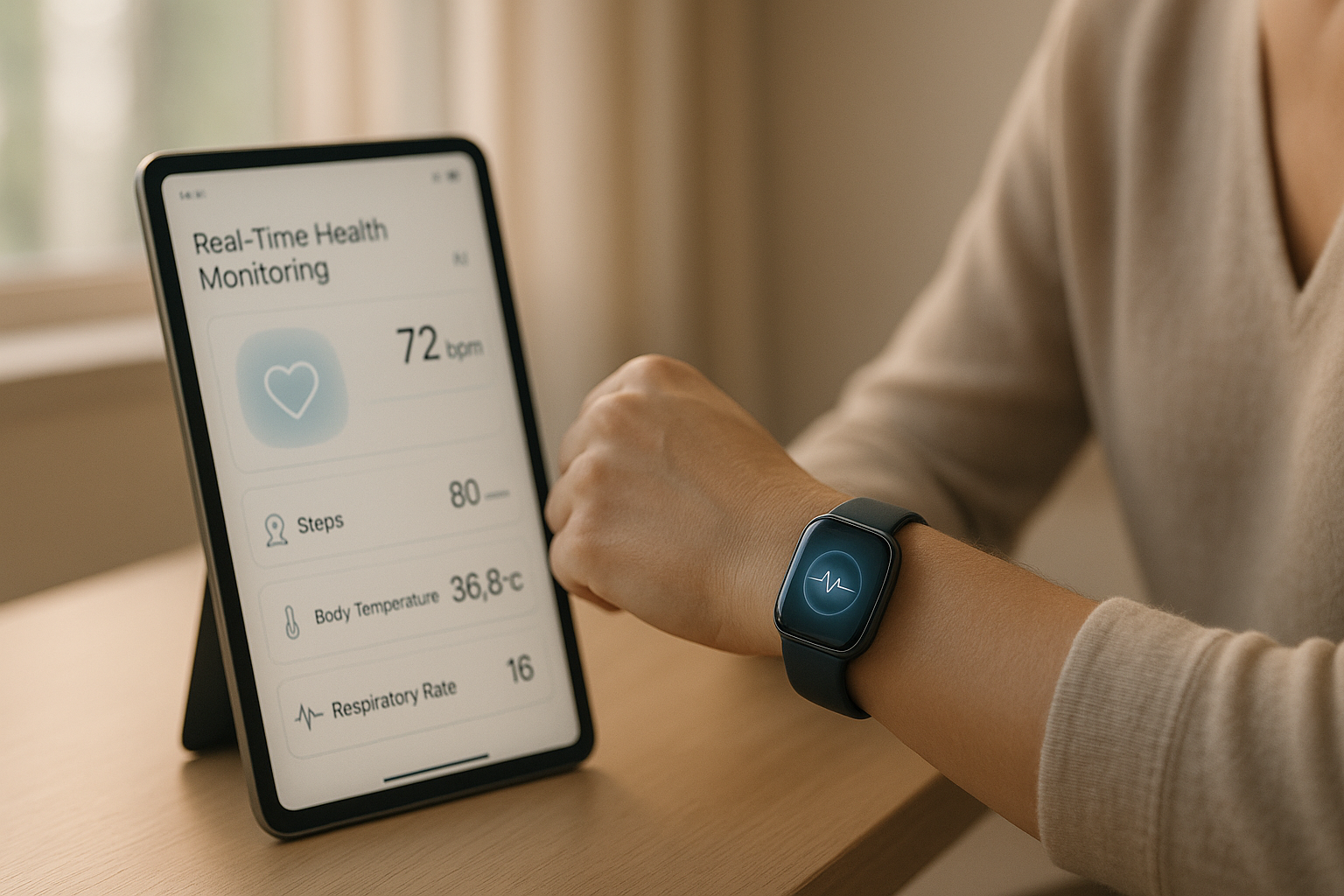
AI-powered health monitoring is transforming healthcare by continuously tracking patient data and providing actionable insights in real-time. Here's a quick breakdown of how it works:
- Data Collection: Wearable devices and sensors gather health metrics like heart rate, activity levels, and real-time biomarkers.
- AI Processing: Machine learning algorithms analyze data to detect patterns, identify risks, and create personalized health profiles.
- Unified Systems: Platforms like BondMCP integrate fragmented health data into a single, real-time decision-making tool.
- Real-Time Feedback: AI provides instant recommendations, helping patients and doctors make informed decisions faster.
This approach not only improves patient care but also reduces medical errors and enhances operational efficiency. However, challenges like privacy concerns, scalability, and ethical issues require careful attention to ensure its success. Let’s dive deeper into the components, technologies, and future of this healthcare revolution.
How AI Powered Remote Patient Monitoring is Transforming Healthcare Improve Patient Care with #rpm
Core Components of AI-Driven Real-Time Monitoring
Real-time health monitoring systems depend on three interconnected elements that turn raw health data into actionable insights. Each component is essential in creating a responsive system capable of detecting health changes as they occur.
Data Collection Across Devices
At the heart of any real-time health monitoring system is the collection of data from multiple sources. Wearable devices play a key role, using sensors like heart rate monitors, accelerometers, and advanced biosensors to track metrics such as sweat composition, saliva, and other bodily fluids [4][6]. This data is wirelessly transmitted to smartphones or tablets via Bluetooth or Wi-Fi and then securely uploaded to cloud servers for processing and storage [3][4]. Together, these streams create a continuous and detailed health profile.
The wearable tech market is booming, with projections estimating its value to exceed $100 billion by 2027. By 2025, global sales of wearable devices are also expected to surpass $100 billion [5]. APIs ensure smooth data exchange between systems, while standards like Health Level Seven (HL7) and Fast Healthcare Interoperability Resources (FHIR) enhance the sharing of electronic health information [4]. These tools and standards emphasize the need for seamless integration, ensuring data from diverse devices can be effectively utilized.
This rich data ecosystem sets the stage for AI to process and transform raw inputs into meaningful insights.
AI-Driven Data Processing and Integration
Once collected, raw health data undergoes advanced AI processing to uncover patterns and provide actionable insights. Machine learning algorithms analyze vast datasets, identifying trends and correlations that might escape human observation, thus improving diagnostic precision [7]. This involves filtering data, recognizing patterns, and generating insights [3].
AI also consolidates various healthcare data streams into a unified patient profile. This is especially relevant in today’s data-driven world, where 90% of all data was created in just the last two years [9]. For example, GE Healthcare integrated TensorFlow into MRI imaging systems by 2025, automating the identification of body parts, reducing processing time by 30%, and improving diagnostic accuracy [9].
AI systems are constantly refining their processes, including error detection and correction [8]. BondMCP's Health Model Context Protocol exemplifies this by unifying data from wearables, labs, supplements, and even sleep patterns into a cohesive system. Rather than functioning in isolation, these systems form a connected intelligence layer, acting as context-aware health agents that understand individual needs, creating a comprehensive health optimization framework for recovery and longevity.
Real-Time Analytics and Feedback
After AI processes and integrates the data, real-time analytics provide immediate and practical feedback. These analytics continuously monitor health metrics, compare current readings against personalized baselines, and flag anomalies. AI-powered insights support clinical decisions by delivering instant, tailored recommendations [8].
Predictive analytics also play a critical role in proactive health management. By forecasting health trends, AI enables earlier interventions and population health management [7]. A notable example is the UK’s National Health Service (NHS), which, in 2024, launched an £11 million AI trial to assist radiologists. By analyzing thousands of past mammograms and comparing them with new scans, the AI system helped radiologists identify abnormalities more quickly and accurately. This trial not only doubled radiologist efficiency but also improved early-stage cancer detection rates, leading to faster interventions [9].
Personalized feedback is delivered in user-friendly formats through mobile apps, wearable notifications, and healthcare dashboards. This ensures that users can act on insights immediately, enabling better health management and engagement. Additionally, the integration of AI into wearable biosensors boosts predictive accuracy, offering recommendations that align with an individual’s unique health profile, lifestyle, and goals [3].
Together, these components form a dynamic and responsive monitoring system. However, its success depends on addressing challenges related to privacy, security, and scalability effectively.
Key Technologies and Standards
Real-time AI health monitoring hinges on three main components: wearable sensors, AI algorithms, and standardized health protocols. Together, these elements turn raw health data into meaningful insights, enabling accurate and responsive health monitoring. Here's a closer look at how each technology plays a role in this process.
Advances in Wearable Sensor Technology
Modern wearable sensors have revolutionized how we collect physiological data. Using cutting-edge mechanisms, these sensors can capture highly detailed information about the body. For example, polymer nanocomposite sensors stand out with their enhanced piezoresistive sensitivity, offering both linear and nonlinear responses. Compared to piezo-capacitive sensors, which typically have lower sensitivity levels, these nanocomposite sensors deliver much more precise measurements [10].
In addition, triboelectric devices now outperform traditional piezoelectric generators by producing higher power densities and achieving better energy conversion efficiency [10]. Both piezoelectric and triboelectric sensors respond instantly to stress, enabling continuous and real-time monitoring of vital signs and activity levels [10].
AI Algorithms for Health Monitoring
Once data is gathered by sensors, AI algorithms step in to analyze and interpret it. These algorithms play a pivotal role in transforming raw data into actionable insights. For instance, ensemble-boosted trees have shown promise in health forecasting, while a Transformer-based Self-Attention Model (TL-SAM) recently achieved impressive results in disease classification, with 98.62% accuracy, 97% precision, 98% recall, and a 97% F1-score [12].
AI goes beyond simple predictions - it can forecast potential health issues like heart attacks or strokes by detecting personalized health insights from wearable anomaly data such as patterns in activity levels, sleep quality, and heart rate variability [10]. Additionally, AI ensures data reliability by identifying and correcting errors, while advanced filtering techniques isolate individual signals for more accurate results [10]. Automation further simplifies the process by handling data preprocessing, anomaly detection, and data fusion, making it easier for healthcare teams to manage and act on the information.
Standardized Health Context Protocols
For wearable sensors and AI to work seamlessly, standardized protocols are essential. These protocols ensure that data from different systems can integrate smoothly. Interoperability standards, such as HL7 v2, are already used by over 95% of U.S. healthcare organizations to facilitate data exchange. Meanwhile, FHIR builds on modern web principles, using JSON and XML formats to streamline communication between systems [13][14].
Nationwide initiatives like TEFCA aim to create unified architectures for data sharing, while standards such as USCDI ensure consistent sharing of key data elements [14]. BondMCP, for example, consolidates diverse data streams into a single intelligence layer, enabling real-time decision-making. This allows sleep tracking data to inform training plans, lab results to adjust supplement protocols, and long-term health goals to shape immediate actions.
"Healthcare deserves trustworthy AI. With HMCP, Innovaccer turns this vision into reality. Let's collaborate to build it securely and responsibly." – Innovaccer [11]
These protocols also tackle semantic interoperability, ensuring that clinical concepts retain their meaning across different systems [14]. Implementation guides, like IHE profiles (including XDS, PIX, and PDQ), provide detailed instructions for structuring and integrating data [13][14].
The impact of these standards is significant. By integrating AI with proper protocols, private payers could cut administrative costs by up to 20% and medical costs by 10%. Additionally, health systems can reduce data verification times from days to near real-time [1]. Together, wearable sensors, AI algorithms, and standardized protocols are creating a connected ecosystem that captures precise data, delivers actionable insights, and ensures seamless integration - transforming the way healthcare is delivered.
sbb-itb-f5765c6
Implementation Challenges and Solutions
AI-powered health monitoring systems face hurdles like privacy concerns, scalability issues, and ethical dilemmas. Addressing these challenges requires thoughtful strategies. Let’s dive into the key obstacles and their practical solutions.
Privacy and Security Requirements
AI in healthcare deals with vast amounts of patient data, which raises significant privacy and security concerns. Even anonymized data isn’t foolproof. For example, a 2019 study found AI could re-identify 99.98% of individuals in anonymized datasets using just 15 demographic attributes. Similarly, a 2018 study showed algorithms could re-identify 85.6% of adults and 69.8% of children in physical activity studies [18][19].
Public trust is another hurdle. A 2018 survey revealed that only 11% of American adults were comfortable sharing health data with tech companies, compared to 72% who trusted their physicians [16]. This skepticism is fueled by incidents like the 2016 DeepMind partnership with Royal Free London NHS Foundation Trust, where critics argued patients weren’t given control over their data. A senior advisor described the data acquisition as based on an "inappropriate legal basis." The situation worsened when Google took control of DeepMind’s app, transferring patient data from the UK to the US [16].
To address these concerns:
- Implement multi-layered security measures like encryption, access controls, and real-time monitoring.
- Conduct Data Protection Impact Assessments (DPIAs) to identify and mitigate risks before deployment [17].
- Establish clear policies for how patient data is processed, accessed, and retained [15].
- Train healthcare professionals on AI security practices and potential vulnerabilities.
- Ensure AI algorithms remain transparent and interpretable to minimize biases and privacy risks [15].
Scalability and Adaptation
Expanding AI health monitoring systems to diverse populations and settings comes with technical and operational challenges. With healthcare systems already facing staff shortages, scalable AI solutions are more critical than ever [22].
Organizations can tackle scalability by adopting technologies like cloud platforms and modular architectures, which can handle growing data volumes and user demands [20]. Machine Learning Operations (MLOps) plays a key role in moving AI tools from research to real-world deployment [21]. Here’s how MLOps principles address scalability challenges:
| MLOps Principle | Functional Requirement | Challenge Addressed |
|---|---|---|
| Clinical workflow integration | Conduct workflow analyses for equitable deployment | Manages resource usage and mitigates AI biases |
| Stakeholder collaboration | Document health equity assessments and form expert panels | Promotes transparency in evaluating AI tools for safety and performance |
| Continuous monitoring | Include fairness drift detection with pre-deployment triggers | Ensures models remain accurate and safe for patient use |
| Automated deployment | Automate bias and fairness checks in deployment pipelines | Reduces operational burdens while maintaining consistency in evaluations |
| Regulatory compliance | Expand automated quality checks for bias and fairness | Prevents deployment of high-risk AI models |
Tools like BondMCP simplify scalability by consolidating data streams into unified platforms, reducing complexity while enabling comprehensive monitoring.
Ethics and Transparency in AI
Even with technical safeguards and scalable solutions, ethical oversight is vital. AI systems can introduce biases, leading to discrimination or unequal access to care [15][19]. Current privacy laws often fail to cover AI-specific risks, leaving gaps in data protection [15]. Over-reliance on AI may also reduce human oversight, creating vulnerabilities and ethical blind spots [15].
To address these issues:
- Develop robust data governance policies with clear, objective standards for AI systems [22].
- Document every aspect of AI model development, including data sources, feature selection, validation methods, and bias mitigation strategies [22].
- Embed automated bias and fairness checks into deployment pipelines to ensure models remain accurate and equitable [21].
- Update traditional governance frameworks to tackle AI-specific challenges like algorithmic bias, data quality, and interpretability [22].
"Organizations may make the mistake of overlooking the ongoing need for hands-on employee training because they rely too heavily on machine automation." - Perry Carpenter [15]
Real-world examples highlight the stakes. The 2021 ransomware attack on Ireland’s Health Service Executive (HSE) shut down hospital IT systems, disrupting patient care [19]. This incident underscores the need for strong security frameworks and continuous monitoring in AI health systems.
A successful implementation balances automation with human oversight, ensures transparency in decision-making, and guarantees equitable access to AI-driven healthcare tools for all.
Benefits and Impact for Stakeholders
Real-time AI monitoring brings a range of benefits to patients, healthcare providers, and developers, reshaping healthcare delivery through unified systems. While each stakeholder group enjoys unique advantages, they also face specific challenges.
| Stakeholder | Key Benefits | Considerations |
|---|---|---|
| Patients | Access to personalized insights via combined data streams, early detection enabling proactive care, seamless health optimization across devices | Concerns about data privacy, adapting to new technologies, and potential over-reliance on AI-generated recommendations |
| Clinics | Streamlined workflows improving efficiency, cost reductions through better resource management, enhanced patient outcomes | Challenges with system integration, staff training needs, and ensuring compliance with regulations |
| Developers | Faster deployment with scalable, unified protocols, reduced complexity through standardized ecosystems, consistent health data context | Complexity of initial implementation, ongoing maintenance demands, and interoperability hurdles |
These advancements are driving a broader transformation in healthcare. Patients benefit from unified insights that support proactive health management, while clinics and developers experience streamlined processes and simplified integration. For example, BondMCP consolidates sleep, lab, and supplement data to eliminate conflicting advice, ensuring a more cohesive care approach.
The rapid adoption of centralized systems highlights their growing importance. Following the 2009 HITECH Act, nearly all U.S. hospitals transitioned to centralized electronic health record (EHR) systems [23].
Healthcare providers have seen measurable improvements in operations thanks to unified monitoring. A study on hospital acquisitions revealed a 2.5% decrease in operating expenses per adjusted admission, all while maintaining quality care without increasing revenue [25].
"Integration can mean better care, improved access, greater ability to respond to disasters and lower costs for patients."
– Rick Pollack, AHA News [25]
The pandemic further accelerated the adoption of integrated health technologies. Telemedicine use surged from 0.3% of all clinical interactions pre-pandemic to 23.6% in 2020 [2], emphasizing the need for unified systems that support remote care and monitoring.
Developers also gain substantial benefits through standardized protocols and unified ecosystems. Instead of creating separate integrations for every data source, they can build applications that seamlessly connect with comprehensive platforms. BondMCP addresses these needs by offering structured protocols and SDKs that streamline memory systems, agent routing, and toolchain development.
Examples from around the world showcase the impact of centralized systems. In Turkey, the "saglik.net" platform was introduced to standardize healthcare data, improve information flow, and save resources [23]. Similarly, India is working on a centralized database for its newborn sickle cell program [23].
Unified AI monitoring not only enhances collaboration but also transforms healthcare delivery. By providing consistent, real-time data across providers, these systems foster better communication and coordination among healthcare professionals. This integrated approach improves access to care, raises service quality, and reduces overall healthcare costs [24].
"Integration is a key to strengthening health care in this country and ensuring every community – whether rural, urban or suburban – has access to affordable, evidence-based care."
– Rod Hochman, M.D. [25]
The momentum toward unified systems is clear. By 2021, over 90% of hospitals and half of clinical physicians had adopted some form of electronic medical record (EMR) system [2].
Addressing these challenges ensures that real-time AI monitoring continues to drive meaningful advancements in healthcare delivery.
The Future of AI in Health Monitoring
Healthcare is evolving at an incredible pace. By 2025, 90% of hospitals are projected to use AI technology for early diagnosis and remote monitoring [26]. This marks a major shift toward smarter, more proactive healthcare systems designed to anticipate and address patient needs before they become critical.
AI is already reshaping efficiency and patient care. Autonomous systems are moving beyond simple reactive monitoring to intelligent health management that predicts and prevents issues [27].
"As generative AI keeps improving, healthcare organizations can look forward to smarter tools, like real-time conversational AI assistants for doctors and fully automated coding systems. These advances will help providers spend less time on paperwork and more time caring for patients."
- Jeremy Mackinlay, Senior Industry Marketing Manager, SS&C Blue Prism [27]
Generative AI is proving its worth by cutting physician paperwork by 65%, enhancing decision-making by 37%, improving diagnostic accuracy by 42%, and increasing treatment effectiveness by 38% [26].
Personalized Medicine and Real-Time Biometrics
Personalized medicine is no longer limited to genomics. AI now integrates real-time biometrics, wearables, lab results, and lifestyle data to create treatment plans that adapt dynamically [27]. This approach tailors care to each individual in ways that were unimaginable just a few years ago.
"Personalized Medicine 2.0: Going beyond genomics to include real-time biometrics for custom-tailored treatment plans – this catchphrase will be big."
- Anna Twomey, Senior Director, Healthcare – Providers, SS&C Technologies [27]
Mental Health Monitoring: The Next Frontier
AI isn’t just transforming physical health - it’s also breaking new ground in mental health. By analyzing data from wearables, self-reported outcomes, and even ambient sensors, AI can detect early signs of stress, anxiety, or depression [1]. This shifts mental healthcare from crisis intervention to prevention, offering a proactive approach to wellbeing.
Unified Systems and Predictive Analytics
Platforms like BondMCP are emerging as vital tools for consolidating diverse health data into a unified system. BondMCP acts as a shared context layer, enabling devices and data to work together seamlessly. This orchestration ensures AI technologies function in harmony, driving real-time decisions and improving patient outcomes.
"Orchestration is the invisible conductor of healthcare AI, harmonizing complex workflows, integrating disparate systems, and ensuring that generative AI technologies work in concert to deliver seamless, intelligent patient care."
- Mike Thorpe, Senior Solutions Consultant, SS&C Blue Prism [27]
Predictive analytics is also becoming a standard practice. AI processes large volumes of multimodal data to identify patterns, helping to stratify high-risk patients with precision [1]. Hospitals are already experiencing 38.1% improvements in completing administrative tasks and a 29.5% reduction in time spent on routine work thanks to these intelligent systems [26].
Enhancing Medication Adherence and Physician Efficiency
AI is tackling medication non-compliance through personalized interventions, virtual assistants, and behavioral nudges [1]. This technology has also revolutionized medical record management, improving efficiency by 47.61%, enabling doctors to spend nearly 47% more time with patients, and increasing patient satisfaction rates by 80% [26].
As these advancements continue, over 80% of physicians now support the integration of AI into patient care [26]. The future of healthcare lies in this collaboration between human expertise and AI, delivering care that is personalized, proactive, and precise on a scale never seen before.
FAQs
How do AI algorithms ensure accurate and reliable health data from wearable devices?
AI algorithms play a key role in ensuring the precision of health data collected from wearable devices. By leveraging machine learning models and error detection systems, these algorithms analyze sensor data in real time, spot irregularities, and adjust inconsistencies to maintain accuracy.
What’s more, AI gets smarter over time. By studying patterns in the data, it improves its ability to interpret and verify metrics like heart rate, sleep patterns, and activity levels. This ongoing refinement means users receive insights they can trust, empowering them to make informed health choices.
How is privacy protected in AI-powered health monitoring systems?
When it comes to AI-powered health monitoring systems, privacy isn't taken lightly. These systems rely on strong security measures like encryption, access controls, and frequent updates to their AI models. This ensures they can quickly spot and block potential threats. On top of that, techniques such as data masking and pseudonymization add another layer of protection by safeguarding sensitive health information during processing. This reduces the chances of breaches or unauthorized access.
To further ensure data is handled responsibly, these systems adhere to strict privacy laws, including HIPAA in the U.S. and GDPR in Europe. Regular checks and audits make sure these standards are consistently met, giving users peace of mind that their personal health data stays secure.
How can AI-powered health monitoring systems adapt to different populations and healthcare environments?
To make AI-powered health monitoring systems work effectively for various populations and healthcare environments, they need to be designed with a focus on inclusivity and scalability. This means relying on diverse datasets to reduce biases, establishing governance frameworks to promote ethical practices, and adhering to strict regulatory standards to ensure accuracy and build trust.
On top of that, using interoperable and context-aware protocols - like BondMCP - can significantly improve system integration and customization. These protocols enable smooth communication between devices such as wearables, lab testing systems, and other health tools. The result? AI systems that can cater to a wide range of users and adapt to various healthcare infrastructures effectively and fairly.