
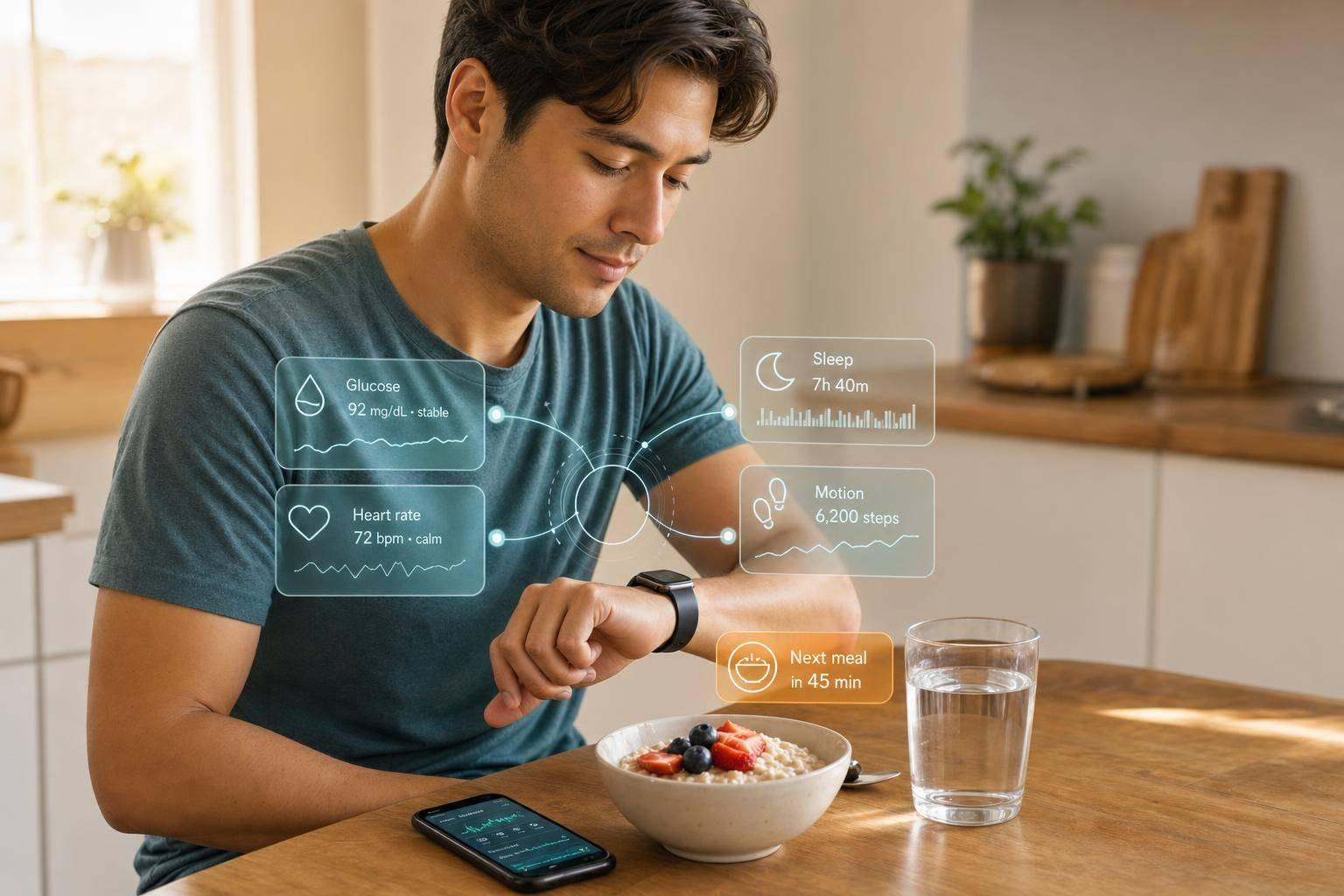
Wearables can show how your body responds to food, but they can’t tell you what you ate. What they do best is track signals like glucose, heart rate, HRV, sleep, activity, and skin temperature, then match those signals to meal timing through logs, photos, or passive meal detection.
Here’s the short version:
- CGM is the strongest diet-related signal because it shows post-meal glucose patterns
- Sleep, stress, and activity help explain day-to-day changes in meal response
- Meal timing is a big missing piece unless users log meals or devices detect eating well
- Machine learning can predict glucose response, but performance often drops outside controlled studies
- CGM-guided diet plans can improve HbA1c, time above range, and weight, mainly in people with prediabetes or type 2 diabetes
- The biggest limits are accuracy, missing data, privacy concerns, and user effort
A few numbers stand out. As of 2023, 35% of U.S. adults use wearable health devices and 40% use health apps. In one trial, a CGM-guided diet cut daily time above 140 mg/dL by 65%, compared with 29% for a Mediterranean diet. But passive eating detection still has issues, with top systems reaching only about 80.77% F1 in daily-life testing.
So if I had to sum it up in one line: wearables are best at showing patterns, not giving perfect meal-by-meal answers. The useful part is not the raw data. It’s the small set of actions you can take the same day, like changing meal timing, spotting trigger foods, or walking after dinner.
The Role of Wearable Diagnostics in Personalized Nutrition
sbb-itb-f5765c6
Which Biometrics Wearables Use for Diet Insights
Wearables pull diet insights from three main signal groups: glucose response, metabolic context, and meal detection. The big idea is simple: these signals become much more useful when researchers can line them up with the exact time someone ate.
Continuous Glucose Monitoring and Post-Meal Response
CGM is the most direct nutrition signal a wearable can collect. It tracks glucose in interstitial fluid throughout the day, which lets researchers watch what happens after a meal, including:
- how high glucose peaks
- how fast it climbs
- how long it stays up
In free-living adults without diabetes, CGM shows that most glucose stays in range. But repeated post-meal spikes above 180 mg/dL can point to worsening metabolic control [5][3][4].
There’s an important catch here. CGM measures interstitial fluid, not blood directly, so readings can lag during fast glucose swings right after eating. That’s why researchers use CGM to study patterns over time, not to make one-point judgments from a single reading. Device accuracy also varies, which is another reason CGM works better for trends across many meals than for one-off numbers.
That gives researchers the response side of the meal equation.
Heart Rate, HRV, Sleep, Activity, and Temperature Around Meals
Once a meal is pinned down, context signals help explain why the same food doesn’t always lead to the same outcome, showing how biometric data powers AI health coaching to personalize nutrition. Heart rate and HRV can show stress and recovery state. Sleep duration and sleep quality are tied to appetite control and glucose handling. Short or broken sleep is linked to poorer food choices and less favorable post-meal glucose patterns [6][7].
Activity matters too. Step count and exercise intensity affect insulin sensitivity, which shapes how the body handles carbs at the next meal. A walk after dinner and a day spent sitting around don’t set the body up the same way.
Skin temperature adds one more clue. Changes in wrist temperature can reflect circadian shifts and recovery state, both of which shape how the body processes food. Put together, sleep, stress, activity, and skin temperature help explain why the exact same meal can land differently from one day to the next.
The last hurdle is timing: knowing when eating happened.
Detecting Eating From Motion, Audio, and Phone Context
Researchers need meal timing so they can match each signal to a meal response. To do that, they use passive methods that timestamp eating. Wrist motion, audio, and phone context can all help flag meal timing, but multi-sensor systems do a better job than any single signal on its own.
Meal detection isn’t the final target. It’s the link that lets models connect food timing with glucose and recovery patterns.
The tradeoffs are pretty clear. Wrist motion by itself can produce false positives in free-living settings, especially in the early morning and late evening, when non-eating arm movements look a lot like eating gestures [8]. Audio-based chewing detection tends to do better in lab settings, but it brings comfort and privacy concerns in daily life. Smartphone-based meal logging, such as photo timestamps and location patterns, is easier to roll out, but it still depends on the user remembering to open the app.
How Researchers Turn Raw Sensor Data Into Diet Recommendations
From Raw Sensor Data to Digital Biomarkers
Once researchers know when a meal happened, they can turn sensor streams into features a health AI model can work with. The first step is cleanup. Raw wearable data is messy, so researchers have to remove noise, fix artifacts, and line up timestamps across devices before they can get anything useful from it.[9][15]
After that, they define meal windows, usually from 30 minutes before a meal to 180 minutes after it. Inside those windows, they pull out digital biomarkers such as overnight fasting duration, meal frequency, eating episode length, peak glucose, and glycemic measures like time-in-range and incremental area under the glucose curve (iAUC).[9][10][14] Those features then go into the models.
Machine Learning for Eating Detection and Glucose Prediction
With cleaned biomarkers ready, researchers train machine learning models for two main tasks: detecting eating events and predicting glucose response.
For eating detection, studies use random forests, gradient boosting (XGBoost), support vector machines, and deep learning models such as convolutional and recurrent neural networks. Things get harder outside the lab. In free-living settings, performance tends to slip. One smartwatch model that mixed deep and classical methods reported a precision of 0.85, recall of 0.81, and an F1-score of 0.82 in person-independent, free-living tests.[11] Another multi-device study using consumer wearables and CGM reached average sensitivity up to 71% with random forest and SMOTE resampling.[15]
For glucose prediction, one digital biomarker study used food logs, activity, and sleep data to predict glucose peaks. It reported a mean absolute error (MAE) of 0.32 ± 0.04 mmol/L on training data and 0.62 ± 0.15 mmol/L on test data.[9] Researchers also use SHAP to show which inputs are driving predictions, including carbohydrate content, pre-meal activity, and sleep duration.[9] That makes the outputs easier to turn into plain advice instead of black-box scores. This transparency is critical when developing AI-driven treatment plans that prioritize patient understanding.
Those results matter only if they still hold up when people go about normal life.
How These Models Are Validated
Researchers check model outputs against weighed food records, test meals, and glucose challenges.[9][16][17][18]
The same weak spots show up again and again. Small sample sizes make it hard to know how well results carry over to other groups. Models that look good on training data often get worse in free-living conditions, which points to overfitting.[9][15][18][19] Participant diversity is also limited, so a model trained on one group may not work as well for another. For now, these gaps leave the field in an awkward middle ground: the results are promising, but they are not ready for routine daily use.
But promising results do not yet mean reliable daily guidance.
What Research Says About Personalized Diet Guidance
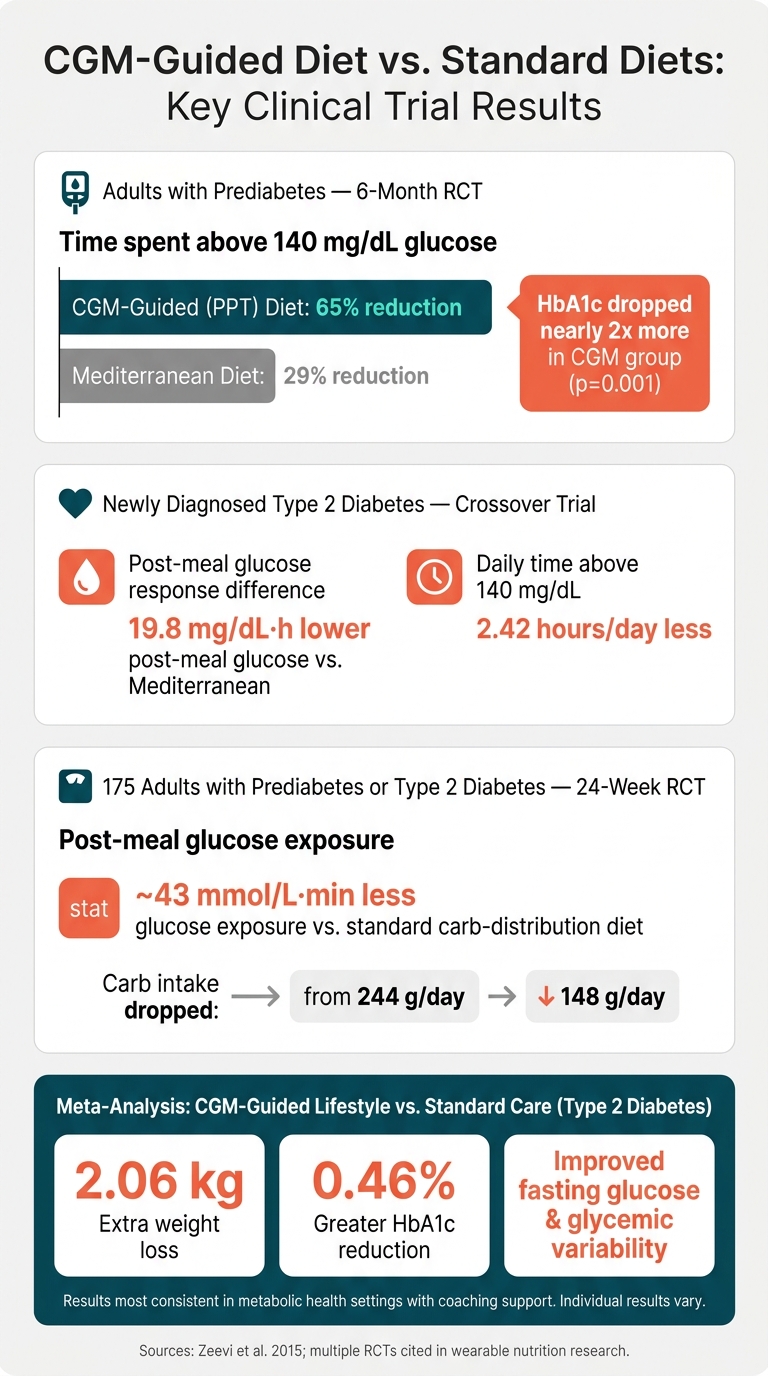
CGM-Guided Diet vs. Standard Diets: Key Clinical Trial Results
CGM-Guided Meal Changes and Precision Nutrition
Clinical trials now ask a pretty practical question: can these glucose predictions help people eat differently and improve glucose control in day-to-day life?
A landmark 2015 study by Zeevi et al. (Cell) showed that people can have very different glucose responses to the exact same foods, and that the same person can react very differently across foods.[28][29] That pushed back on the old idea that one diet plan should work for everybody.
Since then, researchers have tested CGM-guided post-meal targeting (PPT) diets against standard diet plans. In a six-month RCT comparing PPT with a Mediterranean diet in adults with prediabetes, daily time spent above 140 mg/dL fell 65% in the PPT group vs. 29% in the Mediterranean diet group (p=0.001), and HbA1c dropped almost twice as much.[31] A crossover trial in people with newly diagnosed type 2 diabetes found that the PPT diet lowered average post-meal glucose response by 19.8 mg/dL·h more than the Mediterranean diet and reduced daily time above 140 mg/dL by another 2.42 hours per day.[32] A 24-week RCT in 175 Chinese adults with prediabetes or unmedicated type 2 diabetes found that the PPT approach reduced post-meal glucose exposure by about 43 mmol/L·min more than a standard carbohydrate-distribution diet, while carbohydrate intake in the PPT group dropped from 244 g/day to 148 g/day.[30]
The diet changes themselves are not complicated. People are usually asked to:
- eat protein and vegetables first
- move more carbs earlier in the day
- cut back on personal trigger foods
- swap high-glycemic foods for lower-GI options
Across trials, CGM-guided diets improved post-meal glucose, HbA1c, and time above range more than standard diet plans.
Still, there are some clear limits in the evidence. Most trials last only 8 to 12 weeks, and many combine CGM use with heavy coaching, which makes it tough to separate the effect of the device from the effect of extra support.[22][24][26] They also often recruit people who are already highly motivated, which can make the results harder to apply to the general public.[23][24][25] And in some precision nutrition RCTs that compared CGM-guided diets with well-built standard diets in prediabetes, the gaps in HbA1c and glycemic variability were modest.[20][21][27] Put simply, a carefully planned standard diet can narrow much of the difference.
Automated Meal Logging, Feedback Loops, and Weight Management
The next hurdle is simple: logging meals is a pain, so the system has to work with less manual effort.
Passive meal detection helps by flagging eating episodes without asking the user to enter everything by hand, then matching those moments with shifts in glucose, heart rate, or activity.[13][23] Systems like iEat use bio-impedance signals between the hands, mouth, utensils, and food to detect eating episodes. Other systems combine wrist motion, chewing-related signals, or acoustic features with smartphone context.[13] The big win here is timing. Connecting meals to sleep, glucose, and activity tells you more than a weekly average ever could.
For weight management, CGM-based feedback systems have produced better outcomes in several trials. One study found that adding CGM to personalized nutrition therapy doubled weight and fat mass loss compared with nutrition therapy alone.[26] A meta-analysis of CGM-guided lifestyle interventions in type 2 diabetes found about 2.06 kg of extra weight loss and a 0.46% greater HbA1c reduction versus standard care without CGM, along with small gains in fasting glucose and glycemic variability.[24] Those numbers are not huge, but they matter in clinic. The reason is pretty easy to see: when people can watch the effect of food choices in real time, behavior change gets a lot less abstract.
Most automated detection systems still do a better job telling you when you ate than what you ate, so full nutrition detail still needs human input or image-based food recognition.[13][23] Even so, timing data alone, paired with glucose and sleep trends, can reveal patterns that generic advice would miss.
AI Coaching as the Bridge From Research to Practice
Turning research into daily behavior is the hard part.
Strong data does not help much if a person cannot use it in the moment. AI coaching can bridge that gap by turning biometric patterns into simple, daily guidance around meals and recovery. Across this research, the same theme shows up again and again: feedback loops work best when they are timely, specific, and tied to an action someone can take right away. That might mean shifting meal timing after a poor night of sleep, spotting a personal glucose trigger food, or putting the largest meal of the day near peak activity.
Limits of Today's Evidence and What Comes Next
Where the Evidence Is Strongest and Weakest
The results so far are promising, but the evidence isn't evenly spread.
Right now, the clearest support comes from metabolic health settings. In those cases, CGM-guided lifestyle changes improve HbA1c, time in range, fasting glucose, and weight.[24]
Outside metabolic conditions, things get murkier. In healthy adults without diabetes, glucose responses to the exact same meal can swing quite a bit from one day to the next.[2][1] So a single reading doesn't tell you much on its own. Repeated measurements matter far more than one-off food scores.
Passive eating detection has a limit too. A 2025 systematic review found that only 24% of 161 studies on wearable eating-detection systems took place in free-living settings. The rest were done under controlled lab conditions.[39]
Technical, Privacy, and Adoption Challenges
Wearable signals like movement, heart rate, and temperature can be thrown off by device placement, skin tone, motion, and temperature artifacts.[35] In one free-living study, a wristband sensor had a mean bias of -105 kcal/day in energy-intake estimates, and signal loss was a major source of error.[40]
Missing data adds another problem. Dead batteries, spotty wear habits, and connection gaps force models to fill in the blanks or toss out readings. That weakens prediction quality. These systems also need accurate meal timestamps and meal descriptions during training, and that labeling work is still a major bottleneck.[35][34]
Even strong multimodal eating-detection systems top out at about 80.77% F1 in real-world testing.[33] In plain English, false positives and missed eating events are still common enough to matter.
Privacy is another sticking point. Diet patterns can reveal religious practices, cultural habits, and daily routines. Pair that with nonstop biometric tracking, and you get a very detailed personal profile. In the U.S., consumer apps don't automatically fall under HIPAA. Research keeps pointing to the same worries: data breaches, black-box AI decisions, and unclear consent around using personal data to train models.[35][36]
That matters because people don't keep wearing devices they don't trust. Sometimes they stop using them altogether. Other times, they quietly turn off the features that feel too invasive.
Key Takeaways for Readers
The near-term problem isn't getting more data. It's validating tools better and cutting user burden.
Across the research, three ideas show up again and again:
- Combining CGM with sleep, activity, and stress data works better than using glucose by itself.[12][35]
- Individual responses need repeated measurements, not one-time experiments.[2][1]
- The tools that change behavior are the ones that turn multimodal biometric streams into clear diet decisions instead of dumping raw metrics on the user.[36][12]
| Area | Current capabilities | Near-term research goals | Longer-term vision |
|---|---|---|---|
| CGM-guided diet advice | Improves glycemic outcomes in metabolic-health settings with coaching[24][43] | Larger RCTs in non-diabetic populations; longer follow-up[12][20] | Real-time AI translating glucose patterns into meal guidance[12] |
| Passive eating detection | Promising in lab; less reliable in daily life[35][39] | Fewer false positives; lower labeling burden[39][35] | Continuous, low-friction meal logging[42] |
| Macronutrient estimation | Possible with multimodal sensors; accuracy limited[35][40] | Better calibration; more diverse real-world datasets[40][39] | Automated nutrient tracking in personalized coaching[38][12] |
| Personalized nutrition apps | Supports feedback and habit change; adherence and privacy concerns remain[36][37] | Simpler interfaces; better explainability[38][41] | AI coaches turning biometrics into actionable food decisions[14][12] |
What matters most isn't the sensor data by itself. It matters when that data leads to a few clear actions a person can use the same day.
FAQs
Can a wearable tell what I ate?
Not exactly. A wearable can’t tell, on its own, what’s sitting on your plate. What it can do is spot patterns linked to eating by tracking signals like motion, audio, and heart rate.
When you want to estimate what someone ate, tools like Healify pair those signals with AI photo recognition. A meal photo can help identify ingredients, estimate portion sizes, and calculate nutrition. From there, the system turns that information into a personal action plan.
Who benefits most from CGM-based diet insights?
People who need to manage blood sugar - especially those with diabetes or prediabetes - tend to get the most from CGM-based diet insights.
A CGM shows your glucose levels in real time after you eat certain foods. That matters because it lets AI shape nutrition targets around your own metabolic response, not just calorie counts on a label.
How accurate is passive meal detection in daily life?
Passive meal detection with wearable sensors is still in its early stages. It can spot when you’re eating and estimate how long a meal lasts, which helps track patterns like snacking or skipping meals.
In day-to-day use, accuracy often gets better when people confirm what they ate with a quick photo or voice note. That hybrid setup helps keep the data dependable enough to support useful health insights.