
Wearables and IoT health devices are everywhere, tracking everything from your heart rate to your home’s air quality. But here’s the catch: this data - often highly personal - comes with serious privacy risks. Unlike your credit card, you can’t “cancel” or replace stolen biometric data. With healthcare records fetching up to $250 per record on the Dark Web, these devices are prime targets for breaches. Worse, most of this data isn’t protected by [HIPAA](https://en.wikipedia.org/wiki/Health_Insurance_Portability_and_ accountability_Act), leaving it vulnerable to misuse by insurers, employers, or third parties.
Key Takeaways:
- Wearables (like smartwatches) collect biometric data 24/7, such as heart rate and sleep patterns. This data can reveal sensitive details like stress levels or pregnancy.
- IoT health devices (like smart scales or home sensors) gather environmental data and often track multiple people without explicit consent.
- Privacy risks include profiling, data breaches, and lack of strong legal protections. For example, 82% of Americans don’t realize HIPAA doesn’t cover wearable data.
- Data flow: Wearables send data via Bluetooth to apps and cloud servers, while IoT devices connect directly to the internet, creating more entry points for breaches, often due to firmware security issues.
Quick Comparison
| Factor | Wearables | IoT Health Devices |
|---|---|---|
| Data Type | Biometric (heart rate, sleep) | Environmental (temperature, light) |
| User Control | Individual, limited by manufacturers | Hard to manage for shared spaces |
| Privacy Risk | Profiling, sensitive health insights | Multi-user tracking, broader exposure |
| Regulation | Minimal (FTC, state laws) | Varies by sector, often weak |
Privacy concerns demand action. Real-time monitoring tools and simplified privacy controls, like those offered by systems such as BondMCP, can help protect your data while maintaining functionality. Without stronger safeguards, the risks of data misuse outweigh the benefits of these devices.
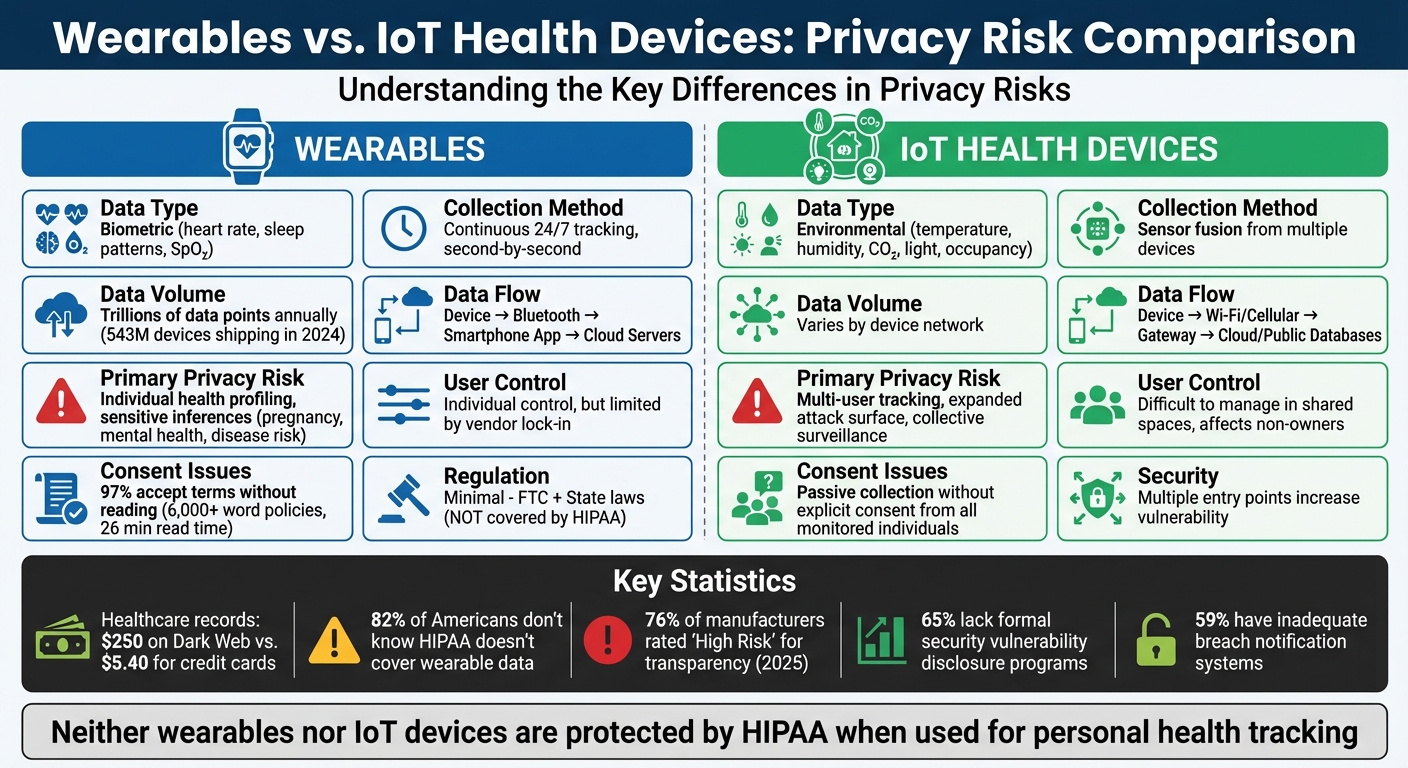
Wearables vs IoT Health Devices Privacy Risks Comparison
IoT Trust by Design: Lessons Learned in Wearables and Smart Home Products
Implementing these lessons requires a robust framework for wearable health data security to protect user information across all connected endpoints.
How Health Data Moves: Wearables vs. IoT Devices
The way health data travels plays a major role in determining privacy risks for wearables and IoT systems. The routes this data takes, along with the access points it passes through, shape both vulnerabilities and legal protections.
Wearable Health Data Collection and Flow
Wearables zero in on body-related metrics. Think of your smartwatch or fitness tracker - it’s constantly recording data like heart rate, blood oxygen levels (SpO₂), skin temperature, sleep patterns, and physical activity such as steps taken or calories burned. These devices collect biometric data every second, resulting in tens of thousands of data points daily[1].
Here’s how the data moves: the wearable collects the information and sends it via Bluetooth to a smartphone app. From there, the data is uploaded to the manufacturer’s cloud servers for processing, storage, and analysis[2]. With over 543 million wearable devices expected to ship worldwide in 2024[1], this adds up to trillions of data points generated every year. Each heartbeat, step, or sleep cycle is recorded and sent to the cloud, where users often lose direct control over their data, highlighting the importance of anonymization vs. de-identification in wearables.
IoT Health Data Collection and Flow
IoT health systems take a broader approach, gathering environmental and behavioral data from entire spaces. For instance, smart pill bottles track whether medications are taken on time, motion sensors monitor gait patterns, and environmental devices measure room temperature, humidity, CO₂ levels, and light to infer occupancy and daily habits[3].
One standout feature of IoT systems is "sensor fusion." By combining data from multiple sensors, these systems can derive insights that individual sensors alone couldn’t provide. For example, they might analyze CO₂ levels alongside temperature and lighting to figure out not only if someone is home but also details about their routine.
Unlike wearables, IoT devices often connect directly to the internet via Wi-Fi, cellular networks, or even satellites - bypassing smartphones entirely. Data is routed through local gateways to centralized servers or public databases, which creates more potential entry points for breaches[3]. This complex flow of information introduces unique privacy challenges and complicates oversight across different device ecosystems.
U.S. Legal Frameworks for Health Data
When it comes to legal protections, the entity collecting your health data matters more than the sensitivity of the data itself. The Health Insurance Portability and Accountability Act (HIPAA) only applies to Protected Health Information (PHI) collected by "covered entities" such as healthcare providers, hospitals, or health insurers[2].
"If an individual uses a wearable device to gather health data for personal use, HIPAA regulations do not apply." – Asma Sifaoui, University of Texas at Austin[2]
This means that most health data from wearables and IoT devices falls outside of HIPAA’s jurisdiction. Instead, it’s governed by the Federal Trade Commission (FTC) and state privacy laws, like California’s CCPA, which generally offer weaker protections. For example, heart rate data collected by a smartwatch receives far less legal protection than similar data gathered during a doctor’s visit.
| Data Category | Typical Sources | Primary Legal Framework | Protection Level |
|---|---|---|---|
| Protected Health Information (PHI) | Doctors, hospitals, health insurers | HIPAA | Strong federal protection |
| Consumer Wearable Data | Smartwatches, fitness trackers | FTC + State laws (e.g., CCPA) | Limited protection |
| IoT Environmental Data | Smart home sensors, occupancy monitors | FTC + State laws | Limited protection |
Privacy Risks in Wearable Devices
Wearable devices come with a host of privacy risks that often fly under the radar. The combination of constant data collection, vague consent practices, and gaps in regulation leaves many users vulnerable to having their personal data misused - without ever realizing it.
Continuous Data and Inference Risks
Wearables collect an immense amount of biometric data around the clock. To put it into perspective, millions of these devices generate trillions of data points every year, tracking metrics like steps, heart rate, and sleep patterns in real time[1].
But it’s not just the sheer volume of data that’s concerning - it’s what can be inferred from it. Advanced algorithms analyze patterns in this data to uncover deeply personal details you never knowingly shared. For instance, wearables can hint at mood swings, mental health conditions, pregnancy, disease risks, and even behavioral traits that might influence job opportunities or insurance rates[1][5]. And the stakes are high - healthcare records are a hot commodity on the Dark Web, fetching up to $250 each compared to just $5.40 for stolen payment card data[1].
This issue isn’t theoretical. In November 2022, Google settled a $391.5 million case with 40 U.S. states after it was found to have continued tracking users’ location data through Wear OS and Fitbit devices, even when users had disabled the "Location History" setting[1]. Such cases highlight how data inferences can lead to broader privacy violations.
Consent and Security Problems
The risks tied to data inferences are only magnified by issues with consent and security. When it comes to wearables, meaningful consent is almost nonexistent. Why? The average privacy policy for these devices is over 6,000 words long and takes about 26 minutes to read[1]. Unsurprisingly, 97% of users accept terms without fully understanding them, not out of laziness but due to "privacy fatigue" - a sense of being overwhelmed by complex policies that offer little real choice. Declining these terms often means the device won’t work at all.
The small size of wearables makes things worse. Without full screens or keyboards, these devices can’t provide clear, real-time privacy notices or let users give detailed consent for specific data uses[3].
Security vulnerabilities add another layer of concern. Less than half (47%) of wearable privacy policies explicitly mention encryption methods for wearable health devices[1]. Many devices lack the capability for robust security measures, leaving them exposed to breaches. For example, in 2021, a third-party fitness platform suffered a breach that exposed over 61 million records from users of multiple wearable brands[1].
There’s also the issue of unintended data collection. In 2025, Apple settled a $95 million lawsuit over claims that its Siri-enabled devices, including Apple Watches, recorded private conversations without users’ consent due to accidental activations. These recordings were reportedly reviewed by human contractors - a practice that hadn’t been clearly disclosed in the company’s privacy policy at the time[1].
Regulatory Gaps and Enforcement
Regulations around wearable data are surprisingly sparse. For example, the Health Insurance Portability and Accountability Act (HIPAA) doesn’t apply to most wearable data. If you’re using a smartwatch to track your heart rate for personal reasons, that data isn’t protected under HIPAA[2].
"Commercial wearable health devices do not fall under FDA oversight, and data not paired with a doctor–patient relationship do not fall under HIPAA privacy protection; thus, much of the gathered health-related metrics are left without regulation and open to be sold to data brokers." – Asma Sifaoui, University of Texas at Austin[2]
This lack of regulation is a big deal. A staggering 82% of Americans don’t realize that HIPAA doesn’t stop health apps from selling their data[2]. Instead, wearable data is governed by the Federal Trade Commission (FTC) and state laws like California’s CCPA, which offer far weaker protections. This means companies can legally sell sensitive health information to data brokers, who might then pass it along to insurers, employers, or even law enforcement[2].
The Food and Drug Administration (FDA) complicates things further. It focuses only on devices marketed for medical diagnosis or treatment. Many wearables sidestep this scrutiny by branding themselves as "wellness" devices, leaving their data accuracy and privacy practices largely unchecked[2]. A 2025 evaluation found that 76% of wearable manufacturers were rated "High Risk" for their transparency in reporting, and 65% lacked formal programs to disclose security vulnerabilities[1].
Privacy Challenges in IoT Health Systems
IoT health systems bring a new layer of privacy concerns, going well beyond the risks posed by standalone devices. The issue isn’t just about one gadget collecting your data - it’s the combined exposure from an entire web of interconnected devices. Each link in this chain introduces potential vulnerabilities, making it harder to ensure data security and accountability.
Expanded Attack Surface and Multi-User Risks
Adding more IoT devices to your health setup increases the potential entry points for cyberattacks. Imagine a network that includes a smart scale, a sleep tracker, a medication dispenser, and even a smart thermostat. If just one of these devices has a security flaw, it could jeopardize the entire system. This interconnected web relies on various vendors, cloud services, and data handlers, meaning a breach at any point could compromise the whole network.
The problem worsens when "rogue" devices enter the mix. For instance, connecting a personal smartwatch to a company’s Wi-Fi could create an unprotected entry point, even in an otherwise secure environment. Many organizations lack centralized tools to manage and update all IoT devices, leaving outdated or unmonitored devices vulnerable to attacks.
In shared settings - like smart homes or assisted living facilities - IoT devices often gather information about multiple individuals, including people who haven’t given consent. Many of these devices lack user-friendly interfaces, making it difficult to verify who is accessing sensitive data. This shared environment not only increases the number of potential targets but also makes it harder to determine who is responsible for what.
"The passive nature of many IoT devices can make it difficult for individuals to be informed that their personal information is being collected." – Office of the Victorian Information Commissioner[3]
Data Integration and Fusion Risks
Beyond the risk of network breaches, the way IoT devices combine data introduces another layer of privacy concerns. A process called "sensor fusion" merges data from various devices - like temperature sensors, CO₂ monitors, and light trackers - to draw detailed conclusions about your health and behavior. This level of insight can reveal deeply personal information that no single device could uncover on its own.
Healthcare data is already a lucrative target for cybercriminals. For context, stolen medical records can sell for as much as $250 on the Dark Web, compared to just $5.40 for stolen credit card data[1]. When IoT health data is integrated, it becomes even more valuable due to its depth and context. The problem? This data often passes through multiple hands - from city governments and telecom providers to cloud storage companies and even law enforcement. With so many stakeholders, it’s nearly impossible to pinpoint who is ultimately responsible for protecting your information.
Regulatory Complexity for IoT Devices
Regulating IoT health devices is a tangled mess. Unlike single-purpose wearables, IoT systems span multiple vendors, jurisdictions, and use cases, leading to a patchwork of rules. For example, HIPAA protects data handled by healthcare providers and insurers, but once that data flows to third-party vendors, it enters a legal gray area. In some cases, this data can be legally sold to employers, insurers, or other parties.
The FDA further complicates things by regulating only devices marketed for medical diagnosis or treatment. Many consumer IoT health devices sidestep these rules by branding themselves as "wellness" products, which exempts them from strict oversight on data accuracy and security practices[2][4]. This fragmented regulatory landscape leaves IoT health data vulnerable to exploitation.
"The lack of consistency in IoB laws among states and between the state and federal level potentially enables regulatory gaps and enforcement challenges." – RAND Corporation[4]
Enforcement is another sticking point. A 2025 evaluation found that 76% of IoT manufacturers were rated "High Risk" for transparency in reporting data-sharing practices, while 65% lacked formal processes for disclosing security vulnerabilities. Even worse, 59% had inadequate systems for notifying users of data breaches[1]. When a breach does occur, there’s often no clear path to hold anyone accountable or to fix the problem. These regulatory shortcomings highlight the urgent need for better privacy safeguards in the complex world of IoT health systems.
sbb-itb-f5765c6
Wearables vs. IoT Devices: Privacy Risk Comparison
Key Comparison Factors
When it comes to privacy, wearables and IoT health systems pose distinct challenges. Understanding these differences can help users make better decisions about how they trust and manage their data.
| Factor | Wearable Health Devices | IoT Health Systems |
|---|---|---|
| Data Nature | Personal, biometric, and physiological | Environmental, spatial, and multi-user |
| Data Volume | Extremely high (continuous second-by-second tracking) | Inconsistent |
| Primary Risk | Continuous surveillance and health profiling | Expanded attack surface and multi-user privacy loss |
| User Control | Individualized but often restricted by vendor lock-in | Hard to manage for guests or non-owners |
| Regulatory Oversight | Limited regulation | Varies by sector (e.g., utility vs. municipal) |
| Inference Risks | Specific health conditions, pregnancy, or disease onset | Household habits, presence of individuals, lifestyle patterns |
Take a smartwatch, for example. It tracks heart rate, sleep cycles, and movement every few seconds, building a highly detailed health profile. With over 543 million units expected to ship globally in 2024, this translates into trillions of data points generated annually[1].
IoT systems, on the other hand, focus less on individuals and more on shared environments. These devices monitor factors like room temperature, light levels, and air quality. The real privacy concern arises with sensor fusion, where data from multiple sensors is combined to infer detailed information - such as who’s in a room, what they’re doing, and when. Unlike wearables, these devices affect everyone in the vicinity, not just the owner.
In 2025, a review found that 76% of wearable manufacturers were rated as "High Risk" for transparency in how they share data with governments or third parties[1]. This highlights the stark differences in privacy risks between individual and shared data systems.
Personal vs. Environmental Data Impact
The privacy risks tied to personal and environmental data are fundamentally different. Wearables create individual surveillance risks by collecting highly sensitive information. For instance, heart rate data might hint at pregnancy, sleep patterns could suggest depression, and activity levels might influence insurance rates. This kind of biometric data is also highly sought after on black markets[1].
In contrast, IoT devices pose collective privacy risks by monitoring shared spaces. A smart thermostat, for example, doesn’t just track the person who installed it - it can reveal when everyone in the household is home. Similarly, a smart meter can deduce which TV shows are being watched based on power usage patterns.
Consent is another major distinction. When you wear a fitness tracker, you’re actively choosing to share your data (even though 97% of users skip reading the terms and conditions)[1]. But with IoT devices, there’s often no way to opt out. If you enter a smart building or visit someone’s connected home, environmental sensors can track your presence and behavior without your knowledge or consent.
Real-Time Privacy Monitoring and Solutions
Why Static Privacy Policies Don't Work
Static privacy policies fall short when it comes to managing the ongoing collection of data. A one-time consent agreement simply can't keep up with the constant flow of information generated by modern devices. Paula Pizzotti from Fraser Health Authority highlights this issue, explaining that consent often becomes more symbolic than meaningful. For example, a smartwatch can produce tens of thousands of data points daily[1]. Clicking "I agree" during setup doesn’t begin to address the long-term privacy implications. The Office of the Victorian Information Commissioner puts it plainly:
"One off 'I agree' consent mechanisms are a single decision at a single point in time that may be inappropriate for the ongoing and evolving nature of the IoT"[3].
Recent legal cases have further emphasized how outdated these static consent models are in today’s digital landscape.
How Real-Time Privacy Monitoring Works
To address these challenges, privacy management needs to shift from static agreements to dynamic, real-time monitoring. Connected health devices require continuous oversight to ensure privacy policies are upheld. Here’s how real-time monitoring works:
- Data Flow Tracking: This keeps tabs on where your information is going. It identifies which servers receive your heart rate data, which third parties access your sleep patterns, and flags when data leaves your device unexpectedly. Default settings prioritize protection, allowing users to opt into additional sharing as needed[1].
- Policy Enforcement: Real-time systems compare actual data flows to the stated privacy policies. For instance, if a fitness tracker suddenly starts sending data to a new server or an unspecified third party, the system flags this discrepancy immediately. This ensures that data use aligns with what was promised.
- Anomaly Detection: By spotting unusual patterns, this feature helps identify potential breaches or unauthorized access. For example, it could detect irregular data flows like those that led to a breach exposing over 61 million fitness tracker records[1]. Early detection can minimize damage and protect sensitive information.
How BondMCP Supports Privacy-Aware Health Optimization
Real-time monitoring not only identifies privacy risks but also enables solutions like BondMCP, which protect user data while maintaining seamless integration. Many health systems force users to choose between privacy and functionality - BondMCP eliminates that trade-off. Acting as a shared intelligence layer, BondMCP unifies data from wearables, lab results, supplements, fitness trackers, and sleep monitors, all while enforcing strict privacy controls.
BondMCP ensures that AI systems access only the specific data needed for personalized recommendations, limiting unnecessary sharing. For example, your sleep tracker can provide insights for your fitness coach without revealing every detail of your sleep cycle. Similarly, lab results can update your supplement plan without exposing your entire medical history.
This approach helps break down the barriers created by vendor silos, enabling systems to work together securely. BondMCP ensures that health data is integrated through controlled and auditable channels, offering a practical balance between privacy and functionality.
To simplify privacy management, BondMCP offers user-friendly privacy profiles during setup. Options like "Maximal Privacy", "Balanced", or "Performance Optimized" make it easy to adjust settings[1][6]. Additionally, the system incorporates explainable AI, so users can see exactly how health recommendations are generated and understand which data influenced those decisions[6].
Conclusion: Managing Privacy in Connected Health Systems
Wearables and IoT health devices bring both opportunities and challenges, especially when it comes to privacy. These devices generate an enormous amount of biometric data - trillions of data points every year - opening the door for detailed behavioral profiling by insurers, employers, and others. At the same time, IoT systems use techniques like sensor fusion to piece together highly personal details, such as whether someone is home or what activities they’re engaged in, from seemingly harmless environmental data. High-profile cases like Apple's $95 million Siri settlement in 2025 and Google's $391.5 million location tracking settlement highlight how even industry giants have struggled to ensure their data practices align with their policies[1].
The traditional reliance on static consent forms is no longer enough. Users are overwhelmed by long privacy policies, leading to widespread consent fatigue. This makes it nearly impossible for individuals to manage their privacy effectively on their own. Instead, solutions like default privacy settings and simplified data-sharing controls can help reduce this burden while still maintaining user trust.
One promising approach is the adoption of unified systems like BondMCP (Model Context Protocol), which aim to reduce fragmentation and enhance transparency. By creating a centralized intelligence layer that connects wearables, labs, and fitness systems, users can easily see how their data is being used. For example, sleep tracker data can be shared with training coaches through secure, auditable channels, ensuring users don’t have to choose between privacy and functionality. This kind of oversight offers a glimpse into how connected health systems can balance security with seamless user experiences.
As Petar Radanliev explains:
"The passive and pervasive nature of data collection, the opacity of model inference, and the risk of algorithmic discrimination all call into question the adequacy of existing regulatory frameworks"[6].
To truly protect privacy in connected health systems, institutional accountability and real-time oversight are essential. Without these mechanisms, the risk of exploitation outweighs the benefits of these technologies. By addressing these challenges head-on, we can ensure that connected health systems work for users - not against them.
FAQs
What privacy risks should I be aware of with wearables compared to IoT health systems?
Wearable devices and IoT health systems both come with privacy risks, but the scope and complexity of these risks set them apart.
Wearables often operate outside the protections of traditional health privacy laws, leaving biometric data exposed to unclear policies and third-party access. Key concerns include ambiguous data ownership, weak wireless security, and constant location tracking. On top of that, the AI algorithms powering these devices can bring challenges like lack of transparency in decision-making and possible bias.
IoT health systems take these risks a step further by linking multiple devices into a single network. This interconnected setup increases the chances of data breaches and enables the creation of detailed personal profiles, which might be used in ways beyond their original purpose. The absence of consistent privacy standards across devices makes it harder to enforce consent and monitor who has access, raising the likelihood of sensitive information being misused.
How does the lack of regulation impact the privacy and security of data collected by wearables and IoT devices?
The lack of strict regulations surrounding wearables and IoT health devices leaves the data they collect exposed to potential misuse or security breaches. Since most of these devices don’t fall under the category of "covered entities" defined by HIPAA, they’re not required to adhere to its privacy and security rules. This gives companies significant leeway to collect, store, and even share sensitive biometric data, often with little oversight.
On top of that, broader U.S. privacy laws, like the FTC Act or COPPA, only address certain aspects of data management. This creates a regulatory "gray zone" where many devices operate without clear rules. The result? Weak encryption, inadequate authentication protocols, and inconsistent breach notifications are all too common, leaving users’ health data more vulnerable to hacking or unauthorized access. Until more robust and comprehensive regulations are put in place, these privacy concerns are unlikely to go away.
How can I protect my personal data when using wearable and IoT health devices?
When using wearables and IoT devices, protecting your personal health data is crucial. Start by reading the device's privacy policy carefully - it will explain how your data is collected, stored, and shared. Look for devices that comply with U.S. health privacy laws, such as HIPAA, and offer clear options for data sharing consent.
You can limit data collection by turning off features you don’t need, like GPS or microphones, and opting for local data storage whenever possible. Strengthen your device and app security with strong passwords, biometric locks, and two-factor authentication. Keeping your software updated is also essential to avoid potential security gaps.
To stay in control of your data, regularly check app permissions and remove unnecessary third-party access. Make sure your data is sent over encrypted connections for added safety. It’s also a good idea to periodically audit and delete old health records stored in cloud accounts. Tools like the BondMCP Health Model Context Protocol can help you centralize your health data on a single, secure platform - this reduces risks tied to scattered systems and gives you better control over your information.