
Real-time health monitoring devices, like wearables and IoMT systems, generate a constant flow of sensitive data, making them prime targets for cyberattacks. Without robust encryption, your medical details - heart rate, glucose levels, and more - can be intercepted or manipulated, leading to identity theft, fraud, or even life-threatening errors in care.
Here’s why encryption must be active at all times:
- Healthcare data is lucrative: A single health record can sell for up to $1,000 on the black market.
- Data breaches are costly: The average healthcare breach cost reached $10 million per incident in 2024.
- Weak security in wearables: Many devices use outdated protocols, leaving data vulnerable during transmission.
- Decryption risks: Even milliseconds of decrypted data can expose systems to attacks.
To tackle these risks, advanced encryption methods like AES-256, Homomorphic Encryption (FHE), and edge-assisted processing ensure data remains secure without compromising performance. Systems like BondMCP lead the way by encrypting health data locally and unifying fragmented streams into one secure ecosystem.
The takeaway? Continuous, real-time encryption is no longer optional - it’s essential for protecting sensitive health data in an increasingly connected world.
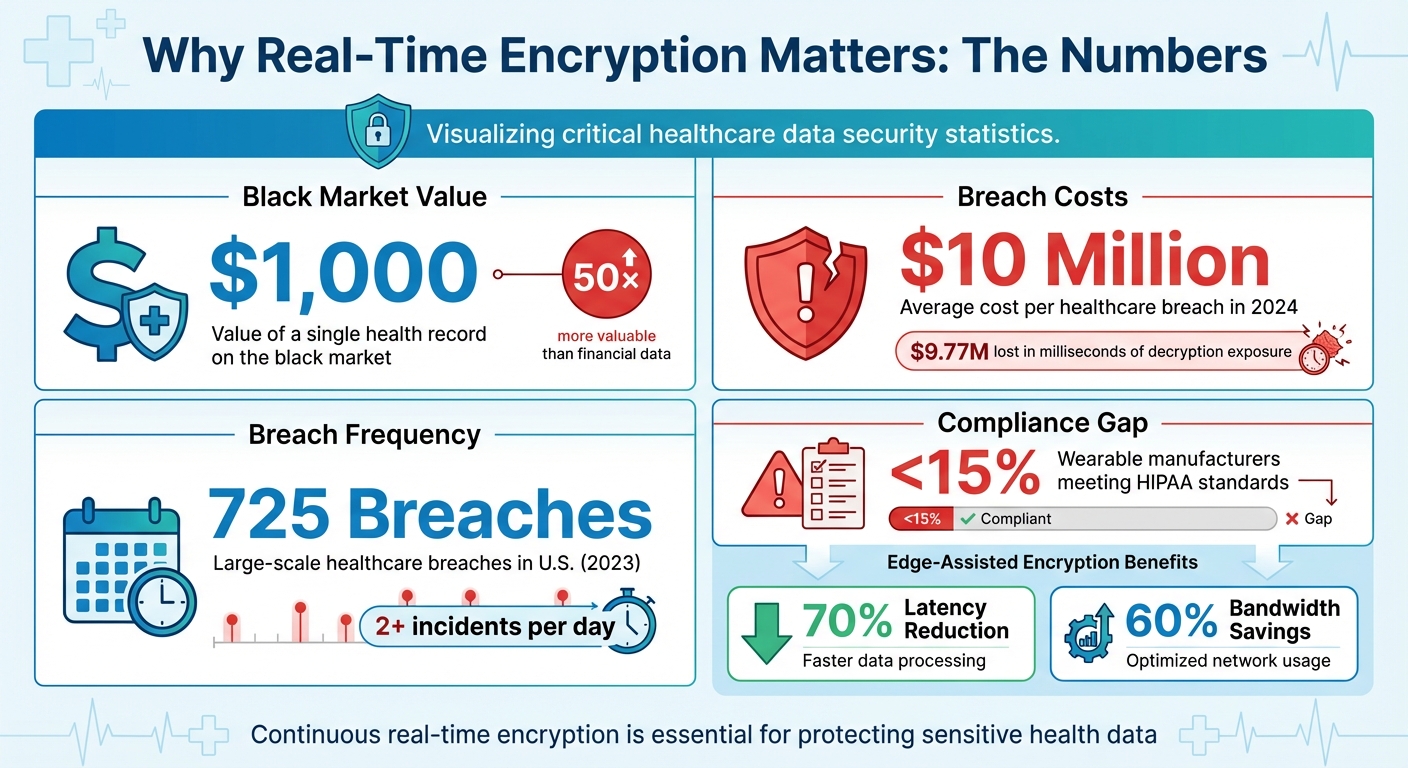
Healthcare Data Breach Statistics and Encryption Impact 2023-2024
Privacy Risks in Real-Time Health Monitoring
Data Transmission Vulnerabilities
When wearable devices transmit data to your phone or the cloud, that information faces the risk of interception. If the data streams are unencrypted or use weak encryption, they become easy targets for man-in-the-middle attacks, where hackers can intercept and manipulate the data during transit [1]. Many Internet of Medical Things (IoMT) devices still rely on outdated protocols like early versions of Bluetooth or ZigBee. These protocols weren’t designed with robust medical-grade security, leaving them vulnerable to exploitation [6].
To carry out tasks such as AI-powered analysis through the MCP protocol, clinical decision-making, or billing, systems must decrypt data into plain text. Even a brief decryption window - lasting just milliseconds - can create an opportunity for attackers. As Wodan AI highlights:
"That gap – sometimes just a few milliseconds – costs the healthcare industry an average of USD 9.77 million every time an attacker makes it through." [5]
This fleeting exposure emphasizes the need for continuous, real-time encryption in health monitoring systems to minimize risks.
Another concern arises when compromised edge nodes - like malicious gateways - alter encrypted data without detection. For instance, a gateway could manipulate a heart rate reading from 78 bpm to 100 bpm [9]. Such tampering can disrupt the entire stream of critical health data. Since IoMT devices are interconnected, even a single weak link can jeopardize the integrity of a patient’s continuous data flow.
These vulnerabilities highlight the significant risks inherent in real-time health monitoring with AI.
Consequences of Privacy Breaches
The weaknesses in these systems lead to serious operational and clinical consequences. In 2023 alone, the United States reported 725 large-scale healthcare security breaches - averaging more than two incidents per day [8]. The financial impact of each breach is immense, with personal health information fetching up to 50 times more than financial data on the black market [5][10].
However, the damage goes beyond monetary losses. Privacy breaches can result in incorrect diagnoses, improper prescriptions, and flawed treatment plans [7]. When patients lose trust in the ability of healthcare providers to protect their sensitive information, they may hesitate to seek care or follow medical advice [7].
Regulatory penalties add another layer of complexity. Fines for HIPAA violations can reach up to $1.5 million annually, while GDPR violations can cost up to €20 million or 4% of a company’s global revenue [7]. Shockingly, fewer than 15% of wearable manufacturers currently adhere to HIPAA standards for data management, leaving millions of users at risk [1].
sbb-itb-f5765c6
Why Real-Time Encryption Is Required for Health Monitoring
Securing Continuous Data Streams
Health monitoring devices constantly generate sensitive data - like heart rate, oxygen levels, and blood pressure - that needs protection from the moment it's collected. Unlike traditional medical records stored in databases, this data moves continuously, traveling from wearables to smartphones, then to cloud servers, and sometimes back to healthcare providers. Every step in this journey opens up potential risks for interception.
To safeguard this data, encryption must remain active throughout the entire process, ensuring there are no vulnerable gaps [2]. Real-time encryption achieves this by securing the information throughout its entire lifecycle. Advanced techniques like Homomorphic Encryption even allow data to be analyzed while still encrypted, removing the need to decrypt it. This eliminates the critical moment when sensitive health information could be exposed to attackers.
Low-Latency Encryption for Real-Time Monitoring
Continuous protection is essential, but speed is just as important in medical emergencies. Imagine a wearable detecting an irregular heartbeat or a sudden drop in oxygen levels - such situations require instant processing. Traditional encryption methods can slow things down, and in life-threatening scenarios, even small delays can have serious consequences.
The challenge lies in balancing robust encryption with fast performance. Research published in Scientific Reports highlights how even milliseconds can influence emergency treatments [11]. To address this, healthcare systems increasingly use lightweight encryption methods like AES-256, which are efficient enough to run on low-power devices.
Modern systems also leverage edge-assisted offloading to optimize performance. Instead of relying on small wearables to handle complex encryption tasks, nearby edge devices - like home routers or local gateways - take on the heavy lifting. Studies show this approach can reduce latency by 70% and save 60% on bandwidth compared to cloud-only methods [11]. This hybrid model ensures encryption remains both secure and fast, meeting the demands of real-time health monitoring.
A Real World Example of Lacking Encryption in Healthcare
Encryption Standards and Algorithms for Real-Time Health Monitoring
Protecting continuous health monitoring systems requires encryption standards that can handle real-time data securely and efficiently. These standards tackle the privacy risks associated with streaming sensitive health information.
Advanced Encryption Standards (AES-256)
AES-256 has become the go-to choice for safeguarding health data during transmission. It’s often paired with RSA-2048 for secure key exchanges and SHA-256 to ensure data integrity[11].
For real-time applications, AES-GCM (Galois/Counter Mode) is a standout. It offers confidentiality, integrity, and authenticity all at once. Plus, AES-GCM reduces encryption and decryption times by over 45%[12]. This makes it ideal for wearables that constantly transmit vital stats like heart rate and oxygen levels.
Lightweight Encryption for Wearables
Wearables demand energy-efficient encryption methods that strike a balance between security and performance. Elliptic Curve Cryptography (ECC) is a popular choice because it lowers computational requirements and conserves battery life. Additionally, selective encryption focuses on protecting critical data - like irregular heart rhythms - while applying lighter safeguards to routine metrics[3][11][12].
Hardware-based solutions also play a key role. Technologies like ARM TrustZone ensure encryption keys remain secure, even if the device itself is compromised[1]. Combining lightweight encryption with fog-edge architectures has proven effective, reducing latency by 70% and boosting energy efficiency by 30%[11].
Homomorphic Encryption for Secure Analytics
Fully Homomorphic Encryption (FHE) offers a groundbreaking way to analyze data without decrypting it. The CKKS scheme is particularly suited for health monitoring, as it processes continuous numerical data - such as glucose levels, blood pressure, and heart rates - while keeping everything encrypted[3][12].
The MedGuard framework is an example of FHE in action. Using CKKS-based FHE alongside zk-SNARKs, it achieved a latency of just 64.8 milliseconds and handled 1,200 queries per second across 1,000 devices, delivering robust security without sacrificing performance[9].
"Privacy should be a verifiable property of the system itself, not dependent on the good intentions of operators." - Chandan Jain H P, Researcher, RV Institute of Technology and Management[4]
However, FHE does come with a trade-off: it demands far more processing power than traditional encryption methods. To address this, many systems adopt a hybrid model. For simpler calculations, FHE is used, while Trusted Execution Environments (TEEs) - like Intel SGX - handle more complex tasks that require faster processing speeds[4].
How BondMCP Enhances Secure Real-Time Health Monitoring
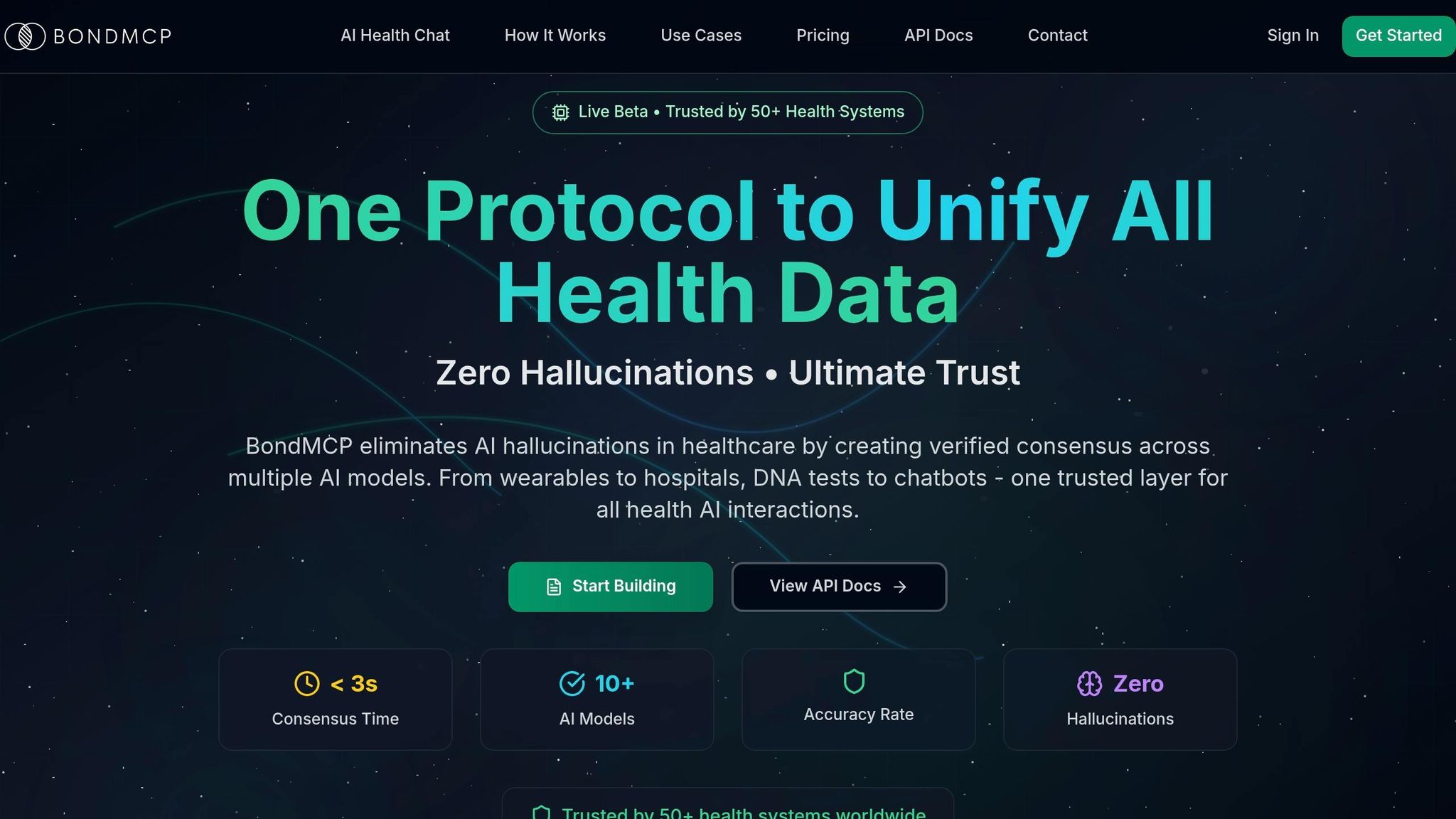
BondMCP tackles encryption challenges by combining client-side Fully Homomorphic Encryption (FHE) with a Model Context Protocol gateway that secures health data before it even leaves your device. Whether you're using a wearable or a smartphone, the system encrypts health data locally via FHE implemented through WebAssembly. This ensures that sensitive information like vital signs and lab results stays encrypted throughout the entire processing chain[4].
Unified Data Streams Across Wearables and Labs
BondMCP goes beyond just securing data - it brings together fragmented health data streams for a more complete picture. Think about it: your sleep tracker, fitness app, and lab results often operate in silos, disconnected from one another. BondMCP acts as a unified protocol, securely integrating data from wearables, hospitals, DNA tests, and lab work into one trusted system[13].
At the heart of this system is a "Consensus Super AI" engine, which uses over 10 medically trained AI models working together to validate health data in real-time. This setup achieves an impressive 99.8% accuracy rate, while also eliminating the hallucinations that can occur with single-model AI systems[13]. To ensure security, every interaction goes through a Trust Layer that issues cryptographic certificates, achieving consensus in under 3 seconds[13].
Since wearables often have limited processing power, BondMCP shifts heavy cryptographic tasks to trusted edge devices like home routers or gateways. This edge-assisted approach not only preserves your wearable's battery life but also maintains robust security measures[3][11]. Additionally, the system enforces least-privilege access, ensuring context-aware health agents only access the minimum data required for their tasks[4].
AI-Driven Privacy and Personalization
Beyond unifying and securing data, BondMCP uses advanced AI to enhance both privacy and personalization. The MCP gateway employs typed input/output schemas and automatically redacts sensitive fields before making any external API calls[4]. For real-time responsiveness - essential for detecting conditions like arrhythmias or hypoxemia - the system utilizes a dual execution path. Simple operations are handled by FHE, while more complex AI tasks are processed using Trusted Execution Environments (TEEs) like Intel SGX[4].
A notable example of this approach is "Secure Bridge", a privacy-first AI framework developed by Chandan Jain H P in December 2025 at the RV Institute of Technology and Management. In tests involving 150 concurrent users, the framework demonstrated a P95 latency of 420–500ms and an error rate below 3%. This shows that it's possible to balance enterprise-grade privacy with the responsiveness needed for consumer applications[4].
This architecture means your encrypted sleep data can guide your fitness recommendations, lab results can automatically adjust your supplement plan, and your long-term health goals can influence real-time decisions - all while keeping your raw data secure throughout its lifecycle[4][13].
Conclusion
Key Takeaways
Protecting sensitive health data in real time has become a critical priority, especially as information flows through continuous wearable data sync, labs, and monitoring devices. Health data breaches come with enormous costs, making uninterrupted encryption a must. While traditional encryption methods safeguard data at rest and in transit, they leave it vulnerable during decryption. Enter Fully Homomorphic Encryption (FHE), a technology that allows AI models to process and analyze encrypted health data without ever decrypting it, ensuring end-to-end security [5].
"FHE changes the default from 'decrypt to innovate' to 'keep it encrypted and go faster.'" - Wodan AI [5]
FHE not only secures sensitive data but also enables real-time analysis. The challenge, however, lies in achieving both security and speed. Wodan AI addressed this in July 2025 by demonstrating a stroke-detection model that analyzed encrypted CT images for intracranial bleeds in under one second, meeting HIPAA encryption standards during processing [5]. BondMCP builds on this innovation by combining FHE with edge-assisted processing, creating a unified system that securely integrates fragmented health data - everything from sleep trackers to lab results - into one interoperable platform. This proves that privacy and real-time performance can work together seamlessly.
These advancements pave the way for a future where privacy and speed are no longer at odds.
Looking Ahead
The need for real-time encryption is reshaping how health data privacy is approached. Moving forward, systems must treat privacy as a verifiable feature rather than a promise. As researcher Chandan Jain H P aptly noted:
"Privacy should be a verifiable property of the system itself, not dependent on the good intentions of operators." [4]
Currently, fewer than 15% of wearable manufacturers fully comply with HIPAA standards [1], highlighting the urgency for encrypted-by-default systems. BondMCP exemplifies this next-generation approach by securely integrating diverse data streams into a single, responsive ecosystem. Imagine a world where your sleep data informs your fitness plan, lab results adjust your supplements, and longevity goals guide real-time health decisions - all without your raw data ever being exposed in plaintext.
The message is clear: the future of health monitoring lies in interoperable, encrypted systems that prioritize both security and personalization equally.
FAQs
What does “real-time encryption” mean for wearable health data?
Real-time encryption works to protect wearable health data the moment it's created and shared, keeping it confidential and out of reach from unauthorized access. By encrypting data instantly as it's collected, it prevents any chance of interception during wireless transmission. This constant layer of security protects sensitive details like heart rate or sleep patterns while also helping devices meet privacy regulations such as HIPAA. And the best part? It achieves all this without noticeably affecting the performance of the device.
How can AI analyze my health data without decrypting it?
AI employs cutting-edge techniques to analyze sensitive health data while safeguarding privacy. One such method, homomorphic encryption, allows computations to be performed directly on encrypted data without ever decrypting it - ensuring the data remains secure throughout the process. Another approach, federated learning, trains AI models locally on devices or servers, sharing only encrypted updates rather than raw data. Additionally, blockchain technology provides tamper-resistant storage and controlled access, ensuring data integrity and security. By combining these methods, AI can generate valuable insights while maintaining strict privacy standards and adhering to regulations.
Will always-on encryption slow alerts or drain my device battery?
Always-on encryption is built to shield sensitive health data while keeping device performance intact. Thanks to improvements in encryption algorithms and hardware design, these systems work efficiently, cutting down delays and preserving battery life. Today's health monitoring devices rely on secure, energy-conscious protocols that ensure real-time alerts and constant data protection. This demonstrates that strong encryption can effectively protect privacy without sacrificing speed or draining battery power.