

Genomic data storage is reshaping healthcare and research, but it also raises complex ethical questions. Storing genetic information can improve precision medicine and address health disparities, yet it presents risks like privacy breaches, discrimination, and misuse. This article explores key ethical principles, informed consent models, privacy challenges, and global standards for managing genomic data responsibly.
Key Takeaways:
- Ethical Principles: Respect for persons, beneficence, non-maleficence, and justice guide genomic data governance. Transparency and accountability are also critical.
- Consent Models: Dynamic and traditional consent approaches ensure participants understand data use and risks.
- Privacy Risks: Genetic data is hard to anonymize, and sharing it can inadvertently expose family members.
- Equity Issues: Underrepresented populations must be included to ensure diverse benefits from genomic research.
- Global Standards: WHO guidelines and GA4GH frameworks emphasize responsible data sharing, equity, and privacy.
Ethical genomic data systems require strong governance, advanced security, and equitable benefits for all participants. This balance ensures scientific progress while protecting individuals' rights and fostering public trust.
Ethical Uses of Genetic Data: A Conversation with Dr. Bartha Knoppers | Les utilisations éthiques...
sbb-itb-f5765c6
Core Ethical Principles for Genomic Data Storage
Ethical genomic data storage is grounded in three core principles: respect for persons, beneficence and non-maleficence, and justice. These principles, deeply rooted in bioethics, aim to balance individual rights with the broader benefits of scientific research [3].
- Respect for persons emphasizes autonomy, ensuring individuals have the right to make informed decisions about their genetic data. It also safeguards those with limited ability to consent, such as children or individuals with cognitive impairments.
- Beneficence and non-maleficence focus on promoting public good while minimizing harm, such as psychological distress from unexpected findings or risks of discrimination.
- Justice ensures fairness, making sure no group disproportionately bears the burdens of research while others enjoy its benefits [3].
Two additional principles - transparency and accountability - bolster this ethical framework. Transparency involves clear communication about data storage, access, and withdrawal processes. Accountability ensures systems are in place to track data access, manage conflicts of interest, and address security breaches [2]. Together, these principles help maintain public trust and guide the ethical management of genomic data.
Informed Consent and Transparency
Informed consent in genomic research has evolved far beyond a simple signature. Modern approaches recognize that participants need ongoing engagement as research evolves. Four main consent models address this complexity:
- Broad consent: General approval for unspecified future research.
- Specific consent: Permission for a clearly defined study.
- Tiered consent: Options to choose from different research categories.
- Dynamic consent: Real-time interaction through digital platforms [3].
The challenge lies in deciding how much information to provide. The 2024 WHO Guidance on human genome data highlights the need for detailed disclosure, covering data use, risks, and storage infrastructure [6]. However, Professor Donrich Thaldar from the University of KwaZulu-Natal underscores the importance of balance:
"The optimal approach lies in the golden mean: delivering information that a reasonable research participant would consider material to their choice, without overloading them with unnecessary minutiae" [6].
Studies show that multimedia tools, like animated videos and visual icons, significantly improve comprehension compared to dense text documents [3]. Platforms such as those developed by Sage Bionetworks enable participants to navigate consent using smartphone-friendly visuals and videos, simplifying complex genomic concepts [3].
Beyond initial consent, transparency about data transfers, storage timelines, and withdrawal processes builds trust. In "learning health systems", where genomic data informs both clinical care and research through advanced data integration, maintaining this transparency throughout the data lifecycle is crucial [3]. Upholding respect for persons means ensuring participants remain informed every step of the way.
Privacy and Data Security
While transparency fosters trust, robust security measures are critical to protect sensitive genomic data. Genetic information presents unique privacy challenges because it is almost impossible to completely anonymize. Research by Latanya Sweeney revealed that 87% of the U.S. population can be uniquely identified using just three pieces of information: five-digit zip code, gender, and date of birth [3]. This finding forced a reevaluation of what "de-identified" data truly means.
Effective security measures must match the sensitivity of the data. For instance, genomic data linked to medical records demands stricter safeguards than coded data with limited identifiers. Additionally, a single individual's decision to share their data could inadvertently expose genetic information about their family or community, underscoring the need for broader protective measures [5].
Compliance with regulations like HIPAA in the U.S. is essential, and adopting "privacy by design" principles ensures security is baked into every stage - from data collection to secondary use [2][3]. Accountability systems that track data access and provide feedback mechanisms for reporting breaches or inaccuracies further strengthen these protections [2]. These measures not only safeguard data but also demonstrate respect for participants' concerns, reinforcing ethical commitments to beneficence and non-maleficence.
Equity in Genomic Data Use
Equity ensures that the benefits of genomic research are shared fairly. Right now, participation in genetic studies skews heavily toward individuals of European ancestry, leaving African, Asian, Latinx, and Indigenous populations underrepresented [3]. This imbalance creates a cycle where discoveries primarily benefit well-represented groups, while underserved communities see limited clinical applications.
The All of Us Research Program, led by the NIH, aims to address this imbalance by enrolling 1,000,000 Americans, with a focus on historically underserved populations. By integrating biospecimens and electronic health records from diverse groups, the program seeks to make precision medicine accessible to all, not just those of European descent [3]. This approach acknowledges that genetic variations across populations mean findings from homogenous datasets may not apply universally.
Equity also involves examining who profits from genomic data. The Universal Declaration of Human Rights guarantees individuals the right "to share in scientific advancement and its benefits", while also protecting the "moral and material interests" of contributors [2]. This becomes especially important when commercial entities use genomic data for developing drugs or diagnostic tools - participants deserve to know if their contributions will lead to public benefits or private profits.
Achieving equity requires more than diverse representation. It means ensuring that contributing communities benefit from medical advancements, consent processes are culturally relevant, and research addresses health disparities rather than merely documenting them [3]. Without these measures, genomic data storage risks repeating historical injustices, such as the exploitation seen in the cases of Henrietta Lacks or the Tuskegee Syphilis Study, violating the principle of justice at its core.
Key Global Standards for Genomic Data Ethics
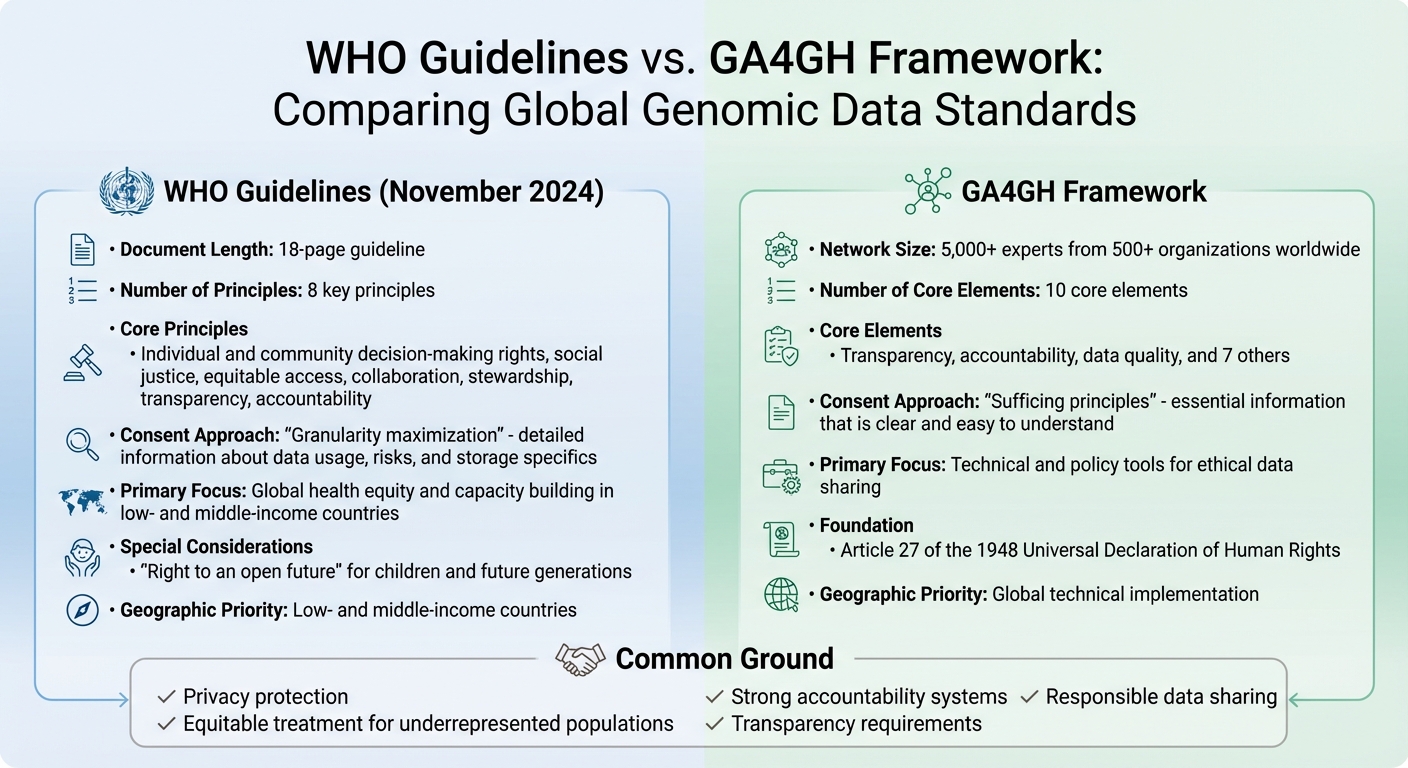
Ethical Frameworks for Genomic Data: WHO Guidelines vs GA4GH Framework
As genomic research continues to grow on a global scale, ethical management of genomic data has become a pressing issue. To address this, international organizations have established frameworks that guide how genomic data is collected, managed, and shared responsibly. Two prominent frameworks leading the way are the World Health Organization (WHO) guidelines and the Global Alliance for Genomics and Health (GA4GH) framework. While both share the goal of protecting individual rights and advancing science, they approach these objectives from distinct but complementary angles.
World Health Organization (WHO) Guidelines

In November 2024, the WHO released an 18-page guideline outlining eight key principles for ethical genomic data management [1]. These principles emphasize individual and community decision-making rights, social justice, equitable access to genomic advancements, collaboration, stewardship, transparency, and accountability [8].
Dr. John Reeder, Director of WHO's Research for Health Department, highlighted the importance of responsible data practices:
"The potential of genomics to revolutionize health and disease understanding can only be realized if human genomic data are collected, accessed and shared responsibly" [7].
A notable feature of the WHO guidelines is their emphasis on "granularity maximization" in consent. This means participants are provided with detailed information about data usage, potential risks, and storage specifics. This approach contrasts with "sufficing principles" seen in other frameworks, which aim to provide enough information without overwhelming participants [6].
The WHO also prioritizes equity and capacity building, particularly in low- and middle-income countries where genomic research infrastructure may lag. The guidelines advocate for investment in local expertise and resources, ensuring that these regions can actively participate in and benefit from genomic research. Additionally, the WHO addresses the "right to an open future", recognizing that decisions made today can influence children and future generations who cannot yet consent [8].
Global Alliance for Genomics and Health (GA4GH) Framework
The GA4GH framework takes a different but complementary approach, focusing on the technical and policy tools needed for ethical genomic data sharing. With over 5,000 experts from more than 500 organizations worldwide, GA4GH develops practical solutions to ensure responsible data use [2].
Rooted in Article 27 of the 1948 Universal Declaration of Human Rights - which affirms the right "to share in scientific advancement and its benefits" - the GA4GH framework builds on a foundation of human rights. It outlines ten core elements, including transparency, accountability, and data quality, to support ethical data sharing [2]. Unlike the WHO's detailed consent model, GA4GH emphasizes "sufficing principles", ensuring essential information is clear and easy to understand.
Both frameworks share common values, such as protecting privacy, ensuring equitable treatment for underrepresented populations, and maintaining strong accountability systems [2]. The WHO's focus on global health equity and collective rights complements GA4GH's technical and policy-driven approach, providing a well-rounded ethical foundation for genomic data governance.
Practical applications of these frameworks are already taking shape. For instance, platforms like BondMCP - Health Model Context Protocol demonstrate how ethical guidelines can be integrated into unified data ecosystems. These systems prioritize data security, transparency, and equitable access, paving the way for advancements in precision health.
Ethical Challenges in Genomic Data Governance
Navigating the ethical landscape of genomic data governance involves juggling individual rights, scientific needs, and commercial pressures. These challenges demand careful consideration, as they sit at the crossroads of privacy, equity, and security.
Balancing Privacy with Scientific Progress
A major challenge in genomic data governance is finding the right balance between safeguarding individual privacy and advancing scientific research. Traditional methods of anonymizing data often fall short. As genomic information is increasingly combined with electronic health records and other personal data, achieving true anonymity becomes almost impossible [3][9].
To address this, governance frameworks use various consent models. Broad consent allows data to be used for unspecified future research, enhancing its utility but reducing individual control. On the other hand, dynamic consent uses digital tools to let participants manage their involvement in specific studies in real time [3]. Striking this balance requires a careful risk–benefit analysis, weighing the potential harms of data misuse against the missed opportunities that come from restricting data sharing [4]. This delicate equilibrium also plays into the broader issues of commercial interests and equitable access.
Equitable Benefits vs. Commercial Interests
The commercialization of genomic data brings up tensions between corporate profits and fair benefit-sharing. Sandra Soo-Jin Lee, Chief of the Division of Ethics at Columbia University, eloquently described this dynamic:
"Data in the 21st century is like oil in the eighteenth century: an immensely, untapped valuable asset. Like oil, for those who see data's fundamental value and learn to extract and use it, there will be huge rewards" [3].
While companies can reap significant profits from genomic data, participants who provide deeply personal biological information often see little direct benefit. Protections like the Genetic Information Nondiscrimination Act (GINA) of 2008 help shield individuals from discrimination in health insurance and employment. However, these protections don’t extend to life, disability, or long-term care insurance [3]. This gap highlights ongoing challenges in ensuring justice and transparency in benefit-sharing.
Data Access vs. Security Risks
Expanding access to genomic data can drive scientific breakthroughs, but it also increases the risk of security breaches. Governance systems must ensure that data access aligns with the original consent while maintaining robust security measures like homomorphic encryption [4][2].
The rise of cloud-based genomic data storage amplifies these concerns. Cloud platforms make international collaboration easier but require advanced governance models to balance accessibility with security. Automated protocols and Data Access Committees (DACs) are often used to evaluate the ethical validity of access requests. However, these measures can slow research due to added administrative layers.
The concept of "contextual integrity" provides a useful framework here. It emphasizes that data should only be used in ways consistent with the original context in which it was shared, taking into account the purpose, method, and parties involved in its use [9]. Tools like BondMCP - Health Model Context Protocol are emerging to address these challenges. By integrating dynamic consent, stringent security protocols, and transparent tracking of data usage, these solutions aim to uphold ethical standards while enabling research to move forward efficiently.
Conclusion: Building Ethical Genomic Data Storage Systems
Creating ethical genomic data storage systems requires a focused effort in governance, security, and long-term reliability. As the Global Alliance for Genomics and Health highlights, "Science proceeds only with the broad support of society; respect for all persons is a primary driver underlying all other derived principles." [4] This means implementing genomic data auditing systems that monitor data access, apply strict consequences for misuse, and maintain the integrity of genomic information over time.
A major shift in genomic data governance is moving from traditional, one-size-fits-all informed consent to a model based on contextual integrity. Ethical systems must respect the norms of each specific context - whether clinical, research, or forensic - acknowledging that genomic data impacts not just individual donors but also their families and communities. This evolution in governance naturally calls for advanced technical protections.
To safeguard privacy while maintaining data usability, technologies like homomorphic encryption, differential privacy, and secure database queries are essential. These tools help counter risks such as membership inference attacks and unauthorized re-identification, ensuring that data remains both secure and functional for research purposes.
Another challenge is the fragmentation of genomic data. When information is scattered across clinical records, wearable devices, and other health data platforms, maintaining transparency and traceability becomes difficult. Platforms like BondMCP address this by providing a unified intelligence layer that integrates data from various sources. With features like dynamic consent management, real-time tracking, and interoperable health ontologies, such systems enable organizations to meet ethical requirements without compromising on efficiency.
Beyond technical and governance measures, accountability and inclusive benefits must also take center stage. Organizations need to go beyond mere compliance by conducting regular risk-benefit evaluations, involving the public in decision-making, and ensuring that genomic research benefits reach underrepresented communities. With over 5,000 individuals and more than 500 organizations already supporting the GA4GH mission [2], the groundwork for global ethical standards is already in place. The real challenge now lies in whether organizations will implement these frameworks with the transparency and diligence that this era of genomic data demands.
FAQs
Can my DNA data ever be truly anonymous?
Completely removing identifiers from DNA data is tough because DNA is inherently unique to each individual. While techniques like de-identification can reduce the risk of exposure, evolving data analysis methods make it easier to re-identify individuals. Ethical guidelines emphasize the importance of informed consent, careful data sharing, and ongoing responsibility to address these risks. Still, it's important to recognize that achieving total anonymity with genomic data is unlikely, as it can often be connected to other personal information over time.
How can I change or withdraw consent later?
Changing or withdrawing consent for genomic data usually requires reaching out to the organization or data custodian managing your information. It's important to know that individuals have the right to withdraw consent, but the process can differ depending on the specific data repository or research project. To take action, review the original consent agreement or directly contact the entity responsible for your data. This ensures your information is no longer used or shared in ways that go against your preferences.
How are benefits shared with underrepresented groups?
Sharing genomic data responsibly with underrepresented groups requires a focus on fairness, openness, and respect for personal rights. Ethical guidelines stress the importance of obtaining informed consent, safeguarding privacy, and ensuring that the use of data genuinely benefits these communities. This involves tackling inequities in research, engaging populations from low- and middle-income regions, and prioritizing participation to support global health progress while upholding individual protections.