

Healthcare faces a critical challenge: how to distribute limited resources effectively while improving patient care. Enter multi-agent systems powered by AI. These systems use real-time data to allocate staff, equipment, and facilities more efficiently, reducing costs by 15% and cutting patient wait times by 30%.
At the heart of this transformation is BondMCP, a platform that connects health data from wearables, labs, and apps into one shared context. By enabling AI agents to work together, BondMCP improves decision-making, personalizes care, and ensures interoperability across systems.
Key takeaways:
- Centralized models streamline operations but can create bottlenecks.
- Decentralized models are faster and more flexible but face coordination challenges.
- BondMCP combines both, offering scalable, accurate, and personalized healthcare solutions.
This hybrid approach is already showing results, from reducing vaccine wastage during the pandemic to improving ICU resource management. Whether you're a healthcare provider or developer, systems like BondMCP are shaping the future of patient care.
Interpretable Machine Learning for Resource Allocation with Application to Ventilator Triage
1. BondMCP - Health Model Context Protocol
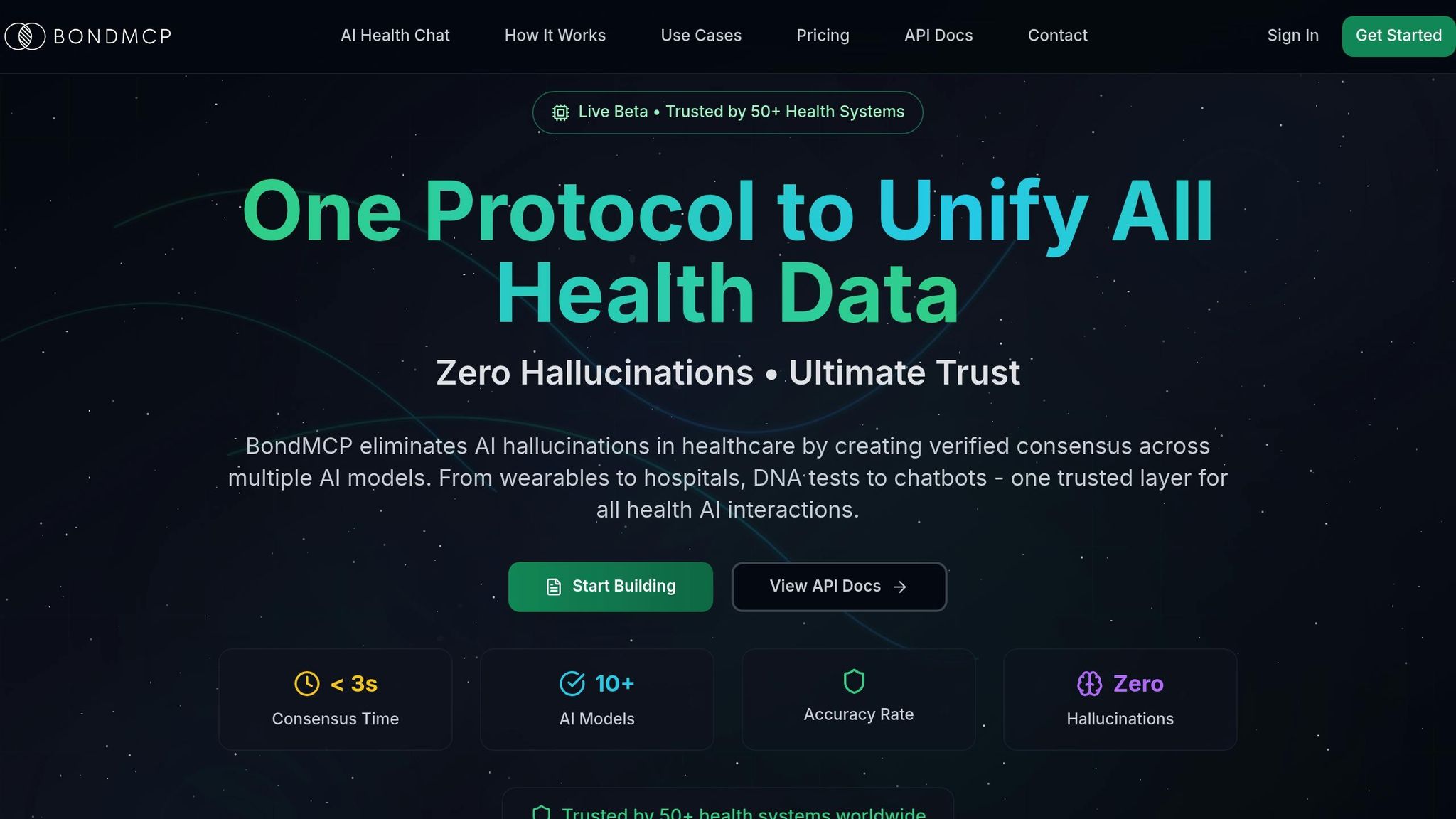
BondMCP is reshaping how health systems work together by acting as a bridge between various healthcare technologies. Think of it as a universal translator that allows AI agents - whether from wearables, hospital systems, or fitness apps - to communicate effortlessly. This protocol fills a crucial gap by enabling these systems to share information and create a unified understanding of a patient's health.
One of the biggest hurdles in healthcare technology is the lack of communication between isolated systems. For instance, your sleep tracker, lab results, and fitness app might all collect valuable data, but without a way to connect them, important insights are lost. BondMCP solves this by establishing a shared context layer, where all health agents can collaborate. This unified framework streamlines decision-making, making it faster and more accurate.
Efficiency
BondMCP dramatically improves efficiency in healthcare systems by using a real-time consensus validation system. Here’s how it works: the protocol processes health-related queries by cross-checking responses from over 10 medically trained AI models, including Claude, GPT-4, Titan, and other specialized tools. This process achieves consensus in under 3 seconds, with an average response time of just 1.8 seconds[1].
This rapid validation eliminates the need for manual cross-referencing, which often slows down decision-making in multi-agent systems. Instead of healthcare staff spending time verifying recommendations from different AI agents, BondMCP ensures 99.8% accuracy and prevents errors[1]. This means decisions can be made quickly and confidently, based on reliable data.
"BondMCP eliminates AI hallucinations in healthcare by creating verified consensus across multiple AI models." - BondMCP[1]
For example, if a patient’s lab results suggest a risk of sepsis, BondMCP enables immediate coordination. The diagnostic agent notifies the resource management agent to handle multi-agent task allocation for ICU beds and prioritize staff, while simultaneously working with the treatment agent to recommend appropriate protocols. All of this happens in real-time, ensuring no delays that could harm patient outcomes[5][6]. This level of efficiency is especially critical in high-stakes scenarios like critical care.
Scalability
BondMCP is built to handle large-scale operations with ease. Its architecture supports broad compatibility and seamless integration, processing over 2.5 million API calls each month while maintaining 99.9% uptime[1].
For healthcare organizations looking to expand their systems, BondMCP offers a structured SDK that simplifies the process. Developers can create agents once and deploy them across the entire ecosystem without needing to rebuild core infrastructure. This approach has already gained the trust of over 12,000 active developers and more than 50 health systems worldwide[1].
Instead of building custom interfaces for every pair of health agents - a process that becomes increasingly complex as systems grow - BondMCP provides a single integration point. This makes it easy to add new tools and agents, supporting rapid advancements as healthcare needs change. Its scalable design ensures personalized, real-time adjustments for patient care without unnecessary friction.
Personalization
One of BondMCP’s standout features is its ability to deliver highly personalized care. By aggregating data from sources like wearables, lab results, and fitness apps, it can instantly adjust recommendations. For instance, if your sleep tracker shows poor recovery, BondMCP can inform your fitness coach agent to modify your workout intensity. At the same time, recent lab results can update your supplement regimen - all tailored to your individual health goals[3][6].
This personalization extends to clinical environments as well. BondMCP can coordinate specialized agents to design care pathways unique to each patient. Its health-specific ontology ensures that data is processed in standardized ways, making it both actionable and easy for healthcare providers to understand[6].
Instead of relying on generic, one-size-fits-all protocols, BondMCP allows agents to adapt recommendations dynamically. It considers real-time data from wearables, genetic tests, environmental factors, and treatment outcomes to provide care that’s truly individualized.
Interoperability
BondMCP tackles one of healthcare’s biggest challenges: interoperability. Using its health-specific ontology and standardized data formats, the protocol acts as a translator, enabling both advanced AI agents and older legacy systems to work together seamlessly[6].
"One Protocol to Unify All Health Data" - BondMCP[1]
This interoperability covers the entire healthcare spectrum. BondMCP’s API can integrate with anything from consumer wearables that track heart rate to hospital systems managing patient flow. Its comprehensive SDKs in Python and JavaScript, along with REST APIs, make it easy for developers to connect their tools[1].
The result? A truly connected healthcare ecosystem. Lab results can automatically inform fitness recommendations. Medication adherence data can trigger alerts for care teams. Even population health trends can guide resource allocation - all without requiring organizations to overhaul their existing systems. This seamless integration ensures that data flows smoothly, unlocking better outcomes for both patients and providers.
2. Centralized Resource Allocation
Centralized resource allocation places a single coordinating authority in charge of distributing resources - such as staff, equipment, and facilities - across an entire healthcare network. This system operates through a central command center, which has a comprehensive view of the organization's needs and available resources[2][5].
This method has proven especially effective in large hospital networks, where managing resources across multiple facilities is critical. For instance, during the COVID-19 pandemic, many healthcare systems relied on centralized allocation to quickly redistribute ventilators, ICU beds, and staff to areas experiencing patient surges in real time[3]. This section sets the stage for comparing centralized coordination with decentralized approaches later on.
Efficiency
Centralized systems are excellent at reducing waste and simplifying operations. A single decision-making hub with access to all resource data allows hospitals to automate tasks that would otherwise require manual coordination between departments.
For example, hospitals that adopted centralized multi-agent systems reported a 15% drop in operational costs within the first year. They also reduced the time it takes to access critical data during emergencies - from 8 minutes to just 12 seconds - using automated authentication and logging processes[2]. These time savings can make a life-or-death difference in critical care situations.
The system functions by continuously monitoring key variables like patient flow, staff availability, and equipment usage. When an emergency department experiences a surge, the central hub can instantly reassign nurses from less busy units, redirect equipment, and even adjust appointment schedules to free up resources. All of this happens automatically, without requiring phone calls or manual coordination between department heads.
Scalability
While centralized systems offer strong coordination capabilities, scaling them across large healthcare networks introduces challenges. As more facilities, agents, and resources are added, the central hub must handle increasingly complex data.
Healthcare organizations address these challenges using distributed computing, hierarchical structures, and advanced algorithms like constraint programming and queueing theory[2][5]. Cloud-based infrastructure plays a crucial role in managing the computational demands of large-scale centralized systems.
To prevent bottlenecks as data volumes grow, modern systems use stream-processing techniques for continuous monitoring and real-time adjustments. Many successful implementations also adopt a hybrid approach, where regional coordinators handle local decisions while reporting to a central authority. This structure balances the benefits of centralized oversight with the need to avoid overwhelming any single decision-making node.
Personalization
Centralized resource allocation has the potential to deliver highly personalized care, provided it incorporates detailed, patient-specific data. The system must integrate information from various sources - such as electronic health records, wearable devices, lab results, and clinical observations - to make decisions tailored to each patient’s unique circumstances[3][5].
For instance, ICU bed allocation might not only consider a patient’s severity score but also account for their medical history, current medications, and data from personal health devices. Achieving this level of personalization requires the central system to process and correlate massive amounts of individual data in real time.
However, personalization can be a challenge if the system lacks sufficient granularity. Without detailed data, centralized systems may fail to account for local or patient-specific nuances, leading to less effective interventions[3][5]. The key is to build systems that can optimize resources on a large scale while still addressing individual needs.
Interoperability
Centralized allocation strengthens interoperability by enforcing standardized protocols across all connected systems, as described in BondMCP's interoperability framework. This standardization ensures that diverse health technologies can communicate seamlessly[6].
For example, a centralized system can merge data from wearables tracking heart rate, lab systems reporting test results, and hospital systems managing patient flow. Acting as a universal translator, the central hub converts data from various formats into a unified language.
This approach also helps integrate legacy systems. Instead of requiring older systems to be replaced, centralized allocation can incorporate them through translation layers and standardized interfaces. This allows hospitals to modernize their resource management processes without the need for costly overhauls of existing technology.
sbb-itb-f5765c6
3. Decentralized Resource Allocation
Decentralized resource allocation moves decision-making away from a single central authority, distributing it among multiple independent agents across the healthcare network. Unlike centralized systems, this approach empowers local agents to act independently, allowing them to respond more effectively to immediate needs. While the goal remains to optimize performance, decentralized systems prioritize adaptability by enabling decisions based on real-time, localized data.
During the COVID-19 pandemic, decentralized multi-agent systems significantly improved vaccine distribution. These systems reduced infections and deaths by an average of 14.25% compared to centralized models [3][4]. This localized approach proved invaluable for delivering swift and efficient responses in critical situations.
Efficiency
Decentralized systems enhance efficiency by enabling agents to act on local demands without waiting for central approval. In emergencies, these systems streamline resource allocation by automating processes, cutting data access times from minutes to seconds.
For example, decentralized systems have been shown to reduce patient wait times and improve early disease diagnosis rates by up to 30% [3]. Pandemic simulations using decentralized multi-agent reinforcement learning frameworks demonstrated even better outcomes - some configurations reduced infections and deaths by up to 15.44% when paired with multi-agent voting mechanisms [4]. These results stem from agents' ability to use real-time data, such as local infection rates and population vulnerabilities, to dynamically optimize resource distribution [3].
Scalability
One of the standout strengths of decentralized systems is their ability to scale across large healthcare networks. By distributing the computational load among multiple agents, these systems avoid the bottlenecks often seen in centralized systems. This distributed structure allows healthcare networks to expand - adding new facilities, departments, or services - without overwhelming any single decision-making hub.
For instance, decentralized multi-agent systems used during vaccine distribution in a pandemic achieved lower wastage rates and more efficient dose utilization compared to traditional centralized models [3].
Personalization
Decentralized systems excel at tailoring care to individual patients by taking into account both local conditions and personal health data. Treatment recommendation agents, for example, analyze a patient's physiological data and medical history to create customized care plans. Risk stratification agents, meanwhile, calculate personalized risk scores based on detailed patient profiles.
In sepsis management, decentralized agents continuously monitor patient data, calculate risk scores, recommend treatments, and allocate resources based on the severity of each case. This real-time monitoring and rapid response capability not only improves patient outcomes but also boosts operational efficiency [3][5]. Beyond individual care, these agents adapt interventions to reflect regional health trends and community needs - something centralized systems often struggle to accomplish.
Interoperability
While decentralized systems offer numerous advantages, they must address the challenge of interoperability via APIs. Agents need to exchange data and coordinate actions across a wide range of platforms, devices, and healthcare systems - all while maintaining consistent communication protocols [3][6]. The fragmented nature of healthcare technology adds complexity, requiring the integration of diverse data sources and strict adherence to data privacy standards.
BondMCP tackles these interoperability challenges by providing a structured context layer and a health-specific ontology. This framework allows agents to share data, routines, and interventions seamlessly across wearables, labs, supplements, and other healthcare domains. By enabling coordinated actions, personalized care, and automated decision-making, BondMCP transforms disconnected technologies into a unified ecosystem. With its standardized context layer, decentralized systems can unify diverse health technologies to deliver real-time, patient-centered care efficiently.
Advantages and Disadvantages
Every resource allocation strategy in health agent systems comes with its own set of strengths and weaknesses. Understanding these trade-offs is crucial for healthcare organizations to choose the approach that best aligns with their goals and limitations. These considerations also provide a framework for comparing centralized and decentralized models.
Centralized systems are highly effective in controlled settings where efficiency and oversight are critical. They can implement system-wide changes quickly and enforce consistent policies across all agents. With a single point of control, management becomes more straightforward, reducing the complexity of coordinating multiple decision-makers.
However, centralized systems come with notable downsides, especially as they scale. Bottlenecks can occur when a single controller has to handle requests from numerous agents, leading to delays. A failure in the central authority can disrupt the entire system. Additionally, this top-down approach often lacks flexibility, making it harder to tailor solutions to individual patient needs, as broad policies may overlook specific circumstances.
On the other hand, decentralized strategies address many of these issues by enabling local decision-making. They excel in scalability and adaptability, as seen during the COVID-19 pandemic. Decentralized systems reduced patient wait times and improved early disease diagnosis by up to 30% [3]. These systems allow agents to respond immediately to local conditions without waiting for central approval. Multi-agent systems using decentralized allocation have also been linked to a 26% reduction in adverse drug events and a projected 45% return on investment in drug discovery applications [3].
That said, decentralized systems are not without challenges. The absence of a central authority can lead to coordination problems, such as conflicting decisions or duplicated efforts, which may waste resources. Maintaining data consistency across multiple agents requires advanced protocols and constant monitoring. Additionally, distributing sensitive health data across various nodes increases security risks [7].
BondMCP's hybrid model combines the strengths of both centralized and decentralized approaches. It uses a shared context layer that facilitates seamless communication between agents while allowing them to act independently. For example, a patient’s sleep tracker can automatically inform their training coach, and lab results can update supplement protocols - all without manual intervention or central oversight. This balance ensures both agility and oversight.
| Strategy | Efficiency | Scalability | Personalization | Interoperability | Disadvantages |
|---|---|---|---|---|---|
| Centralized Allocation | High | Low-Medium | Low | Low | Bottlenecks, single point of failure, less adaptive [2][3] |
| Decentralized Allocation | Medium | High | Medium-High | Medium | Complex coordination challenges, data consistency issues [7][3] |
| BondMCP | High | High | High | High | Implementation cost, requires ecosystem adoption [6] |
Centralized systems often require a significant initial investment in powerful servers but tend to have lower ongoing maintenance costs. Decentralized systems, by distributing computational tasks across multiple nodes, are more affordable to scale but can be harder to secure and coordinate. BondMCP, while requiring initial ecosystem adoption, offers long-term savings by eliminating redundant tools and streamlining fragmented systems.
In real-world scenarios, hierarchical multi-agent models using reinforcement learning have shown the potential to reduce infections and deaths by 14.25%–15.44% in pandemic simulations compared to traditional centralized methods [4]. This illustrates how the choice of allocation strategy directly impacts both patient outcomes and operational efficiency.
Healthcare systems continue to grapple with integrating diverse data sources, such as wearables, lab systems, and electronic health records. BondMCP addresses this challenge by offering plug-and-play orchestration that unifies these disconnected technologies, enabling precision health delivery at scale.
Conclusion
There's no one-size-fits-all solution when it comes to resource allocation in healthcare. Centralized systems work well in situations that demand strict oversight and regulatory compliance, ensuring uniform policies and efficient decision-making. However, they often struggle to scale and adapt, which can lead to delays in critical care. On the other hand, decentralized systems thrive in dynamic environments, offering the agility to respond quickly to local needs. For example, real-world applications of decentralized multi-agent systems have been shown to reduce patient wait times by 30% and operational costs by 15%. Additionally, hierarchical multi-agent models have demonstrated a reduction in infections and deaths by up to 15.44% compared to traditional centralized methods [2][3][4]. That said, decentralized systems face their own challenges, such as coordination issues and maintaining data consistency, especially when communication between agents is lacking.
This is where BondMCP steps in, blending the best of both worlds. It combines the oversight of centralized systems with the flexibility of decentralized models. Unlike traditional methods that force healthcare organizations to choose between control and adaptability, BondMCP ensures seamless communication between agents while preserving local autonomy. Imagine a patient’s sleep tracker instantly updating their training coach or lab results automatically adjusting supplement protocols - BondMCP eliminates the fragmentation that often hampers current healthcare technology.
When choosing a resource allocation strategy, healthcare organizations need to consider their specific operational requirements. Centralized systems might be ideal for large hospital networks with strict compliance needs, while decentralized models are better suited for distributed clinics or emergency response scenarios. However, for organizations aiming to connect diverse health agents - like wearables and electronic health records - context-aware systems like BondMCP offer a more integrated solution.
The potential of multi-agent systems is clear. They’ve been shown to deliver a 45% ROI in drug discovery and reduce adverse drug events by 26% [3]. But these outcomes depend on effective communication and seamless context sharing among agents. With its plug-and-play orchestration, BondMCP turns fragmented health data into a coordinated ecosystem, paving the way for precision healthcare on a large scale.
FAQs
How does BondMCP enable seamless collaboration between different health technologies and systems?
BondMCP simplifies collaboration between health-focused AI agents through its structured protocol and SDK, enabling them to work together more effectively. With a shared context layer and a health-specific ontology, it ensures smooth communication between data sources like wearables, lab results, and fitness trackers.
By bringing these elements together, BondMCP creates a cohesive system where AI agents are context-aware and can deliver real-time, personalized health solutions. This approach eliminates the hassle of fragmented tools and disconnected data, paving the way for a more streamlined and precise approach to health management.
What are the key benefits of using BondMCP’s hybrid model for resource allocation in health optimization systems?
BondMCP’s hybrid model blends the best features of centralized and decentralized resource allocation systems, offering a smarter approach to managing health-focused multi-agent systems.
Using a shared context layer, BondMCP integrates data from diverse sources - like wearables, lab results, and fitness trackers - allowing them to interact seamlessly. This creates a context-aware system where AI agents collaborate to deliver personalized, automated health insights. Unlike centralized systems that can struggle with scalability or decentralized systems that often lack cohesion, BondMCP strikes a balance by enabling agent collaboration while maintaining both flexibility and precision.
The outcome? An efficient, interoperable ecosystem that minimizes redundancy, sharpens decision-making, and provides personalized clarity for users and developers alike.
How does BondMCP improve personalized health care by integrating data from wearables and other sources?
BondMCP takes personalized health care to the next level by bringing together data from wearables, lab tests, fitness trackers, supplements, and sleep monitors into one streamlined system. This integration ensures that all your health information works in harmony, enabling smarter, real-time decisions tailored specifically to you.
With this connected approach, BondMCP delivers clarity, personalization, and automation. Imagine your sleep tracker helping fine-tune your workout routine, or your lab results guiding adjustments to your supplements - all without juggling multiple apps or dealing with conflicting advice. It’s a seamless and efficient way to enhance your health and well-being.