
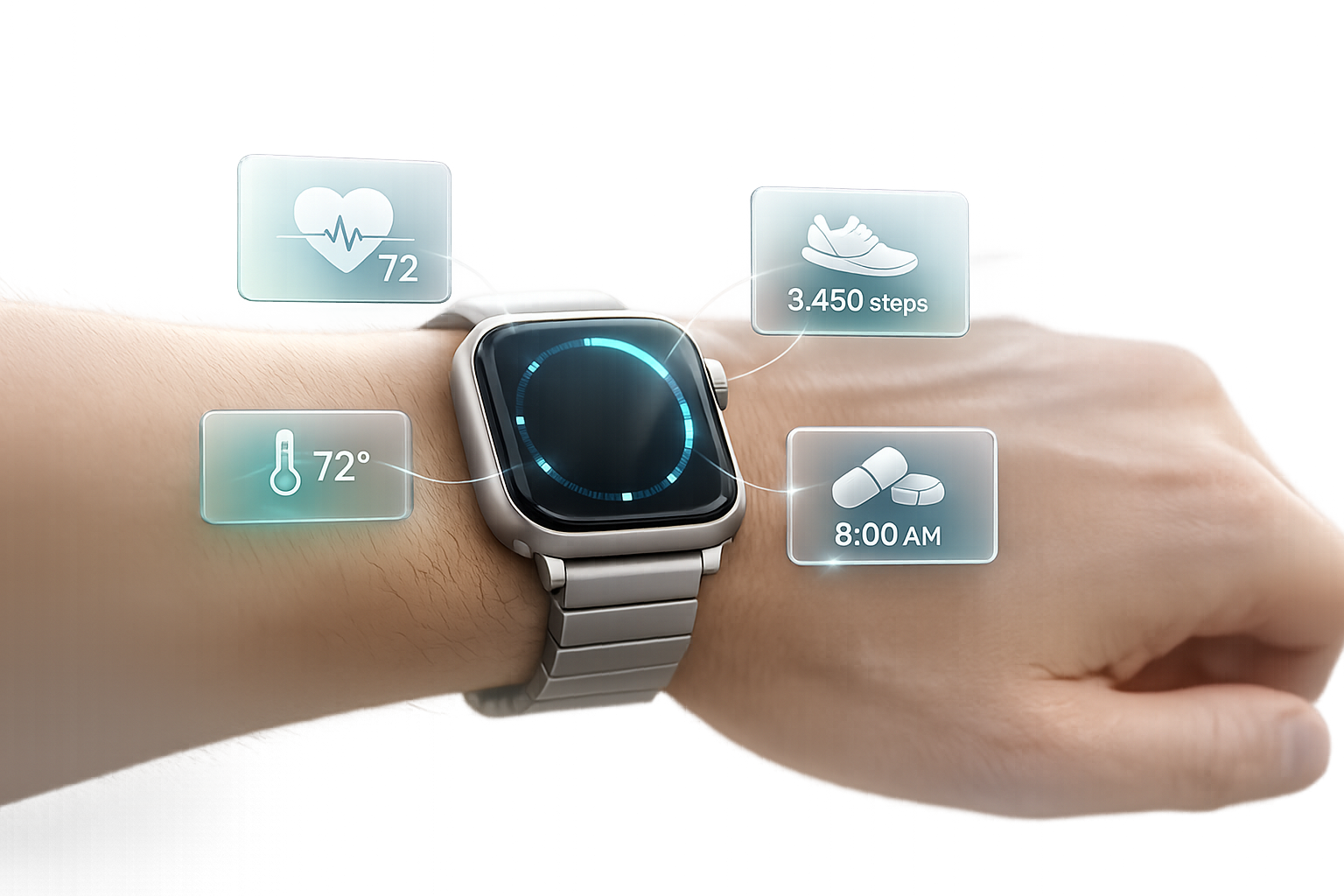
Wearables are getting smarter. Instead of just tracking your steps or heart rate, they now use context-aware AI to understand why your body is reacting a certain way. This means better health insights tailored to your lifestyle, habits, and environment.
Here’s what this technology does:
- Connects the dots between data like sleep, workouts, nutrition, and even lab results.
- Predicts health issues like fatigue or stress before they happen.
- Automates actions like logging meals, adjusting workouts, or notifying caregivers.
- Standardizes data from multiple devices (e.g., Garmin, Apple Health) for seamless integration.
Key advancements include machine learning models that analyze real-time metrics, adaptive feedback systems to recommend actions, and platforms like BondMCP that unify fragmented health data. The result? Wearables that help you make smarter health decisions by learning how to set up your AI wellness system without the guesswork.
Context-Aware Wearables
This integration relies on standardized frameworks like the Model Context Protocol in health optimization to identify behavioral patterns to ensure seamless data flow between devices and context-aware health agents.
sbb-itb-f5765c6
How Context-Aware AI Works in Wearables
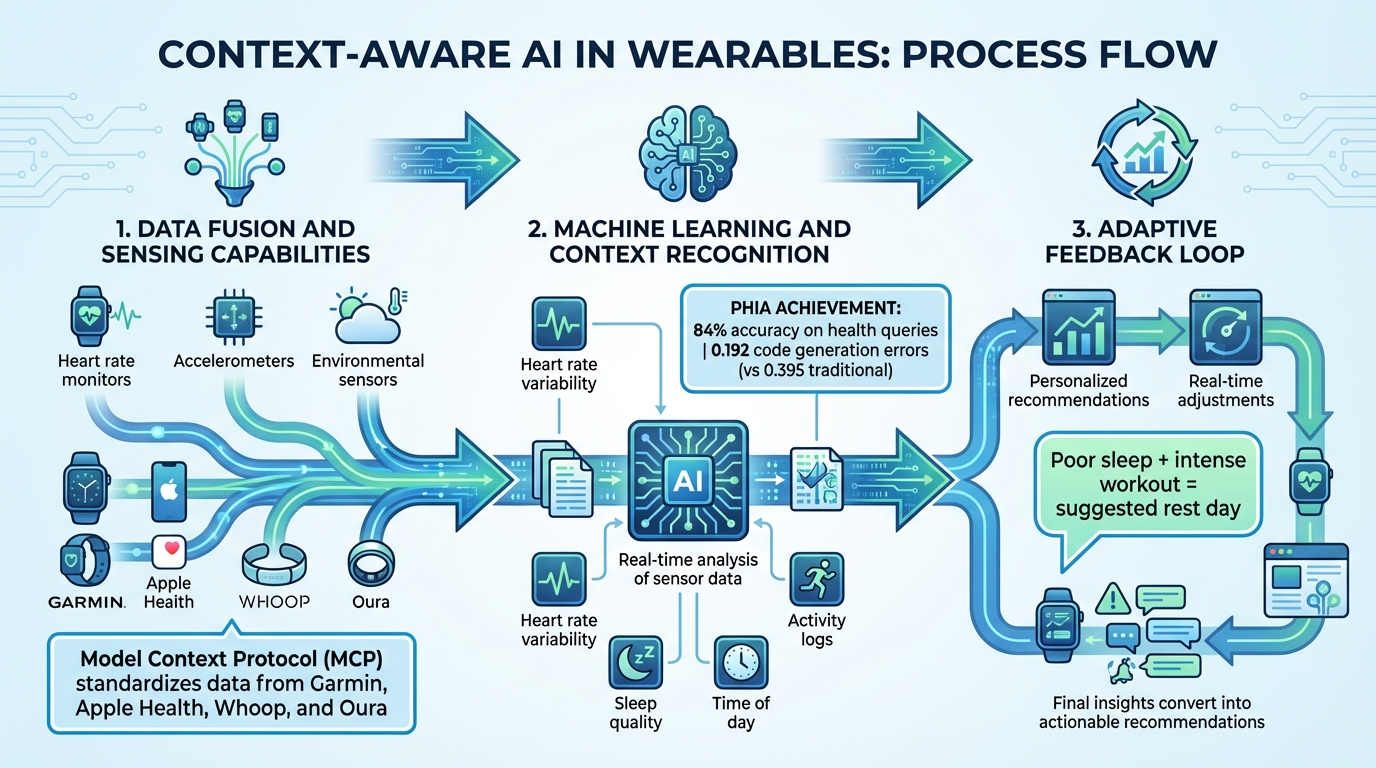
How Context-Aware AI Works in Wearables: 3-Step Process
Context-aware AI goes beyond simply gathering data - it analyzes and interprets it in real time. This process relies on three main components: data fusion, machine learning, and an adaptive feedback loop.
Data Fusion and Sensing Capabilities
Wearable devices collect information from a variety of sensors. For example, heart rate monitors track cardiovascular activity, accelerometers measure movement, and environmental sensors record ambient conditions. Data fusion combines all these inputs into a unified, usable framework.
The Model Context Protocol (MCP) plays a crucial role here, acting like a universal translator. It standardizes data from devices such as Garmin, Apple Health, Whoop, and Oura, ensuring seamless communication between platforms [2].
Machine Learning and Context Recognition
Machine learning models are at the heart of context-aware AI. These models analyze sensor data to figure out what’s happening in real time. For instance, they can distinguish whether an elevated heart rate is due to exercise, stress, or even caffeine. This is accomplished by cross-referencing various factors like heart rate variability, sleep quality, time of day, and activity logs.
Advanced systems like the Personal Health Insights Agent (PHIA) take this a step further. Introduced in February 2026, PHIA uses code generation and multi-step reasoning to analyze time-series data. In a rigorous 650-hour expert evaluation, PHIA achieved 84% accuracy on numerical health queries and received 83% favorable ratings for its open-ended insights. It also significantly reduced code generation errors to 0.192, compared to 0.395 in traditional models [7].
Adaptive Feedback Loop
The final step is turning insights into real-time health alerts. Context-aware wearables don’t just deliver data - they adjust their recommendations based on your current condition. For example, if your sleep quality was poor and you had an intense workout the day before, the system might suggest a lighter activity or a rest day.
In December 2025, Derick W Owens developed an AI fitness hub using MCP integration. This system featured voice prompts that automatically logged data to platforms like Fitbit through open APIs, showcasing how wearables can seamlessly adapt to user needs [3].
Benefits of Context-Aware AI for Health Optimization
Personalization at Scale
Context-aware AI takes generic health advice and turns it into customized guidance tailored specifically to you. By analyzing your unique habits, metrics, and lifestyle, it delivers recommendations that actually make sense for your situation. For instance, in September 2025, Spike Technologies launched a 360° health data API in New York. This system could differentiate between two 60-year-olds - one an active runner, the other managing high cholesterol - offering each personalized recovery plans and lifestyle tips based on wearable data, nutrition logs, and lab tests [1].
Why does this level of detail matter? Studies show that even a small increase in Physical Activity Energy Expenditure (PAEE) - just 5 kJ/kg/day higher - can lower the risk of premature mortality by 37% [7]. With context-aware AI, your daily fitness goals are adjusted to your current fitness level, sleep patterns, and recovery needs, going far beyond generic "10,000 steps a day" targets. This approach not only helps you hit meaningful milestones but also lays the groundwork for preventive health strategies.
Early Interventions
Most wearable devices today are reactive - they notify you after something has already gone wrong, like poor sleep or a sudden spike in heart rate. Context-aware AI flips this script by predicting potential issues before they happen. A great example is the Personal Health Insights Agent (PHIA), launched in August 2025, which uses multiple data streams to forecast health concerns with impressive accuracy [7].
What does this look like in practice? Imagine getting a hydration reminder before dehydration impacts your performance or being prompted to take a breather when your heart rate variability suggests rising stress levels. This proactive approach pays off: users of activity trackers reportedly take an additional 1,800 steps per day on average [7].
Automated User Experience
Context-aware AI goes a step further by automating actions based on its insights. Instead of just offering advice, these systems take care of tasks for you. As Derick W Owens, a well-known AI advocate, put it:
"I'm no longer interested in chatbots that tell me about nutrition. I want AI agents that take action on my behalf" [3].
In December 2025, Owens introduced an AI fitness hub that allowed users to log data effortlessly. For example, saying, "Log my lunch to Fitbit: chicken breast 150g, brown rice 100g", would trigger the system to pull data from the USDA database, calculate nutritional values, update Fitbit via API, and even record the information in a Google Sheet for long-term tracking [3].
This kind of automation eliminates the hassle of switching between multiple apps. With tools like BondMCP, your health data becomes seamlessly integrated. The Open Wearables MCP Server, launched in February 2026, showcased this by enabling natural language queries like "How much sleep did John get last week?" across platforms like Garmin, Apple Health, and Whoop [2]. The result? Your health data works for you, not the other way around, so you can focus on achieving your goals instead of managing endless data inputs.
Real-World Applications of Context-Aware AI in Wearables
Stress and Mental Health Monitoring
Context-aware AI is transforming how wearables monitor stress by combining data from various sources like sleep patterns, activity levels, nutrition logs, and even lab results. This holistic view helps paint a clearer picture of your mental and physical well-being [1].
In September 2025, Spike Technologies showcased this potential with its MCP server. The system avoided false alarms by interpreting data in context - for example, recognizing that a high heart rate after a workout is part of recovery, not a stress signal [1].
Similarly, Google explored the concept with its Personal Health Agent framework, as part of the WEAR-ME study involving 1,165 participants. The system relied on three specialized agents - a Data Science Agent, a Domain Expert, and a Health Coach - to analyze wearable data alongside blood tests. Users found this multi-agent system far more reliable, with a trust rating of 96.9%, compared to 38.7% for general-purpose AI. Health professionals also favored this collaborative approach in 80% of evaluations [8].
But stress monitoring isn’t the only area seeing advancements. Context-aware AI is also reshaping fitness coaching by delivering real-time, personalized guidance.
Fitness and Performance Coaching
Fitness coaching has entered a new era, thanks to context-aware AI. These systems provide dynamic, real-time feedback by analyzing your vitals and recovery status. They can even predict fatigue before it sets in, adjusting workout plans on the fly [5].
Google's research team highlighted the effectiveness of this approach. Their Data Science Agent achieved a 75.6% success rate in creating statistical analysis plans for workout data, outperforming baseline systems, which managed only 53.7% [8]. By interpreting metrics like pace trends, biomechanical data, and heart rate variability, the AI can craft recovery plans tailored to individual needs.
This same adaptability extends beyond fitness, offering significant benefits for managing chronic health conditions.
Chronic Condition Management
For individuals dealing with chronic conditions such as diabetes or hypertension, context-aware AI offers a more personalized approach. It integrates data from wearables with medical records, lab results, and even nutrition logs to provide tailored insights [1][8].
By cross-referencing this data, the AI distinguishes between scenarios that might otherwise trigger conflicting advice. For instance, it recognizes when a high-calorie meal is part of post-exercise recovery rather than a dietary issue [1]. This level of precision simplifies chronic condition management.
Google's research underscored the value of this approach. With over 7,000 human annotations and 1,100 hours of expert review, their system validated AI-driven health interventions [8]. The Domain Expert Agent stood out by interpreting biomarkers and offering clear, evidence-based explanations of medical conditions. As Piotr Ratkowski, Head of Growth at Momentum, explained:
"Health data isn't just medical records. It includes lab results and diagnoses, wearable data, training logs, nutrition tracking, mental state indicators, and recovery markers. All of it provides context" [8].
Platforms like BondMCP are taking this a step further. By standardizing data across systems, they enable seamless integration of health information, creating a unified ecosystem for managing chronic conditions more effectively.
BondMCP: The Intelligence Layer for Wearable Integration
Unified Data and Interoperability
One of the biggest hurdles in health tech is fragmented data. Wearable metrics, lab results, and nutrition information often sit in separate silos, making it tough to get a full picture of someone’s health. BondMCP tackles this problem by acting as a bridge, connecting these disparate data sources into a single, unified system for telehealth.
Here’s how it works: BondMCP queries APIs from platforms like Garmin, Apple Health, Whoop, and Polar, then normalizes the data into a consistent format [2]. For example, whether a sleep metric comes from an Oura ring or a Fitbit, it looks the same to the AI. Bartosz Michalak, Director of Engineering, puts it this way:
"The Open Wearables MCP Server removes that friction. It gives AI assistants direct access to unified user wearable data, so developers can ask questions in plain English and get answers grounded in actual measurements from users' devices." [2]
Beyond wearables, BondMCP integrates clinical data using FHIR (Fast Healthcare Interoperability Resources) servers, combining lab results and medical records with real-time wearable data [8]. This creates a strong foundation for AI-driven health insights, blending everyday metrics with clinical-grade information.
Personalized Health Optimization
BondMCP doesn’t just collect data - it uses it to create personalized health strategies. Its multi-agent AI architecture includes three specialized agents: a Data Science Agent to analyze trends, a Domain Expert to interpret medical biomarkers, and a Health Coach to provide motivational support [8].
This approach is backed by research. Multi-agent systems earned approval from health experts in 80% of evaluations [8]. Trust in the Domain Expert Agent was particularly high, with users rating it at 96.9% compared to just 38.7% for general-purpose AI [8]. The result? Your sleep tracker can inform your fitness plan, lab results can adjust your supplements, and your long-term health goals can shape daily decisions. BondMCP turns wearable data into actionable, personalized guidance, making health management smarter and more intuitive.
Developer and Clinic Benefits
For developers and clinics, BondMCP simplifies integration and implementation. Its structured protocol and SDK eliminate the need for custom device-specific integrations. Thanks to its stateless, decoupled design, developers can easily connect AI systems to wearable data through REST APIs, enabling natural language queries without manual API coding [2][3].
The system’s Data Science Agent also delivers stronger results, achieving a 75.6% success rate in generating reliable statistical analysis plans for health data - significantly higher than the 53.7% success rate of baseline systems [8]. This makes it a practical tool for clinics and health platforms aiming to provide precision care without building costly proprietary systems. As Piotr Ratkowski, Head of Growth, explains:
"MCP is gaining traction as a standard way for AI systems to access data from different sources... The Personal Health Agent orchestrates this data rather than storing it." [8]
Overcoming Challenges in Context-Aware Wearable Technology
Sensor Accuracy and Noise Reduction
Wearable sensors often face challenges like environmental noise and inconsistent data, which can complicate AI interpretations. For instance, a sudden spike in heart rate might simply be a sensor error rather than a genuine health issue. To tackle this, modern systems use multi-step reasoning to break down ambiguous sensor data before making decisions.
Take the Personal Health Insights Agent (PHIA) as an example. PHIA includes a preliminary "Thought" phase, which significantly improves accuracy while minimizing errors [7].
Another effective tactic is data normalization. Protocols like MCP ensure that metrics from different devices - whether from a Garmin watch or Apple Health - are standardized. This consistency allows AI systems to interpret data more reliably. These advancements in sensing accuracy also help lay the groundwork for stronger data privacy measures in wearable tech.
Data Privacy and Security
Health data is incredibly personal, so keeping it secure is essential. One of the most robust methods is self-hosting, where sensitive information remains on the user’s infrastructure without involving third-party servers. As Bartosz Michalak, Director of Engineering, explains:
"Your health data stays on your infrastructure. No third-party services involved" [2].
In addition to self-hosting, features like strict access controls and audit logging ensure that every instance of data access is tracked. Users also benefit from having full control over their data, with options to view, edit, or delete stored information. For example, PHIA combines model guardrails with iterative reasoning, achieving over 99% harmless responses during human evaluations [7].
To further enhance security, API key authentication and standardized protocols like MCP are used to ensure only verified requests are processed [2][4]. Once data security is addressed, the next hurdle is enabling seamless communication across different devices.
Interoperability Across Devices
Fragmented ecosystems are a major obstacle in wearable technology. Devices often use different data formats, and many platforms limit API access. Universal connector standards, like MCP - dubbed the "USB-C of AI" - offer a way forward. MCP serves as a bridge, enabling AI systems to pull data from platforms like Garmin, Apple Health, and Whoop without needing custom integrations [4].
A great example of MCP in action comes from December 2025, when developer Derick W. Owens created an "Agentic AI Fitness Hub" that connected 24 tools across 8 platforms. Owens praised Fitbit for its open write-access API but noted that MyFitnessPal remained inaccessible to independent developers [3]. Platforms that support OAuth 2.0 and write access allow automated actions, while restricted APIs limit integration. As Owens aptly put it:
"Agents are only as useful as the APIs they can access" [3].
| Platform | API Accessibility | Write Access | Authentication |
|---|---|---|---|
| Fitbit | Open / Public | Yes | OAuth 2.0 |
| Nutritionix | Open / Public | Yes | API Key |
| Google Sheets | Open / Public | Yes | OAuth 2.0 |
| MyFitnessPal | Restricted | No (Partners only) | Proprietary |
| Lose It! | Selective Approval | Limited | Manual Review |
For developers, adopting a stateless design and using clear, descriptive tool names (e.g., log_food_to_fitbit instead of vague identifiers) helps AI systems recognize and use tools effectively [3]. By leveraging open standards and overcoming these interoperability challenges, context-aware wearables can deliver precise and proactive health insights.
Conclusion
Context-aware AI is transforming how wearables contribute to health management. These devices have evolved from simple data loggers to proactive tools that predict potential health issues and provide tailored interventions during daily life activities [10]. This progression aligns with the principles of P4 Medicine - care that is Predictive, Preventative, Personalized, and Participatory [9].
The introduction of universal standards like the Model Context Protocol (MCP) has also addressed the challenge of data silos. As CodeWithEze explains:
"MCP is the USB-C of AI - a universal connector standard so that AI systems don't need bespoke plumbing for every data source or tool" [4].
This development paves the way for seamless data integration, allowing wearables to not just collect data but also interpret it, recognize patterns, and act accordingly. For developers, the fast-changing integration landscape offers both opportunities and challenges. Spike Technologies highlights this shift, stating:
"Most products will have AI-powered insights as standard functionality within 1–2 years" [1].
For healthcare providers, context-aware AI reduces the burden of raw data analysis by presenting summarized patient trends, enabling more informed clinical decisions before appointments [6].
As the focus shifts from reactive to proactive healthcare, tools like BondMCP showcase the potential of unifying fragmented health data into a cohesive, intelligent ecosystem. Whether you're monitoring recovery, utilizing AI tools for cognitive stress recovery, managing chronic conditions, or pursuing wellness goals, context-aware AI empowers wearables to act as proactive health allies rather than passive trackers.
FAQs
How does context-aware AI know what’s causing my heart rate to rise?
Context-aware AI pinpoints the reason behind a heart rate spike by examining real-time biometric data alongside contextual inputs from various sensors. It takes into account factors such as physical activity, location, sleep patterns, and surrounding conditions. This helps determine whether the increase is caused by exercise, stress, or something else entirely. By combining these data points, the AI delivers tailored insights and alerts users to unusual changes, supporting proactive health monitoring.
What data do I need to get accurate, personalized insights from my wearable?
To provide you with accurate and personalized insights, your wearable relies on a mix of biometric data and contextual inputs. This includes details like your heart rate, sleep patterns, activity levels, and body temperature, paired with factors such as your location and surroundings. By combining these streams of data, AI can identify patterns, spot irregularities, and offer recommendations tailored specifically to you. This approach allows your wearable to deliver proactive, precise health guidance, making it a valuable tool for managing your personal health.
How does BondMCP - Health Model Context Protocol keep my health data private?
BondMCP is designed with a strong focus on privacy and security, ensuring your health data remains safeguarded. Its structure supports smooth data sharing across devices while maintaining strict data integrity and confidentiality. By incorporating a shared context layer and a health-specific ontology, it reduces exposure by allowing access only to relevant and authorized information. For details on encryption or compliance measures, additional technical information would be necessary.