

Secure Agent Memory Protocols are essential for AI health agents managing sensitive data like lab results, genetic information, and real-time biometrics. These protocols ensure data security, compliance, and efficient collaboration across systems. The article highlights three key protocols:
- SAMEP (Secure Agent Memory Exchange Protocol): Focuses on secure data transfer with dual-layer encryption, healthcare compliance, and compatibility with FHIR standards.
- MCP (Model Context Protocol): Provides a unified interface for AI agents to interact with diverse systems. It relies on TLS encryption but requires external safeguards for HIPAA compliance.
- A2A (Agent-to-Agent Protocol): Enables secure collaboration between AI systems using HTTPS, payload signing, and privacy-centric features like data isolation.
Each protocol addresses specific challenges in healthcare AI, from secure data sharing to multi-agent collaboration, helping organizations integrate AI into their systems effectively.
Quick Comparison
| Protocol | Focus Area | Encryption Strength | Healthcare Compliance | Key Feature |
|---|---|---|---|---|
| SAMEP | Secure data exchange | Dual-layer encryption | Context-aware authentication | FHIR compatibility and scalability |
| MCP | Unified interface for data sources | TLS/HTTPS with JSON-RPC 2.0 | Requires external safeguards | Simplifies integration across systems |
| A2A | Agent collaboration | HTTPS with mandatory payload signing | Privacy-centric features | Enables secure multi-agent teamwork |
These protocols lay the groundwork for secure, efficient AI systems in healthcare, balancing data protection and operational needs.
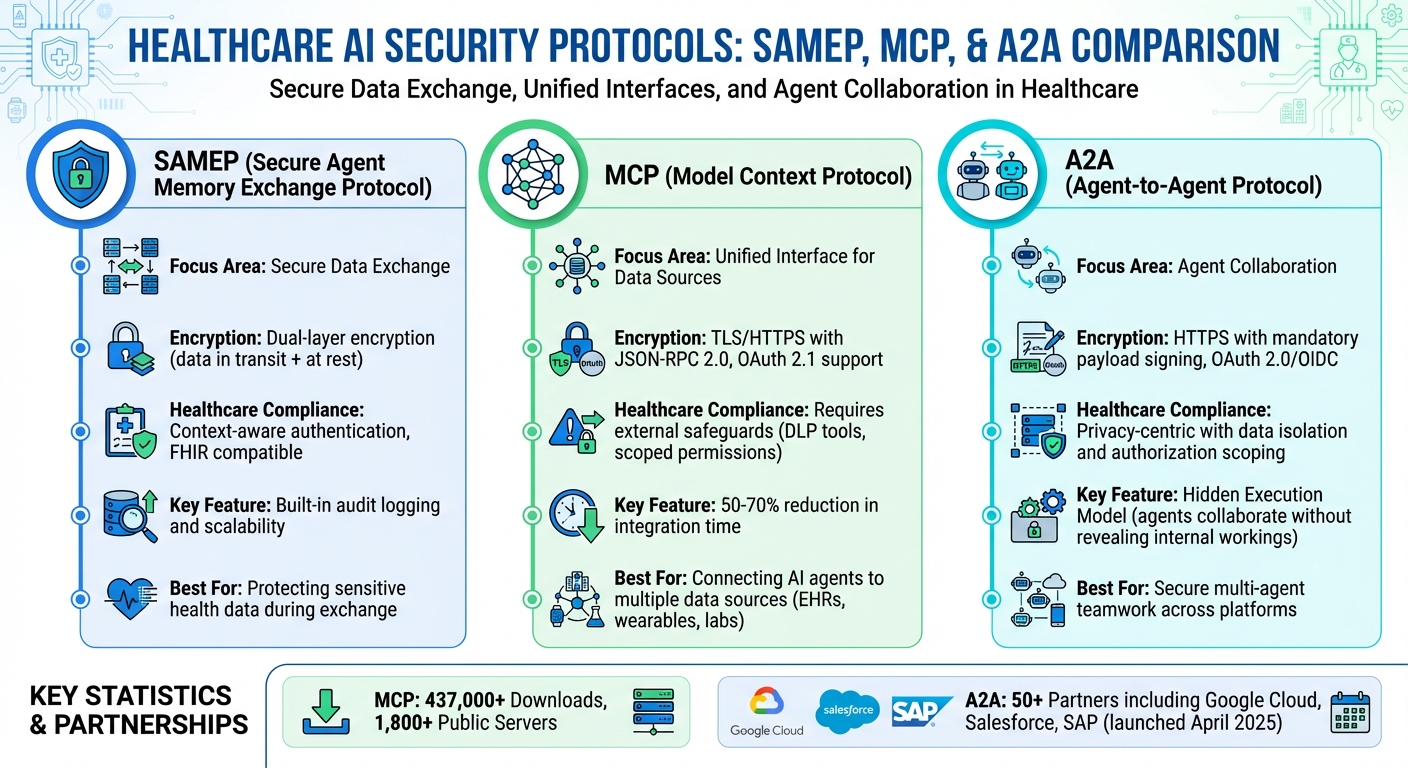
Comparison of SAMEP, MCP, and A2A Healthcare AI Security Protocols
The Model Context Protocol A Universal Port for AI in Healthcare
sbb-itb-f5765c6
1. SAMEP - Secure Agent Memory Exchange Protocol
SAMEP is designed to protect sensitive health data as it's exchanged between AI agents and storage systems, ensuring patient information stays private and secure.
Encryption Strength
To keep health data safe, SAMEP uses a dual-layer encryption system. This protects the information both while it's being transmitted and when it's stored, adding an extra layer of security [5].
Healthcare Compliance
The protocol incorporates context-aware authentication, which adjusts access permissions depending on the type of data. For example, it allows unrestricted access to cardiology information but imposes stricter controls on psychiatric records [5].
Interoperability
SAMEP is compatible with FHIR, the standard framework for exchanging patient data. It also includes built-in audit logging, enabling detailed traceability for every access or interaction [4].
Scalability
SAMEP is built to handle increasing data demands. Features like intelligent caching and query batching make it adaptable for use across various platforms, from edge devices to cloud systems. This makes it suitable for everything from small pilot programs to large-scale, enterprise-wide deployments [2].
Up next, we’ll look at MCP, a protocol that works alongside SAMEP to model context for smoother data exchanges.
2. MCP - Model Context Protocol
Building on the secure data exchange capabilities of SAMEP, MCP takes communication in AI health systems a step further by creating a unified interface. This protocol ensures that AI agents and data sources can interact seamlessly across different platforms.
Encryption Strength
MCP relies on JSON-RPC 2.0 for message exchanges [1][6]. However, encryption isn't built into the protocol itself. Instead, it depends on the transport layer for security. For HTTP connections, using TLS is strongly recommended to safeguard data in transit [3]. In March 2025, the protocol introduced OAuth 2.1 support, enhancing both authentication and authorization processes [1][7]. This addition significantly bolsters the security framework needed for reliable data exchange.
Healthcare Compliance
One critical limitation of MCP is that it doesn't enforce HIPAA compliance. This responsibility lies with the entities implementing the protocol, such as AI application hosts and data servers [6]. This can lead to challenges, as AI agents may unknowingly handle Protected Health Information (PHI) without understanding regulatory requirements [1]. Since these agents are task-oriented, they often overlook compliance boundaries. To mitigate this, organizations need to implement external safeguards like Data Loss Prevention (DLP) tools, user-specific authentication with scoped permissions, and centralized governance via private registries or gateways [1]. These layers help ensure compliance while maintaining operational efficiency.
Interoperability
A standout feature of MCP is its ability to unify diverse healthcare systems. An AI agent can simultaneously pull data from multiple sources - such as wearable devices, lab databases, and healthcare platforms [3]. The protocol organizes these external capabilities into three key categories:
- Resources: Data sources like fitness logs or patient records.
- Tools: Functions that can be executed, such as updating a health record.
- Prompts: Workflow templates to streamline processes.
This structured approach means integrations can be reused across various AI platforms, eliminating the need to rebuild connections for each new system.
Scalability
MCP is designed to scale effortlessly. Its dynamic, user-driven integration process reduces the time spent on configuration by 50–70%, allowing it to support thousands of servers, from databases to enterprise APIs [1]. Instead of relying on engineers to set up each connection manually, end users can link systems themselves. While this democratization speeds up integration, it also introduces potential security risks [1]. By late 2025, researchers identified over 1,800 MCP servers accessible on the public internet [1], highlighting both its widespread adoption and the need for vigilant security measures.
Next, we'll dive into A2A, a protocol specifically crafted for secure communication among multiple AI agents working in tandem.
3. A2A - Agent-to-Agent Protocol
While MCP focuses on connecting a single agent to its tools and data, A2A addresses a different challenge: secure collaboration between independent AI agents. Introduced in April 2025 with the support of over 50 partners, including Google Cloud, Salesforce, and SAP [9], this protocol establishes a standardized framework for agents to work together without exposing their internal mechanisms. This emphasis on discreet collaboration has driven the development of robust encryption standards.
Encryption Strength
A2A ensures all communication occurs over HTTPS, providing secure and adaptable agent identity verification [8][10]. Beyond transport layer security, the protocol incorporates payload signing, which guarantees that messages remain untampered during exchanges between agents [3]. Authentication mechanisms align with enterprise-grade standards, including OAuth 2.0, OpenID Connect (OIDC), and API keys [9][10]. What sets A2A apart, especially in healthcare, is its "hidden execution model." According to IBM Think, agents "can collaborate without having to reveal their inner workings, such as internal memory, proprietary logic, or particular tool implementations" [10]. This approach ensures that sensitive data, such as patient records, remains securely confined within each agent's environment.
Healthcare Compliance
Given the highly sensitive nature of healthcare data, A2A incorporates privacy-centric features. The protocol supports authorization scoping, which restricts agents to accessing only the tasks and data explicitly permitted [8]. For organizations serving multiple clients, an optional "tenant" parameter ensures data isolation in multi-tenant setups [8]. Additionally, "Agent Cards" - JSON metadata files - allow agents to advertise their capabilities without revealing internal details, adhering to data minimization principles while enabling dynamic discovery of agent capabilities [10][9][8][11]. A noteworthy example comes from April 2025, when EPAM Systems utilized A2A to automate FDA documentation during drug discovery, showcasing the protocol's ability to handle sensitive regulatory workflows securely [9].
Interoperability
A2A addresses a long-standing challenge in healthcare IT: enabling seamless collaboration across specialized systems. The protocol is data type agnostic, supporting text, structured JSON, files, and even streaming audio or video references [8][9]. This allows, for instance, an imaging analysis agent to work effortlessly with a diagnostic text agent. Michael Vakoc, Product Manager at Google Cloud, highlights that "A2A focuses on enabling agents to collaborate in their natural, unstructured modalities, even when they don't share memory, tools, and context" [9].
Scalability
To meet the demands of large-scale healthcare operations, A2A employs several technical strategies. For long-running tasks - like processing complex lab results that may take hours or days - the protocol uses webhooks for asynchronous updates instead of maintaining continuous connections [8][9]. To handle extensive patient databases, A2A relies on cursor-based pagination, which avoids the performance issues often associated with offset-based methods as datasets expand [8]. These design choices highlight A2A’s ability to scale effectively in healthcare environments.
Next, we’ll evaluate the pros and cons of these three protocols to help you decide which one aligns best with your specific needs.
Advantages and Disadvantages
Expanding on the protocols outlined earlier, let’s dive into their strengths and challenges, especially in the context of handling sensitive health data.
Each protocol brings its own set of benefits and limitations. MCP stands out for providing a universal interface tailored for AI applications, boasting an impressive 50–70% reduction in time spent on routine tasks [1]. Its healthcare-specific version, MCP-AI, aligns with HIPAA and FDA SaMD regulations while seamlessly integrating with HL7/FHIR interfaces [2]. However, security concerns persist. Researchers have flagged over 1,800 MCP servers accessible online without authentication [1]. Furthermore, the official GitHub repository for MCP servers reveals over 90 tools, capable of consuming more than 46,000 tokens, raising concerns about over-permissioning risks [1].
On the other hand, A2A is lauded for its robust security measures. It employs HTTPS with mandatory payload signing, ensuring data integrity and enabling structured, secure communication between agents across platforms [3].
| Protocol | Encryption Strength | Healthcare Compliance | Interoperability | Scalability |
|---|---|---|---|---|
| SAMEP | Data not available | Data not available | Data not available | Data not available |
| MCP | TLS/HTTPS with JSON-RPC 2.0 [1][6] | HIPAA & FDA SaMD compliant via MCP-AI [2] | High; universal interface design [1] | High; thousands of community servers [1] |
| A2A | HTTPS with mandatory payload signing [3] | General security, focused on agent-to-agent communication [3] | High; cross-platform agent collaboration [3] | High; asynchronous webhooks and cursor-based pagination [8][9] |
It’s worth noting that information about SAMEP is sparse, making it difficult to evaluate its encryption protocols, compliance certifications, or use in healthcare settings.
Expert opinions further emphasize these findings. For instance, Herman Errico from Orca Security highlights a key aspect of MCP:
"MCP blurs the traditional boundary between developers and end users by enabling agents to act as dynamic programs."
While this feature offers flexibility, it also demands stringent governance. The widespread adoption of MCP, with over 437,000 downloads of the mcp-remote package, underscores the urgency for centralized authentication and carefully scoped permissions to curb potential data breaches.
Conclusion
Each protocol plays a unique role within the health AI landscape. The MCP protocol shines in its ability to connect AI agents to real-world data sources like electronic health records (EHRs), wearable devices, and lab results. This connection ensures that AI operates with patient-specific context. In healthcare, its tailored implementation - MCP-AI - integrates essential features like HL7/FHIR compatibility and physician-in-the-loop verification. These capabilities make it particularly effective in clinical settings where compliance and long-term reasoning are critical [2]. On the other hand, the A2A (Agent-to-Agent) protocol focuses on facilitating collaboration across platforms. It allows independent agents to delegate tasks and exchange information securely without revealing internal processes [3]. In simple terms, MCP provides the data and tools, while A2A ensures secure and coordinated teamwork. Together, they create the foundation for integrated health systems.
Imagine a unified health optimization system: MCP gathers biometric data from sources like sleep trackers and lab reports, while A2A coordinates interactions among specialized agents - whether it's a nutrition coach or a supplement advisor. Charles Fleming from Cisco Research captures the challenge perfectly:
"The core problem is this: Current protocols formalize the structure of the request but not the context of the task... The most important information - the shared understanding of terms - is left unmanaged."
This highlights the need for a health-specific implementation. Enter BondMCP, which builds on MCP by introducing a health-focused ontology. This enhancement synchronizes diverse data - like sleep patterns, lab results, and longevity goals - into actionable insights. Instead of working in isolated silos, agents share and align data, driving smarter, real-time decisions.
These advancements don’t just improve how agents interact; they also transform how health platforms operate. Developers can create solutions once and integrate them into a dynamic ecosystem, eliminating the need for redundant memory systems. For clinics and health platforms, this means a scalable way to deliver precision care that works seamlessly in the background. The outcome? Personalization and automation working together, so you can focus on living a healthier life.
This shift - from fragmented tools to unified agent systems - marks a significant change in health optimization. It moves us away from reactive data collection and toward proactive, context-aware intelligence, setting the stage for a more connected and efficient future in healthcare.
FAQs
How does SAMEP comply with healthcare standards like FHIR?
SAMEP ensures adherence to healthcare standards by leveraging HL7/FHIR interfaces to handle memory objects. All information is organized into FHIR-compatible resources, which undergo strict validation to comply with HIPAA and FDA SaMD regulations.
This method ensures secure, standardized data exchange that meets healthcare industry demands while upholding strong privacy and safety measures.
What are the potential security risks of MCP, and how can they be addressed?
The Model Context Protocol (MCP) enables AI agents to collaborate effectively by sharing data and tools. However, this flexibility comes with its own set of security challenges. For instance, content-injection attacks can occur when malicious instructions are embedded within otherwise legitimate data. Similarly, supply-chain attacks might target MCP registries or gateways, compromising the system at its core. Then there’s the risk of misbehaving agents, which, whether due to errors or oversight, could exceed their permissions, leading to data breaches or unauthorized actions.
To address these vulnerabilities, several safeguards can be implemented. Enforcing strict authentication and scoped permissions ensures agents only access pre-approved data and tools. Incorporating provenance tracking helps trace the source of any data or instructions, adding a layer of accountability. Running agents in secure, containerized environments minimizes the risk of unauthorized code execution. On top of this, real-time monitoring and anomaly detection can quickly identify unusual behaviors, while a centralized governance system oversees interactions, keeps detailed audit logs, and can swiftly revoke access for compromised agents. Together, these measures strengthen the security of MCP workflows without compromising their functionality.
How does A2A ensure secure and seamless collaboration between AI agents?
A2A prioritizes secure collaboration by allowing agents to exchange structured and carefully vetted messages, rather than sharing raw memory, internal states, or tool implementations. These exchanges are safeguarded with encryption and digital signatures, leveraging trusted web-security standards like TLS.
To strengthen security measures, A2A incorporates authentication and authorization during the initial handshake. Agents must present scoped credentials before any data exchange or capability discovery takes place. The protocol also enforces provenance tracking and sandboxed communication, ensuring that all shared context remains traceable and that agents function within isolated environments. These measures significantly reduce risks such as data breaches or unauthorized tool usage, fostering a secure and efficient framework for AI agent collaboration.