

AI health agents are reshaping health management by connecting fragmented data like sleep, nutrition, fitness, and lab results into a unified system. These agents don’t just provide advice - they take actions like logging meals, scheduling tests, analyzing biomarkers, and coordinating care. The result? Better insights and more personalized health strategies.
Key takeaways:
- Action-Oriented AI: Unlike chatbots, AI agents actively manage tasks and decisions.
- Data Integration: Protocols like BondMCP unify data from wearables, labs, and apps.
- Real-Time Insights: AI agents analyze your health continuously for timely adjustments.
- Automation: Routine tasks like tracking meals or scheduling tests are handled automatically.
- Examples: Henrik Kniberg’s AI agent flagged a critical medication oversight, potentially extending his lifespan.
AI agents represent a shift from passive tracking to active health management, offering a more connected, efficient way to optimize longevity.
Agentic AI and Longevity - Key topics at NextMed Health 2025
sbb-itb-f5765c6
How AI Agents Improve Personalized Longevity
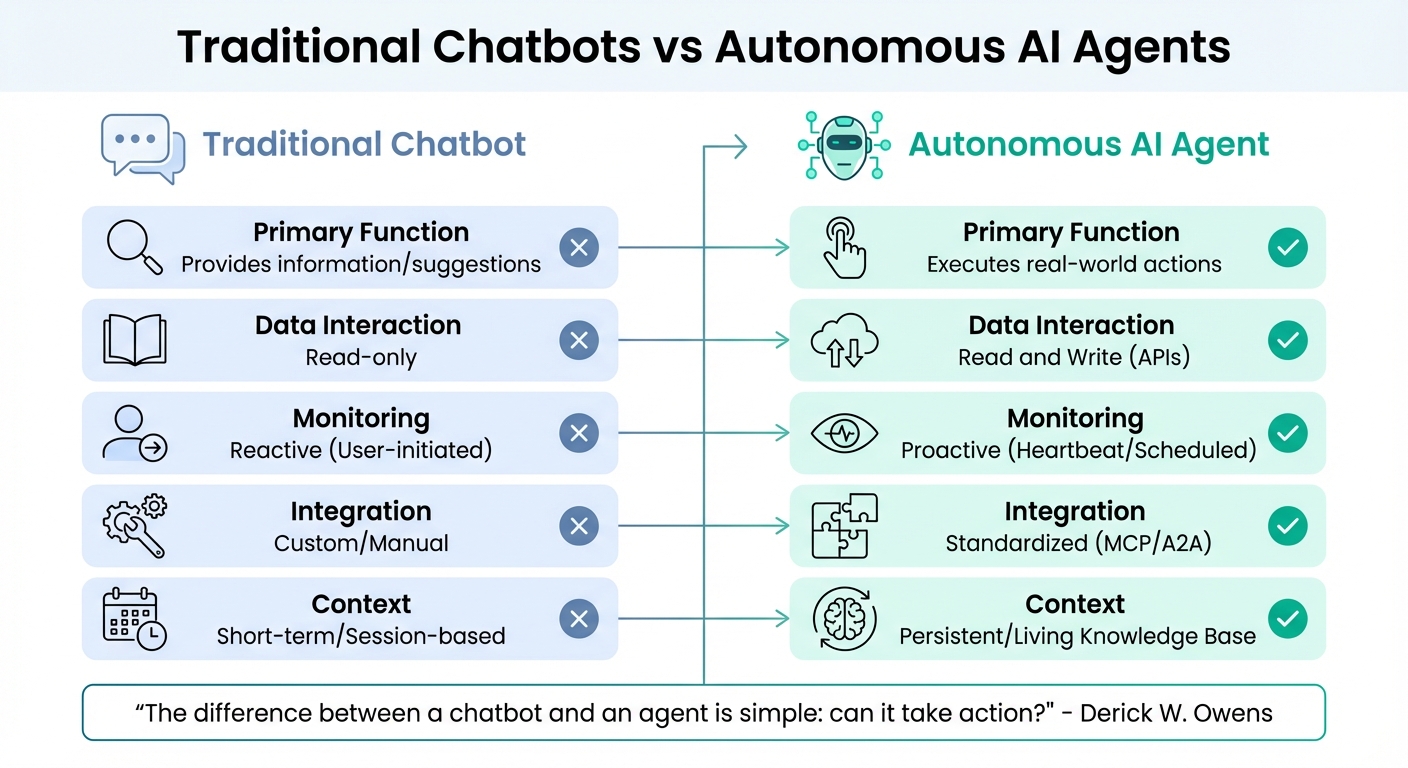
Traditional Chatbots vs Autonomous AI Agents in Health Management
AI agents are changing the game in health management by taking action instead of just offering advice. They collect data from wearables, analyze lab results, log meals, schedule tests, and even coordinate care across platforms. This evolution from passive chatbots to active agents is reshaping how people manage their health and longevity. It all comes down to three key abilities: gathering and integrating data, delivering real-time insights, and automating tasks. Together, these capabilities make health management more efficient and proactive, turning scattered information into a well-orchestrated system.
Data Collection and Integration
Health data often lives in silos. Your sleep tracker doesn’t communicate with your nutrition app, lab results stay buried in PDFs, and workout logs are locked in fitness platforms. AI agents solve this by connecting to multiple data sources using standardized protocols like the Model Context Protocol (MCP) [1].
In December 2025, developer Derick W. Owens showcased the potential of MCP with a fitness system that automated nutrition tracking. A simple command like "Log my lunch: chicken breast 150g" triggered the agent to query the USDA FoodData Central database (which catalogs over 300,000 foods), calculate macros, update Fitbit, and sync with Google Sheets - all without manual input [1].
"The difference between a chatbot and an agent is simple: can it take action?" - Derick W. Owens, AI Enthusiast [1]
By March 2026, Betterness introduced an agentic protocol connecting AI systems to over 50,000 health providers through "Smart Listings." This system integrates with labs like Quest Diagnostics, LabCorp, and BioReference, enabling agents to locate nearby labs, schedule tests, and retrieve biomarker results automatically [7].
Once data is unified, agents use it to deliver actionable insights in real time.
Real-Time Insights and Decision-Making
Unified data is only the starting point. AI agents take it further by continuously analyzing the information to deliver insights and guide decisions. Unlike traditional dashboards that require users to interpret data manually, agents do the heavy lifting in real time.
A study by Google demonstrated the effectiveness of collaborative AI agents in health management. Their three-agent system - comprising a Data Science Agent, a Domain Expert Agent, and a Health Coach Agent - was tested on 1,165 participants in the WEAR-ME study. The Data Science Agent outperformed baseline systems, achieving a 75.6% success rate in generating statistical analysis plans for wearable data. The Domain Expert Agent earned a 96.9% trust rating from users, compared to only 38.7% for general AI systems. Health professionals preferred this multi-agent setup 80% of the time [8].
This approach mimics human care teams. One agent crunches the numbers, another interprets the medical context, and a third offers motivational support. The result? Personalized advice grounded in rigorous analysis, rather than generic suggestions.
"Prompt engineering is not as important any more, instead it's all about 'context engineering'." - Henrik Kniberg, Founder, Abundly.ai [2]
Automation and Adaptability
What sets AI agents apart is their ability to automate routine tasks and adapt to changing conditions without constant user input. These agents monitor health metrics like heart rate, sleep patterns, and activity levels using AI tools for real-time biomarker monitoring, stepping in when intervention is needed [7].
Automation is powered by write-enabled APIs, which allow agents to take action. Platforms like Fitbit, Google Sheets, and Nutritionix support this functionality, making them "agent-friendly." On the flip side, closed systems like MyFitnessPal, which restrict programmatic access, are considered "agent-hostile" [1].
Adaptability comes from "context engineering", which builds an evolving knowledge base. Instead of treating each interaction as a one-off, agents retain and update information as new data arrives. For example, when lab results or doctor’s notes are added, the agent adjusts its recommendations automatically [2]. This creates a system that evolves alongside you, saving you from having to reconfigure everything manually.
A practical example of adaptability was demonstrated in February 2026 with a proposed multi-agent architecture for the NHS. When a patient reported chest pain, a General Practitioner (GP) AI Agent coordinated with a Specialist Cardiology Agent to verify advice or arrange emergency services. These shared protocols allowed agents to deliver care in real time, bypassing human delays [4].
| Feature | Traditional Chatbot | Autonomous AI Agent |
|---|---|---|
| Primary Function | Provides information/suggestions | Executes real-world actions |
| Data Interaction | Read-only | Read and Write (APIs) |
| Monitoring | Reactive (User-initiated) | Proactive (Heartbeat/Scheduled) |
| Integration | Custom/Manual | Standardized (MCP/A2A) |
| Context | Short-term/Session-based | Persistent/Living Knowledge Base |
The leap from reactive chatbots to proactive agents means your health system works for you around the clock. These agents don’t wait for you to ask - they’re always monitoring, analyzing, and acting. This hands-off approach lets you focus on living your life, while the agents handle the details.
BondMCP: The Protocol for Unified AI Agents in Healthspan Optimization
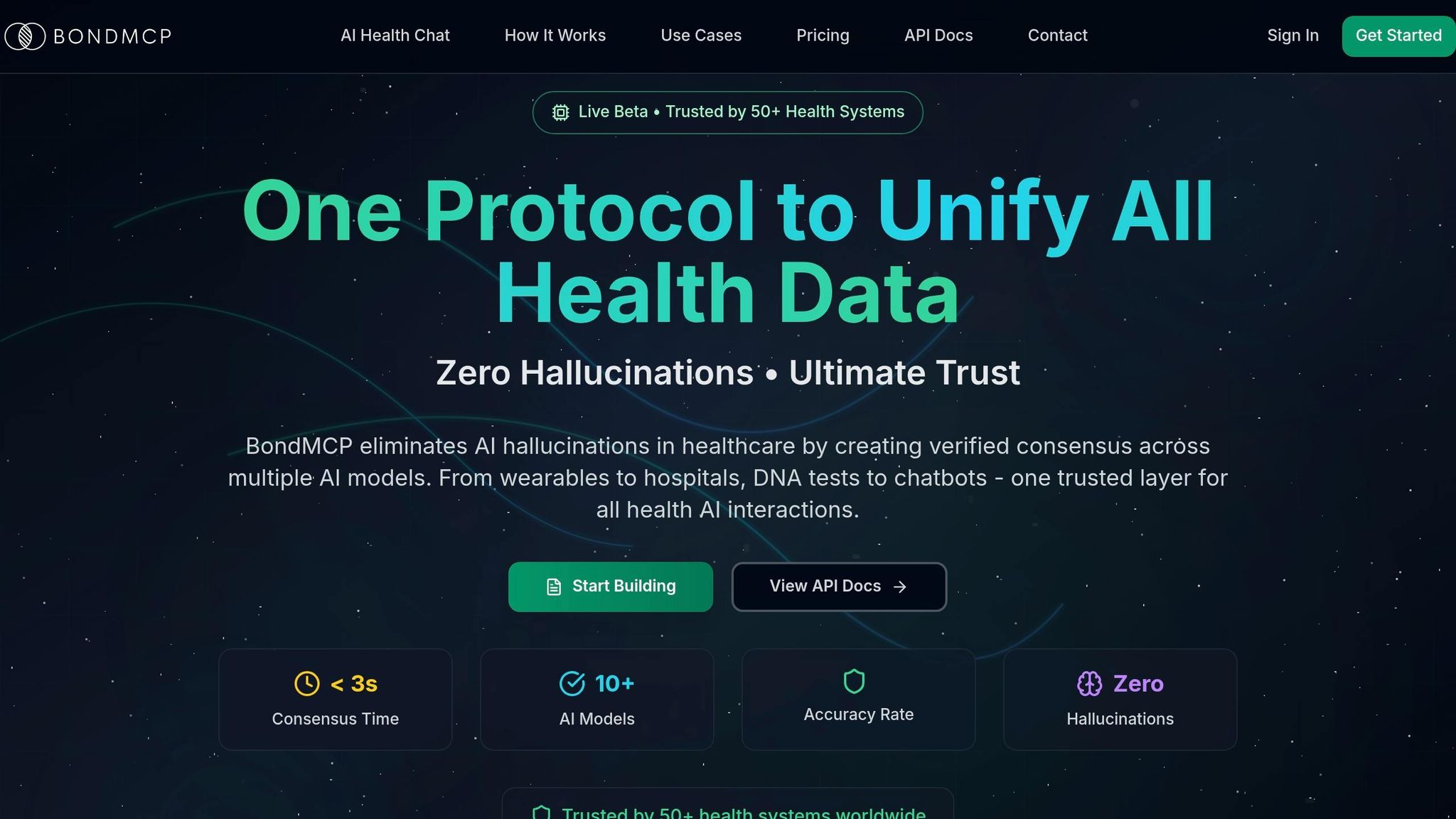
For AI to truly transform health optimization, it needs to go beyond individual tools and create a cohesive system where everything works together. That’s exactly what BondMCP does. It’s a standardized protocol designed to connect AI agents across your entire health ecosystem - whether it’s wearables, lab results, nutrition apps, fitness trackers, or supplement programs. With BondMCP, these tools don't just coexist - they collaborate. Imagine your sleep data influencing your workout plan, or your lab results updating your supplement routine, all in real time.
Think of BondMCP as the health optimization equivalent of HTTP for the internet. Just as HTTP allows websites to communicate universally, BondMCP enables AI agents to seamlessly share and act on data across different health platforms without the need for custom integrations [6][11]. Let’s explore how this protocol breaks down data silos to create a scalable, interconnected health system.
How BondMCP Solves Fragmentation Problems
Most people juggle multiple health apps and devices that don’t talk to each other. Your Fitbit might be tracking your steps, your Oura ring monitors your sleep, your lab results are buried in PDFs, and your meal logs are stuck in a nutrition app. BondMCP eliminates these barriers by merging data from all these sources into one unified system [10].
By March 2026, BondMCP (operating under the Betterness protocol) had integrated with over 50,000 health and wellness providers, including major labs like Quest Diagnostics, LabCorp, and BioReference. This integration allows AI agents to handle tasks like finding nearby labs, scheduling biomarker tests, retrieving results, and cross-referencing them with wearable data - all automatically [7].
"For the first time, AI agents can connect the dots across diagnostics networks, wearable data, biomarker records, and provider ecosystems."
– Demian Bellumio, Co-Founder, Betterness [7]
BondMCP doesn’t just collect data; it acts on it. Write-enabled APIs mean that AI agents can move from simply displaying information to taking proactive steps, like adjusting your supplement schedule or booking a follow-up test.
Personalization Through Context-Aware Agents
One-size-fits-all advice doesn't cut it when it comes to health. BondMCP empowers you to build context-aware health agents that interpret your complete health profile instead of relying on isolated metrics. For example, a traditional app might flag a 1,200-calorie meal as excessive and suggest cutting back. But a BondMCP-powered agent would consider your recent high-intensity workout and recommend those calories for recovery instead [10][1]. This kind of real-time, conditional reasoning tailors advice to your unique situation.
The protocol also enables synchronization across multiple devices. If you’re using both a Garmin and an Oura ring to track heart rate, the agent can determine which device provides the most reliable data for a specific context - like prioritizing Oura for sleep tracking and Garmin for workout intensity [10].
Scalable Solutions for Clinics and Biohackers
With its ability to unify data and provide context-aware insights, BondMCP offers scalable solutions for both clinics and biohackers. Clinics can use AI agents to monitor patient data continuously, flag abnormalities, and coordinate care across providers - replacing static dashboards that require manual analysis [7].
For biohackers managing complex routines, BondMCP’s stateless architecture makes it both reliable and easy to expand. The system processes requests by receiving parameters, querying APIs, and returning results without the need for heavy session management or databases [1][5].
To avoid conflicts between different tools, BondMCP uses a structured naming system. Instead of generic functions like log_food(), it employs explicit commands such as log_food_to_fitbit() to ensure the correct action is always triggered [1][5].
| Feature | Traditional Health Apps | BondMCP-Enabled AI Agents |
|---|---|---|
| Data Handling | Isolated metrics/silos | Unified context (Wearables + Labs + Nutrition) |
| Actionability | Manual entry/Static charts | Automated actions (API writes/Scheduling) |
| Reasoning | Generic/Static rules | Conditional/Context-aware (e.g., recovery-based) |
| Interoperability | Limited to single ecosystems | Open protocol for cross-platform coordination |
| Monitoring | Reactive (User-led) | Proactive (Continuous heartbeat monitoring) |
BondMCP transforms disconnected health tools into a unified, intelligent system. Your data isn’t just collected - it’s contextualized and turned into actionable insights, enabling AI agents to work together to optimize your healthspan like never before.
Applying AI Agents to Key Longevity Areas
AI agents are reshaping how we approach longevity by turning raw data into actionable strategies. These tools, powered by the BondMCP platform, create a unified system that tackles various aspects of health, from sleep to nutrition and fitness.
Sleep Optimization
AI agents can seamlessly integrate with wearable devices through MCP, pulling in real-time sleep and recovery data [1]. By combining this information with medical history and lab results, they uncover patterns that generic apps often overlook [2]. For instance, if your REM sleep decreases and recovery scores dip, the sleep agent may signal the fitness agent to adjust your workout intensity or recommend environmental changes [4][5]. This creates a system where your health tools collaborate, offering proactive, personalized advice based on your overall physiological state. You can even ask specific questions like, "Why has my deep sleep dropped this week?" and receive detailed, data-backed answers [2].
"Agents are only as useful as the APIs they can access."
– Derick W Owens, AI Enthusiast [1]
When choosing sleep-tracking platforms, look for those with write-enabled APIs, such as Fitbit. This functionality lets agents not only read your data but also make updates and store records in a centralized, platform-independent repository [1]. This ensures your data remains accessible and secure, no matter which platform you use.
Just as sleep data drives meaningful adjustments, nutrition insights benefit from a similar level of precision and coordination.
Nutrition and Supplement Protocols
AI agents simplify nutrition tracking by automating the entire process. For example, you can say, "Log 150g chicken breast", and the agent will use databases like USDA FoodData Central or Nutritionix to calculate its nutritional value [1]. By integrating biomarker data, these agents provide highly personalized recommendations. A notable case in February 2026 involved the HealthBuddy agent, which analyzed two years of medical data for a patient with chronic kidney disease. It identified that adding an SGLT2 inhibitor could lower the risk of kidney failure by 39% and cardiovascular death by 31% - a medication the patient hadn't been prescribed [2].
This level of insight relies on collaboration between specialized agents. A Data Science Agent analyzes wearable trends, a Domain Expert interprets biomarkers alongside current research, and a Health Coach offers actionable advice. In fact, health experts favor multi-agent systems in 80% of evaluations [8].
"The AI agent isn't just answering questions - it's maintaining a living knowledge base about my health."
– Henrik Kniberg, Founder, Abundly [2]
To ensure maximum accuracy, keep all your medical data - like lab results, doctor's notes, and supplement logs - in a centralized "Log" folder. This allows the agent to compile a comprehensive, chronological summary for better context [2].
Fitness and Activity Tracking
AI agents also enhance fitness routines by building on sleep and nutrition insights. In December 2025, Derick W. Owens, an AI developer, created a fitness hub using MCP. He used simple commands like, "Log my workout to Fitbit: bench press, 3 sets of 10 at 135 lbs." Within 10 minutes, the agent logged the session, updated a Google Sheet for long-term tracking, and queried ExerciseDB for form verification [1]. This kind of multi-platform coordination ensures your workout data flows seamlessly - whether it's logged to your tracker, shared on social media, or backed up for personal use. The agent can also provide real-time feedback on form and muscle targeting, helping you train more effectively and safely.
Advanced systems feature a three-tier safety model: read-only, confirm, and autonomous modes. Beginners should start with "confirm" mode to verify data accuracy before allowing the agent to operate independently [12]. Gartner predicts that by the end of 2026, 40% of enterprise applications will include task-specific AI agents, with fitness tracking leading the way [12].
When selecting fitness platforms, prioritize those with open, write-enabled APIs like Fitbit and Google Sheets. These platforms allow for greater flexibility and integration compared to systems with restricted API access [1].
The Future of Personalized Longevity with AI Agents
Autonomous AI agents are stepping in to replace the old-fashioned static dashboards. These agents handle tasks like booking medical tests, tracking nutrition, and coordinating care - all automatically [1][7]. Behind this shift is a robust infrastructure built on standardized communication protocols. Shaon Biswas describes this as "the AI equivalent of HTTP", enabling different health agents to work together seamlessly without the need for costly custom integrations [4].
Federated Learning for Collaborative Health Insights
Emerging standards like the Model Context Protocol (MCP) and Agent-to-Agent (A2A) protocol are paving the way for large-scale, privacy-focused collaboration. These protocols serve different purposes but work together effectively. Think of MCP as a universal adapter, connecting a single agent to tools and data, much like a Type-C port. Meanwhile, A2A acts as a network, allowing multiple agents to discover and coordinate with one another, similar to a social network for AI [4]. This setup enables AI agents to analyze aggregated patterns across populations while safeguarding individual privacy. Secure token-based authentication ensures every request is verified without needing to maintain session states [3].
The Betterness MCP protocol is a great example of this in action. It connects diagnostics networks, wearable devices, biomarker records, and healthcare providers. Demian Bellumio, Co-Founder of Betterness, explains:
"For the first time, AI agents can connect the dots across diagnostics networks, wearable data, biomarker records, and provider ecosystems" [7].
This system uses the PhenoAge algorithm to calculate biological age and integrates signals from wearables into structured records, spanning over 50,000 health and wellness providers [7]. With these privacy-preserving collaborations in place, the focus now shifts to providing continuous, real-time care adjustments.
Continuous Feedback Loops for Proactive Care
The MCP Cycle - comprising context building, model invocation, output interpretation, tool execution, and memory updates - enables systems to make continuous, proactive adjustments [9]. This allows for "heartbeat monitoring" and scheduled tasks, where agents track biomarkers and automatically initiate health interventions [7]. Systems also employ "tracking harnesses" to log how protocols are used, generating heat maps that highlight behavioral patterns ready to be automated [5].
By integrating real-time data from fragmented healthcare providers, these systems reduce bottlenecks and significantly enhance the ability to deliver personalized care on a larger scale. Administrative tasks are streamlined through AI-driven automation, enabling healthcare providers to serve more patients with greater accuracy [4].
Expanding Accessibility and Scalability
Stateless architecture plays a key role in scaling these systems. By delegating context management to large language models (LLMs) and letting tools handle input and output, scalability becomes more efficient [1]. Row-Level Security (RLS) at the database level ensures that as these systems grow, data remains secure and isolated for each tenant, preventing leaks [3].
This evolution from "prompt engineering" to "context engineering" makes high-quality health insights accessible to a broader audience. With agents pulling structured data from trusted sources like USDA FoodData Central or FHIR servers, users can receive consistent and reliable results, no matter their technical know-how [1][2]. Multi-agent AI health systems are also gaining traction - health experts preferred them in 80% of evaluations over single-agent setups, highlighting their effectiveness [8]. However, the divide between "agent-friendly" platforms with write-enabled APIs (like Fitbit) and "agent-hostile" platforms with restricted access could shape which ecosystems dominate this space [1].
These advancements are setting the stage for unified, context-aware systems like BondMCP to lead the way in personalized, scalable healthcare.
Conclusion
The move from passive health tracking to autonomous AI agents is reshaping how we think about longevity. Instead of juggling multiple disconnected apps, you now have access to a unified system where your sleep patterns influence your workout plans, lab results automatically adjust your supplement regimen, and wearables prompt timely health interventions.
This transformation is powered by standardized protocols like MCP and A2A, which act as the "AI equivalent of HTTP." These protocols enable various health agents to work together seamlessly [4]. Earlier examples, such as Henrik Kniberg identifying a missing SGLT2 inhibitor [2] and Derick W. Owens's system that logs meals, queries food databases, and updates platforms in real time [1], highlight how these systems operate in practice.
BondMCP takes this concept a step further by integrating diverse data streams into a single, intelligent framework. It creates a shared context layer and health-specific ontology to unify fragmented data from wearables, lab results, supplements, fitness trackers, and sleep monitors. For clinics and biohackers, this means delivering precision health at scale - without relying on outdated dashboards or manual coordination.
The future of healthspan optimization hinges on context engineering and intelligent, proactive actions. As Demian Bellumio succinctly puts it:
"For the first time, AI agents can connect the dots across diagnostics networks, wearable data, biomarker records, and provider ecosystems" [7].
Whether you're managing a chronic illness or aiming for peak performance, these AI-driven systems are turning fragmented data into actionable insights for healthier, longer lives. As this technology evolves, it promises to deliver care that's not only personalized but also adaptable to your unique health journey - ushering in a new era of longevity optimization.
FAQs
What makes an AI agent different from a health chatbot?
AI agents stand apart from health chatbots in terms of autonomy, capability, and complexity. While chatbots primarily function as reactive tools, offering pre-scripted answers to user questions, AI agents go much further. They can analyze information, make decisions, and act independently - whether that's managing medication schedules or interpreting live biometric data. Additionally, AI agents aren't confined to single tasks; they integrate with various tools and workflows, allowing for personalized and proactive health solutions.
How does BondMCP connect my wearables, labs, and apps?
BondMCP brings together data from your wearables, lab results, and apps into one cohesive, context-aware platform. With this setup, AI agents can work together effortlessly, offering real-time health adjustments and personalized insights designed specifically for you. The outcome? A simplified way to improve your health and lifestyle - no more managing multiple tools or dealing with conflicting guidance.
How do AI health agents protect my privacy and data?
AI health agents, powered by systems like BondMCP, are designed with your privacy in mind. These agents operate within secure frameworks that emphasize data protection. They rely on encrypted communication, anonymized or aggregated data, and strictly controlled sharing practices to keep your information safe from prying eyes. By accessing only the data necessary for specific tasks and adhering to health data regulations, they strike a balance between safeguarding your sensitive health information and delivering personalized health management.